
Q&A about Space Medicine with Dr. Dana Levin
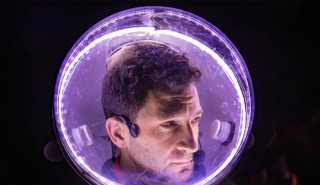
Imagine you’ve been asked to join a mission to Mars. How would you get ready for the trip? You might call Dr. Dana Levin in New York, U.S. He helped create a training program to get doctors and engineers ready for life on another planet. Teams head out to a remote desert area that’s set up to simulate life on Mars. They take on challenges and develop skills for survival in space.
Dr. Levin grew up in New York City, and he’s been fascinated by space since he started watching Star Trek and going to space camp as a kid. Now he’s a physician, professor, and researcher who explores the health challenges of extreme environments. He also helps NASA prepare for deep space missions. Dr. Steve Scotti, our STEAMS Education Advisor, caught up with Dr. Levin to learn about his amazing work.
(noise_scale)(Level3)(tta)(x2.000000)_620_775_80.jpg)
Dr. Levin works in the Emergency Department at Columbia University Medical Center in New York, and also works with NASA.
Q: How would you describe exploration medicine? How is it different from regular medicine?
The biggest difference I would say is most medicine relies on somebody who is sick coming in to get treated for their illness. But the people who are coming in who are healthy and wanting to prevent illness is a relatively small proportion. In exploration medicine, that’s reversed. The vast majority of what we’re doing is trying to keep healthy people healthy when we’re putting [them in] really unhealthy environments. And of course there are the problems that arise when somebody in those environments gets sick or injured and you have to treat them.
Q: What are some of the biggest dangers that space explorers on Mars might have to face?
On Earth, we live in a constant gravity environment. We have an atmosphere surrounding us. We have sunlight, we have nighttime, we have lots of space to move around and interact with. And we have other people around us to lean on when we get sad, to help us out when we feel sick.
When you go to Mars, none of that’s there. There are no people, there’s very little atmosphere, and there’s less gravity.
You’re so far away that you can’t talk in real time to anybody [on Earth]. I’m stuck in something the size of a small camper with five other people for two and a half years [to get to Mars]. And that’s my entire social life, and that’s my entire world. Personally, I think the biggest challenges we’re going to face are the stresses psychologically. Humans are not great about living in isolation. It’s hard.
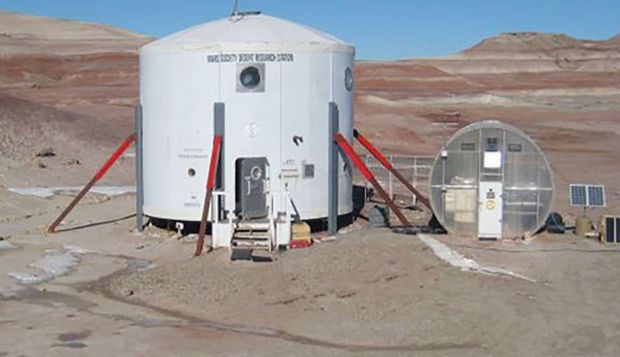
Participants in the Mars training program live in a habitat in the U.S. desert.
Q: What’s in a Martian medical kit that’s different from a regular medical kit?
You look at what the environment causes, and then you plan what the risks are, and what you think you need to treat for. And then you plan for that and pack that in your kit. The work that I do with NASA mostly centers around exactly that—trying to figure out what we’re going to pack in a medical kit. Our effort has been about a ten-year project to figure that out, and we’re getting close, but it’s a difficult question to answer. And it depends on the mission you’re going for.
Q: Do the participants in your program grow their own food, like in the movie, The Martian?
Not quite like the movie The Martian. In the space program right now, we’ve just started growing gardens in space. There’s currently an experiment in growing edible food on the International Space Station, and they have the first alien salads, so to speak. From seeds, they grew some form of lettuce.
On a Mars mission, you can imagine to try to pack three and a half years’ worth of food into a single tiny vehicle, and then launching it out there. We have a whole bunch of ideas on how we might be able to do that. There’s a whole research project built around it. Some of it involves growing our own food, using yeast culture. Some of it involves having a greenhouse and growing things traditionally. Some of it involves having sort of like a hydroponics farm on board the station itself. The big issue is ... what happens if that food store dies and you can’t regenerate it anymore? Those are all the questions we’re trying to learn [about].
Q: What character strengths or virtues will space explorers need to be successful astronauts for a Mars mission?
That’s another research element — the behavioral health and performance element specializes in exactly that ... The most important traits are the ability to recognize your own emotions, recognize when you’re feeling your own limits, and address those before [they] become a problem.
So it’s not about saying, “I can handle this.” It’s about saying, “I’m feeling something today. I have to address that.”
And you go to your friends and your crewmates and say, “Hey, you know what, I’m feeling something.”
And your crewmate says, “Yeah, I’m feeling the same thing.”
Being nonjudgmental about others and being nonjudgmental about yourself. Being willing to engage with the rest of your team. The buzzword term is emotional intelligence, which is just the ability to recognize your own emotions, and recognize others’ emotions, accept them ... and help them through it.
Q: Is there anything you’ve learned in the program that could help people here on Earth?
Communication is a very key thing. Whatever’s going on, have a group of people that can effectively communicate well, so that everybody can get their thoughts through. [You also need] an effective command and control structure.
(noise_scale)(Level3)(tta)(x2.000000)_620_915_80.jpg)
Dr. Levin trains on a “0-G” treadmill at NASA
Q: Do you have any advice for kids who want to go into exploration or aerospace medicine?
Learn what you can about the environment before you go out there. Be adventurous, learn how to work with teams, and listen to people who have experienced that [situation]. If you want to go into that field, reach out to those people [and] ask them. Most of the time, people like talking about the stuff they like doing. And the exploration people really like doing the stuff they’re doing! Reach out and say, “Hey, I’m interested in doing this,” and ask for their advice.
Q: If you had one wish for Brilliant Star readers, what would it be?
Follow your dreams, do what you love. It sounds trite, but seriously, if you follow things that you love doing, you will be successful at them because you love doing them. If you’re following somebody else's goals and you’re following somebody else’s dreams, all you’re doing is making that person happy. You’re not going to make yourself [happy] ... So if you’re passionate about space flight, pick that as your goal, go try for it. See what happens.
Mars Desert Research Station photo by Bandgirl807