
Shining Lamp: Franklin Kahn (1934-2010)
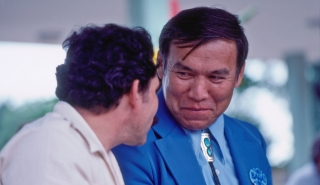
When sick or troubled people asked for help, Franklin Kahn would saddle up horses and lead his blind grandfather to their hogan, or traditional home. His grandfather was a medicine man who spent long hours chanting sacred words of love, comfort, and balance for them. As Franklin listened, the Navajo teachings touched his spirit.
When Franklin was born in 1934 in Arizona, U.S., his grandmother named him Shkake-Ne-Yah (Bravery Arrived). He was the oldest of eight surviving siblings. When he was about seven, he began to learn sand painting. His grandmother taught him Indian designs inspired by nature. She helped him put spiritual messages in his paintings and drawings. He loved art and sold hand-drawn greeting cards at school.
Prophecies Fulfilled
At an Indian school in Nevada, Franklin met Mary Jane Gishie, and they were married in 1955. The next year, they met two Bahá’í women who lived nearby. When he heard about the Bahá’í Faith, Franklin believed it fulfilled prophecies he’d heard in his grandfather’s chants. He and Mary Jane continued to explore and became Bahá’ís in 1962.
Franklin and Mary Jane helped to plan a large gathering to share the Bahá’í teachings with about 1,500 Navajos. Over the next few years, over 100 Navajos became Bahá’ís, including most of Franklin’s family. He said, “This is the one faith which brings all beliefs together. I have always felt that religion should unite all ...”
In 1968, Franklin became the first American Indian to be elected to the National Spiritual Assembly, the nine-member council that guides Bahá’í activities throughout the U.S. He served for over 12 years.
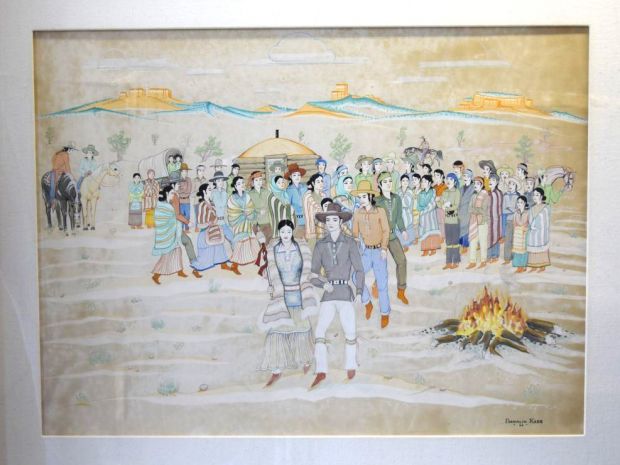
1954 painting depicting Navajo dance by Franklin Kahn
Creativity and Service
Franklin worked as an artist, making electric neon signs. He then started the Kahn Sign Company and used his talents on signs and billboards. He continued to study art in college and to create paintings. He often shared the Bahá’í Faith when he traveled to exhibit his art or give talks about Navajo culture.
He said, “My art is an essential part of my life. Many of these paintings were inspired by the stories and chants of my father and other Old Ones; others came to me in visions; still others as a result of meditating alone amidst the great nature of the Southwest ... Art is meditation—getting in touch with nature in such a manner that the artist is spiritually uplifted and a new creation is born.”
Franklin was also a champion of education. He taught Navajo culture and science to kids at an elementary school. He also helped start an annual pow-wow and a group called Native Americans for Community Action (NACA), which provided medical and social services.
Franklin died in Arizona in 2010, at age 75. The Universal House of Justice, the international governing body of the Bahá’í Faith, praised his “warmhearted and noble nature” and his “legacy of service.”
For a printable version, download a PDF of this article.
Images: portrait courtesy National Bahá’í Archives, article photo courtesy Richard Doering
Discover553 Bahá’í Faith546 Service308 Bahá’ís in History210 Shining Lamps124 Native Americans16 Artists22 Painting14 Biography52 Shining Lamp55 Race Unity224 Race55 National Spiritual Assembly10