
Shining Lamp: Keith Ransom-Kehler (1876–1933)
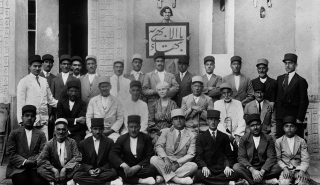

Keith Ransom-Kehler wrote, “Amidst the perplexities ... and problems that often beset my path ... my abiding protection is a sense of deep and reverent gratitude ...”
“Every Bahá’í is a pioneer,” Keith Ransom-Kehler wrote, “a pioneer in a new manner of living, a new outlook on life ...” Keith showed a courageous spirit as she traveled the world to share the Bahá’í teachings and help Bahá’ís who were being persecuted.
Nannie Keith Bean was born in Kentucky, U.S., in 1876. She went by “Keith,” and her personality was as unconventional as her name. At age 22, she graduated from Vassar College, and she later earned a master’s degree—an extraordinary achievement at a time when few women went to college. She married Ralph Ransom in 1901. Sadly, he died of tuberculosis when their daughter, Julia, was one.
In 1910, Keith married Jim Kehler. Keith was an open-minded Christian, and she led a Christian fellowship in Chicago for several years. Then in 1921, she became a Bahá’í. She later wrote, “the great prophecies of Jesus are fulfilled in the coming of Bahá’u’lláh.” She began giving talks about the Faith, and became a sought-after speaker.
All Walks of Life
Keith faced tragedy again when Jim died of a heart attack in 1923. She grieved deeply, but in time she focused on traveling and speaking about the Bahá’í Faith. In 1931, Keith set off for Australia, New Zealand, and several Asian countries. She enjoyed cultural diversity and met with people of all walks of life. In New Zealand, she spent time with the indigenous Maori people, whom she called a “nation of poets and artists.”
Keith made a big impression everywhere she went. She was bold, honest, and passionate in her speech. Wherever she went, the people she visited asked if she could stay longer.
Fighting Forces of Darkness
In 1932, Shoghi Effendi, who led the Bahá’í Faith at the time, asked Keith to go to Persia (now Iran) to convince the sháh (king) to lift a ban on Bahá’í books. Keith was “thunderstruck” at such a challenge, but she rose to meet it. On a visit to Haifa (in what is now Israel), Shoghi Effendi personally tutored Keith in Islam and the customs of Iran.
In Iran, Keith met with an advisor to the sháh, who assured her that the book ban would be lifted immediately. But it was not. She wrote seven long letters to the sháh and had many meetings with officials, but nothing changed. To this day, the government of Iran treats Bahá’ís with prejudice and injustice. Bahá’ís are denied jobs and higher education, and many have been imprisoned and even killed, just for practicing their faith.
Keith was deeply frustrated at the outcome of her efforts. But she wrote, “Nothing in the world is meaningless, suffering least of all. Sacrifice ... blooms, I think forever, in the sweet fields of eternity.”
On October 9, 1933, Keith became very ill with smallpox, and she passed away two weeks later. Shoghi Effendi wrote that he was “SORROW STRICKEN” and said she “FOUGHT FORCES OF DARKNESS WITH HIGH DISTINCTION, INDOMITABLE WILL, UNSWERVING, EXEMPLARY LOYALTY.” He named her the first American Bahá’í martyr and the first female Hand of the Cause of God.*
*A Hand of the Cause of God was a Bahá'í who served the Bahá’í community in significant ways, including encouraging others in teaching and protecting the Faith.
Shining Lamps123 Bahá’í Faith544 Openness39 Sacrifice9 Service308 Discover553 Persia50 Iran69 Oneness of Religion31 Hands of the Cause of God26 WomenHistory29