
Parents and Teachers
Family & Community Life
Parenting Tips & Techniques
Live and Learn: Creating an Educational Environment at Home
“Education is a natural process carried out by the child and is not acquired by listening to words but by experiences in the environment.”—Maria Montessori
Kids are born voracious learners. It’s a natural instinct to be curious about the world and to try to make sense of it. Parents can nurture that passion for learning by providing a home environment that encourages discovery and creativity.
While certainly not an exhaustive list, these seven habits can help create a home environment that nurtures learners of all ages:
Don’t separate learning from living. Adults tend to compartmentalize, standardize, and analyze education to the point that we forget how natural learning really is. People—kids, especially—are learning all the time. When we view learning as our natural mode of being, we can find educational opportunities everywhere. Baking cookies may not be considered “academic,” but it incorporates language arts (reading the recipe), math (fractions, measurement), science (properties of liquids/solids/heat, etc.) and home economics (cooking, cleaning). Those kinds of everyday activities help develop real life skills, reinforce other learning, and strengthen family bonds.
Recognize and honor individual timelines. Like other kinds of growth, learning is an organic, individual process. Not every child will be toilet trained at two, and not every child will read at six. Many parents don’t realize that there’s a wide range of “normal” when it comes to most learning. We can create less anxiety for ourselves, and our children, when we honor each child’s process without pressuring or labeling.
Encourage questions. Curiosity is the cornerstone of learning. It may be exhausting at times, but encouraging and answering kids’ questions is like fanning a flame—it keeps their natural love of learning alive. Children’s questions also give us insight into their interests so we can help them follow their curiosities.
Feed your kids’ interests. If your kids are fascinated by dinosaurs, take them to a museum, find dinosaur books and videos at the library, or create an archeological dig in your backyard. If they’re into comics, encourage them to learn the history of comic books or the craft of comic writing (it’s a lot harder than it looks!). We learn best when we’re exploring something we’re interested in. With a little creativity, any interest can be expanded to cover a wide range of subjects.
Model learning for your kids. Read and explore ideas in front of your children. Better yet, let them see you trying to conquer a new skill, like a musical instrument or foreign language. Witnessing our struggles, failures, triumphs, and delights helps kids see that struggles and challenges are just part of the learning process.
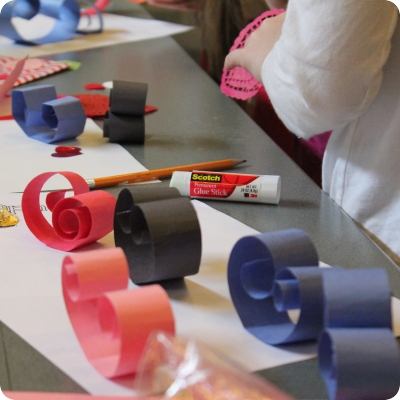
Provide basic craft supplies and space. Set up an area where kids can create, draw, glue, build, and invent to their heart’s content. If you don’t have extra space, fill up a bin with artsy materials (paper, pencils, crayons, markers, glue, stickers, scissors, small craft objects, etc.). Add a plastic tablecloth and voila! A dining table or floor space can be converted to a “Creation Station” in a matter of seconds.
Give kids free time. Kids need unstructured time to play, think, dream, invent, process, reflect, and delve into their own creativity. It’s easy to over-schedule kids with enrichment classes, sports, and music lessons. Structured activities have their place, but if overdone they can cause stress in children. If kids don’t have time to just “be,” they miss out on an important part of their development.
As parents, we can make a significant impact not only on how our kids learn, but on how they view learning. When we encourage discovery, creativity, and curiosity in our home, we help kids hone their learning instinct and give them the freedom to learn without limits.
Some resources for parents and educators:
Collection of articles on homeschooling and education in general.
20-minute talk by creativity and education expert Ken Robinson given at the 2006 TED conference explores the importance of creativity in education.
Peace Corps WorldWise School – global resources for educators and parents
Annie Reneau is a homeschooling mom of three, lover of chocolate and travel, and former assistant editor with Brilliant Star. She now works as associate editor at Upworthy/GOOD and shares her personal musings on life and parenting at Motherhood and More.
For more resources, sign up for
Brilliant Star's Parents & Teachers Newsletter!
Updated on 4.18.13