
Parents and Teachers
Teaching Tools & Ruhi Classes
Effective Teaching Techniques
Memorization Techniques

Memorization is an essential educational strategy which can build a variety of lifelong mental skills. Memory exercises are like mental gymnastics that train the brain to focus, to retain more information, and to work with greater speed and agility. Rote learning allows students to store foundational concepts so they can draw on these resources as needed, freeing up brain power to learn new things. Committing literary passages to memory can increase vocabulary and give students expert examples of sentence structure, word choice, and imagery—providing a model for their own use of the language. In addition, students will enjoy a sense of accomplishment after putting in the effort to memorize something completely. Whatever children learn by heart during the early stages of their development will become part of their nature and will leave traces upon the rest of their lives.
Memorization is done by linking information and by fitting new ideas into existing mental frameworks. A variety of techniques have been developed to help us recall information more easily. A few basic strategies are described below.
Simple Repetition
Read the passage out loud from start to finish. Repeat until it is memorized. Students can work alone, in pairs or in groups repeating after the teacher. Another method is to record the passage and replay it until it is learned.
Forward Buildup
Start at the beginning and recite the first phrase. Repeat until it is memorized, then add the second phrase. Continue in this manner until you have reached the end. Break a long selection into smaller parts and learn each part separately; then connect them.
Backward Buildup
Start at the end and recite the last few words. Repeat until they are memorized. Then add the previous phrase and read through to the end. Continue in this manner until you have reached the beginning and have learned the entire passage.
Disappearing Act
Write a passage on the board and have students read it aloud several times. Then, using an eraser, swipe a diagonal path through the entire passage. This will leave a blank space on each line. Ask for student volunteers to read the passage again. Let everyone take a turn. Then make another eraser swipe and ask for another round of volunteers. Continue until the passage has completely disappeared.
Acronyms
An acronym is a word formed by combining the first letters of a series of words, for example, SCUBA (Self Contained Underwater Breathing Apparatus) or LASER (Light Amplification by Stimulated Emission of Radiation). Acronyms are useful for remembering a group of words or topics in a particular order.
Melodies
Music is a powerful aid to memory. For example, many of us learned the letters of the alphabet to the tune of “Twinkle, Twinkle, Little Star.” Some passages will be easier to remember if set to music.
Logical Patterns
Information can sometimes be organized into a logical pattern to make memorization easier, for example, from small to large, simple to complex, old to new, or by chronological order.
Visualization
Words can be tied to visual cues to aid recall. One method of visualization is called “chaining,” where each image is used as a trigger to help you remember the next item on the list. The task is often easier if the items on the chain are linked in a story. For example, if you are memorizing a grocery list (bananas, bread, cheese, milk, paper towels, etc.), you might create a string of mental images beginning with a monkey as your shopping assistant. Of course, the monkey wants a banana. After finishing the banana, she is still hungry and asks for a sandwich (bread and cheese), which makes her thirsty so you give her a glass of milk, which she spills on the floor, so a paper towel is needed to clean up the mess, and so forth.
Journey
This is another form of visualization. Imagine yourself walking along a familiar path, perhaps from your bedroom to the kitchen, or from your classroom to the cafeteria. Identify a number of landmarks along the way, for example, a certain tree, a bench, a flower garden. Use the path to remember your material by associating each landmark with one item you wish to recall. For example, if you are trying to memorize a list of people, you might visualize the first person climbing the tree, the second person sitting on the bench, and the third person weeding the flower garden. See each person in your mind as you “walk” along the path. The more unusual the image, the easier it will be to remember. Use exaggeration, humor, silly movements and vivid pictures to spice up your journey. For example, the first person might be cutting down the tree; the second person, balancing the bench on his nose; and the third person, growing like a flower in the garden.
Memory Maps
This is another technique that uses visualization and association. The items to be recalled are mentally plugged into a familiar pattern such as a car or a human face. With a face, use the eyes to remind you of the first topic, the ears for the second and the mouth for the third. For example, for a talk on unity in diversity, the eyes could remind you that the eye itself is an example of unity in diversity. Each part (pupil, iris, retina) has a different job, but they all work together for the same goal. The nose (with two essentially identical nostrils), could help you to recall that unity is not sameness. The mouth could remind you that we need different notes to sing a song, but it won’t sound very good unless the diverse notes are sung in harmony.
Mnemonic Devices
Pronounced “neh-MON-ic,” this is a memory trick that helps you remember something difficult by associating it with a phrase that is easier to remember. For example, many budding musicians have learned the lines of the treble clef in music (E-G-B-D-F) by associating them with the phrase: Every Good Boy Does Fine. The taxonomic order for our system of biological classification (Kingdom, Phylum, Class, Order, Family, Genus, Species) is easily remembered with the phrase: King Philip Come Out For Goodness Sake!
Pictures
As another form of visualization, students can draw or cut and paste representative pictures on top of the written words. For example, this quote by Tecumseh*, “A single twig breaks but the bundle of twigs is strong,” might be illustrated as follows:
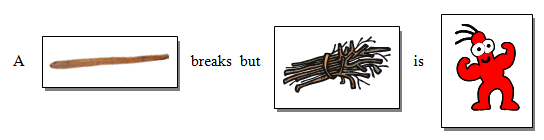
* Tecumseh (1768–1813), Native American chief of the Shawnee tribe. Quoted in Touch the Earth: A Self-portrait of Indian Existence, by T. C. McLuhan, 1973.
Gestures
Gestures can also be used as a memory aid. For example, when teaching the following quote by Bahá’u’lláh,* “So powerful is the light of unity that it can illuminate the whole earth,” flex your arm muscle when saying the word “powerful,” clasp your hands together when saying “unity,” and spread your fingers wide with palms out for “illuminate.” Students can perform the movements as they recite the passage. If you or an assistant knows sign language, you can teach children the correct signs to accompany the words.
* Bahá’u’lláh (1817–1892), Founder of the Bahá’í Faith. Quoted in Gleanings from the Writings of Baha’u’llah, p. 288.
Card Trick
Print each word of the passage to be memorized on a separate large card. Give one card to each student. If there are more students than words, two students can hold the same card. If there are fewer students than words, some can hold two cards. Mix the students up and tell them to arrange themselves in order without speaking. Then have each child read his or her word in order, holding up the card up as they speak.
Two useful websites on memory:
https://geosoc.org/schools/pass/memory/memindex.htm
www.studygs.net/memory
Adapted from Teaching Unity: A Guide for Parents and Teachers with Learning Activities for Ages 8–12, pages 268–280. Used with permission from UnityWorks.
Dr. Randie Gottlieb is the head of UnityWorks, an international diversity training firm; co-founder of the Mona Foundation, supporting grassroots educational initiatives around the world; and adjunct professor of Multicultural Education at Heritage University on the Yakama Nation Reservation. She is the author of nine books and holds degrees in Education from Cal State, Boston University, and Harvard.
For more resources, sign up for
Brilliant Star's Parents & Teachers Newsletter!
Updated on 1.29.14