
Parents and Teachers
Teaching Tools & Ruhi Classes
Empowering Educators
10 Tips for Developing a Neighborhood Virtues Camp

Thanks to educator Julie Iraninejad, kids in San Diego, California, have a unique opportunity each summer to learn about virtues and the Bahá’í teachings. In 2014, Julie started Camp Virtues, a week-long day camp where kids explore character strengths such as unity, truthfulness, and compassion through stories, games, prayers, and the arts.
Starting Camp Virtues was a spur-of-the-moment decision after one of Julie’s friends, Timothy Li, passed away from cancer. Timothy and Julie had shared a love for education, and Julie was searching for a way to offer service in his honor. When a friend asked if she knew of any summer camps that focused on virtues, she felt inspired. She says, “In the immediate moment, it was so clear to me this is what I should do. I said, ‘Yes, I do. It’s happening the first week of August at my house. It’s called Camp Virtues.’ In that conversation, in the moment, Camp Virtues began.”
Camp Virtues has run every year since, serving hundreds of kids. It’s taught by adults, youth, and junior youth from the community. Open to families of all faiths and backgrounds, Julie says, “It’s meant to nurture spirituality in children and lay a strong moral foundation for them, and support families and character development.”
Want to start a similar program in your own neighborhood? Here are Julie’s tips.
1) Build Relationships
Whether it’s inviting kids and families to attend, training teachers, or finding a location, strong relationships are at the center of the camp’s success. According to Julie, “A lot of this is relationship building. You put out a camp and you throw out flyers, and that’s not going to do anything unless you know families and you’ve laid the groundwork for this through a lot of friendship building and elevated conversations. Without that, it will not fly.”

2) Grow Naturally
Through those friendships, Julie invited an initial group of 24 kids to attend the first year of Camp Virtues. She says, “We had three classes, so two downstairs and one upstairs. We put a big tent in our backyard, and that was where we would gather for all-camp assemblies.
“I just reached out to my friends and said, ‘Look, are you interested in this?’ We charged a $50 materials fee and I got some of my friends to co-teach. Then the next year, we moved from 24 [campers] to 50. Obviously, we had outgrown our house, so we moved into a community center for the second year. Then the following two years, we moved to a school. We kept it at 50 the third year, but the fourth year we had 80.”
Word about the camp spread. It’s based in the Bahá’í writings, but families from all religious backgrounds are comfortable with its content about universal virtues.
3) Define Your Purpose
With the camp growing each year, it was important to maintain a clear idea of its purpose. Julie says, “It’s not about an event, it’s about a process. It’s really about introducing people to the concept of children’s classes and getting a feel for children’s classes so that [families] feel more comfortable to join the classes in the neighborhood on a weekly basis.”
In weekly Bahá’í children’s classes during the school year, kids learn about virtues like they do at camp—through games, stories, art activities, and prayer. They strengthen friendships and explore spiritual topics. Camp Virtues gives families a chance to see if the weekly classes might be a good fit for them.
Having a strong sense of the purpose of Camp Virtues helped organizers make important decisions. Attendance is limited to the number of kids who can be accommodated in classes during the school year. Priority placement is given to families who are interested in attending those classes.
4) Identify Participants
Camp Virtues is open to all families, but as interest and enthusiasm spread, it was necessary to prioritize attendance. When registration opened for the fourth summer, all 80 slots were filled in the first day. With such a strong response, Julie expected that the weekly classes during the school year would be full as well. But that wasn’t the case.
She says, “What we found was there was not much transference that fourth year because we hadn’t really made it clear that this is about trying out the children’s classes.”
So the team shifted how they promoted the camp. On the registration forms and website, they clearly stated that their purpose is to introduce neighborhood children’s classes. With this new focus in the fifth year, many more participants showed interest in children’s classes. Julie says, “That was a really important learning for us. It’s much more solid in terms of the purpose of the camp.”
5) Location Strengthens Relationships
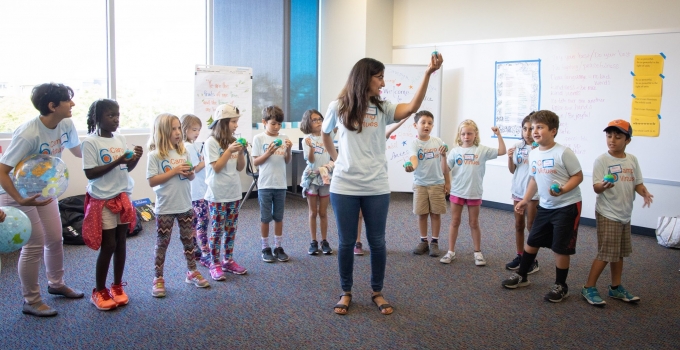
Maintaining the focus on supporting Bahá’í children’s classes also guided decisions about where to hold the camp. After trying different locations, it’s moved to a neighborhood school. Many families who attend both the camp and the weekly classes have kids enrolled in the school, so it’s a natural way to strengthen connections. It’s also the school that Julie’s children attend, so she had a relationship with the principal, and the principal felt comfortable allowing them to rent the space.
Julie says, compared to other locations, “We know the population much better, and the people are typically more receptive. Moving it to the school where my kids are at allows me to follow up much more with those families.”
6) Build Resources Within the Community
From the beginning of Camp Virtues, Julie invited her friends to serve as teachers, and she found that parents were willing to be trained. Now that the camp has grown, word has spread in the neighborhood, and people are approaching Julie, asking how they can be trained as well. Parents have opportunities during the year to attend training. According to Julie, “You have to have a growing staff, and the quality of that training needs to be good. So, little by little, we’ve built up a cohort of teachers in our neighborhood. Now we have a staff 30 at Camp Virtues.”
7) Empower Teachers of All Ages
Another important element has been to establish teaching teams. Julie says, “I think it’s really important that you form small teams, so there isn’t the sense that it’s all on one person. So you’re going to be on a team of a few teachers working together, and you’ll each take part of a lesson. People are more willing to do that when they know they’re going to be accompanied and supported.”
Julie is careful to make the teams diverse and multigenerational. “The camp is for 5 to 11-year-olds. Once they turn 12, they are able to be assistants. So at 12, 13, and 14, as junior youth, they are assistant teachers. They come to our teacher planning day . . . and are involved in helping prep and plan the lessons and can teach a part of it. Then once they’re 15 and have [been trained], they can be full teachers in the class. The youth really like this.”
She says, “We try to have at least one youth in every class, if not more, and then we have one junior youth assistant in every class, sometimes two. This builds up the cohorts supporting the camp, and also it is really important for the campers to have people that are close to their age that they can look up to, that are junior youth and youth. It really creates an important dynamic, and they’re given real responsibilities. They’re contributing members to their teams of teachers who are working on lesson plans.”
8) Incorporate the Arts
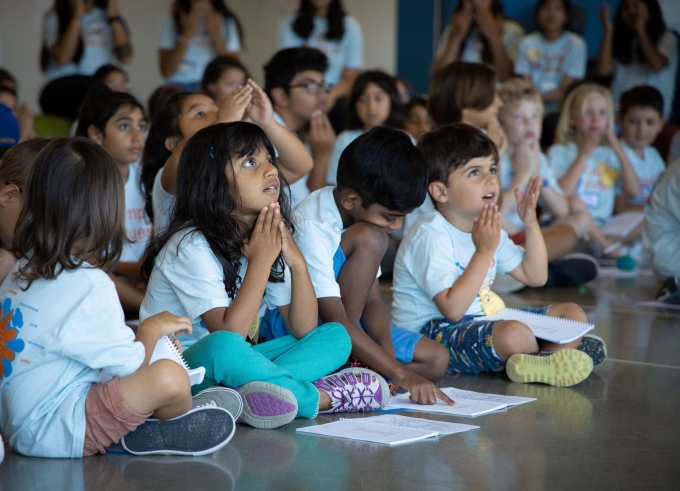
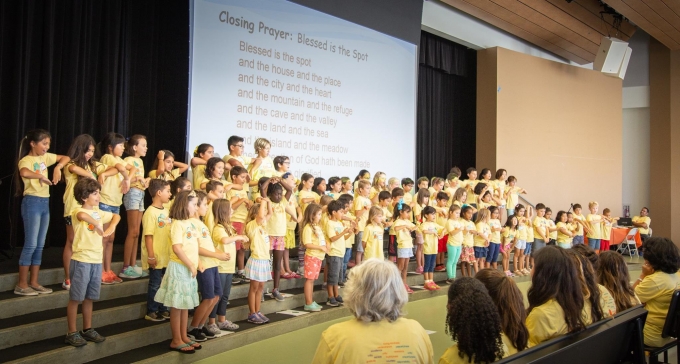
Another important element of Camp Virtues is its focus on the arts. Julie says, “We have a camp songbook and songs that each year relate to the virtues that they’re going to be studying. Our camp song is ‘I Think You’re Wonderful,’ by Red Grammer. So we sing that in the morning when the camp starts. Then at the end of the day, for the last 25 minutes or so, we come together. Each of the classes has two to three minutes to do a little presentation of something that they learned. One class will share a song, one class will share a science experiment they did, one class will show their art project, one group might do a rap about it. So it builds this excitement around it. Then we have a closing prayer.
“Then, the last day of the camp, which is a Friday . . . there’s a family presentation. All of their artwork and things that they’ve made during the week, those are not sent home each day. They’re kept, and on the last day they’re put on tables that are beautifully decorated with flowers and tablecloths. Usually we have a picture of them from the week put in a frame. So that’s on display. Then we do a whole presentation for the parents. We’ll be opening with the prayers they’ve been learning during the week, the Bahá’í prayers, and then we go through each virtue.”
Kids from the classes share something they’ve learned. Julie says, “It’s a really beautiful way of giving people a taste of the meaning and purpose and joy of these classes.”
9) Start Planning Early
Julie and her co-directors meet in January to choose the virtues that will be taught at that year’s camp. Then they begin compiling music for the songbooks, selecting quotes about each virtue, and gathering resources for the teaching teams to use. They design t-shirts for the campers and staff, and meet with the principal and school staff to coordinate schedules. They also select the teaching teams, making sure they have three or four teachers per class, plus junior youth assistants.
Each spring, they offer a study circle to train new teachers using Ruhi Institute Book 3, Teaching Children’s Classes, Grade 1. In April, Julie hosts a teacher planning day. Teachers meet their teams, strengthen classroom management skills, learn about positive discipline strategies, and start on lesson plans. While the co-directors choose the virtues, teachers create their own lessons for each virtue. In June, the lesson plans are given to Julie for review, and she provides feedback. The week prior to camp, the staff meets at the school to set up.
10) Create an Atmosphere of Learning
In order to empower an ever-growing number of people to take ownership of the spiritual education of the children, Camp Virtues creates an atmosphere of learning for both the campers and staff. At the end of each camp, the staff reflects on what went well and what could be improved next year. By working in teams, teachers can learn from one another. As Julie says, “It’s really been a blessing. It allows for a special accompaniment that I think people crave in teaching children. To have people coming together and supporting each other. It’s really this sense of a team.”
To learn more about Camp Virtues, visit www.campvirtues.com.
Julie Iraninejad, M.Ed. is a Certified Positive Discipline Trainer who trains Parent Educators and Classroom Teachers for the Positive Discipline Association. She works as an educational consultant in San Diego, California, and has helped encourage and empower families in character education for 20 years.
Photos by Amethel Parel-Sewell and Kai Parel-Sewell
For more resources, sign up for
Brilliant Star's Parents & Teachers Newsletter!
Updated on 5.15.20