
Shining Lamp: Leroy Ioas (1896–1965)
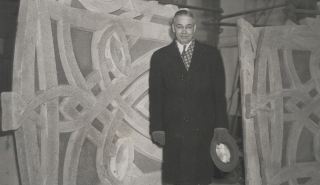
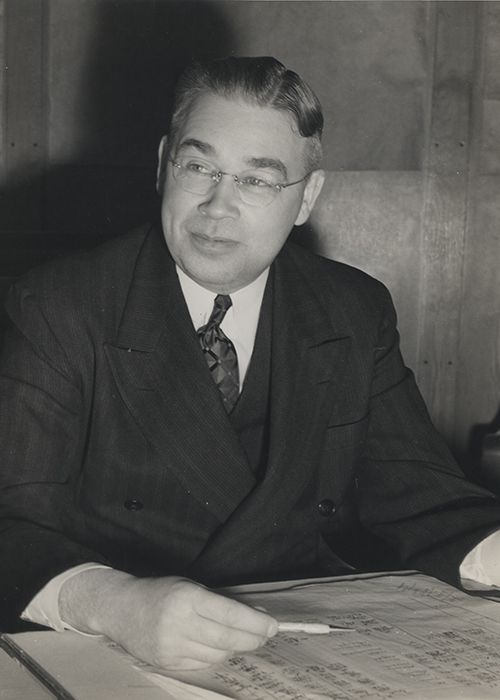
Leroy Ioas in 1944
“I was so frightened,” Leroy Ioas recalled, “I perspired all over and my knees shook.” Despite his fears in high school, Leroy competed as a public speaker. He even won a contest against other schools. Since childhood, he had longed to share the Bahá’í Faith and knew he needed practice with speaking.
Born in 1896, Leroy grew up near Chicago with his nine siblings. His parents became Bahá’ís when Leroy was two, and he began learning Bahá’í teachings.
At 16, Leroy met ‘Abdu’l-Bahá, the head of the Bahá’í Faith, who was visiting Chicago. ‘Abdu’l-Bahá’s spiritual power overwhelmed him. Once, while listening to him speak, Leroy wished ‘Abdu’l-Bahá would look into his eyes. Just then, their eyes met. “It was,” Leroy said, “as if he saw your soul.” Leroy’s enthusiasm for his faith never wavered.
Energetic Leader
Later, Leroy married Sylvia Kuhlman, another Bahá’í. They moved to San Francisco and had two daughters. Leroy worked for the Southern Pacific Railroad and was a respected Bahá’í leader. He helped start the first Conference for World Unity to promote the oneness of humanity. He also worked with John and Louise Bosch to create what would become Bosch Bahá’í School.
In 1932, at age 36, he became the youngest person elected to the National Spiritual Assembly, the nine-member group leading the Bahá’ís of North America. He served on the Assembly for nearly 20 years.
Hercules
Leroy was stunned when Shoghi Effendi, grandson of ‘Abdu’l-Bahá and leader of the Faith after him, appointed Leroy a Hand of the Cause of God in 1951.* Shoghi Effendi also asked Leroy to help him in Haifa, Israel. It was “the most difficult decision I have had to make ...” Leroy wrote. It meant leaving his beloved American Bahá’í community and his successful career. Still, he and Sylvia moved to Israel in 1952.
Leroy took on major tasks. He arranged land purchases, gave public talks, and visited Bahá’ís around the world. He supervised the construction of the International Archives Building and major parts of the Shrine of the Báb. Shoghi Effendi admired Leroy’s success with difficult projects so much that he nicknamed him “Hercules.”
When Shoghi Effendi died unexpectedly in 1957, Leroy was one of nine people elected to guide the Faith’s development for several years. He was so committed to his work that he often neglected his health. Finally, doctors insisted he rest for six months. But Leroy was determined to accomplish Shoghi Effendi’s last instruction: to represent him at the Intercontinental Bahá’í Conference in Singapore.
“Our host at this conference is Shoghi Effendi himself,” Leroy told the crowd. No longer the nervous, youthful speaker, Leroy inspired listeners with his confidence, wisdom, and stories of working with Shoghi Effendi.
Passing away in 1965, at age 69, Leroy had fulfilled Shoghi Effendi’s prediction: “You will, I am sure, persevere till the very end.”
Shining Lamps123 Discover553 Public Speaking10 Communication155 Speaking9 Shoghi Effendi41 Shrine of the Bab4 Holy Places36 National Spiritual Assembly10 Hands of the Cause of God26