
Shining Lamp: Nick Hockings (1942-2012)
During wintertime, Ernest “Nick” Hockings loved to trek across frozen lakes with his small fishing sled in Wisconsin, U.S. When he caught a fish through the ice, he’d laugh with joy.
In warm weather, Nick carried on his Indigenous Ojibwe community’s practice of spearfishing by torchlight. It’s what gave his home its French name, Lac du Flambeau, or “Lake of the Torches.” Nick called it Waswagoning, “the place where they spear fish by torchlight.”
Born in 1942, Nick was a member of the Lac du Flambeau Band of Lake Superior Ojibwe. His Ojibwe name is Bindigegiizhig (Enter the Sky). His family lived in a simple shack with an outdoor water supply. His mother and grandmother had attended government-run boarding schools where Ojibwe language and culture were forbidden. But Nick’s stepfather, Lauren, taught him Ojibwe traditions.
Exploring Nature
With his stepfather, Nick harvested wild rice and tapped trees for maple syrup. Nick learned to cut birch bark for canoes at just the right depth so it popped off the tree trunk, leaving the tree healthy. As he hunted and fished, Nick took only what he needed. When he grew up, he was passionate about sharing this knowledge with others.

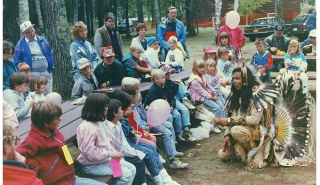
Nick Hockings shared Ojibwe culture at his camp, Waswagoning, and at schools and universities.
In his 30s, Nick learned about the Bahá’í Faith. He became a Bahá’í around 1980. The Faith teaches that Indigenous people will be spiritual leaders of humanity, and Nick took this to heart. He loved to spend time with Ojibwe elders, and he treated everyone with dignity.
Nick married his wife, Charlotte, in 1985. They worked together to protect Indigenous rights, but they faced harsh backlash. When Nick spearfished, protestors against Ojibwe treaty rights threw rocks and fired guns at him. Nick and Charlotte relied on Bahá’í guidance about peace and fairness. Together with a few others, Nick sought justice in court and won legal protection for Ojibwe rights in 1992.
Extraordinary Educator
Nick saw the harm that racism and prejudice cause people and the planet. He wanted to empower future generations to do better. Nick said, “Young people are going to find the answers, regardless of people that become roadblocks and stand in their way.”
Nick and Charlotte built a camp where people of all backgrounds could learn about Ojibwe culture. They called it Waswagoning and ran it for 22 years. Many who attended overcame prejudices and learned new ways to live in harmony with the environment. Nick and Charlotte helped create a documentary about Waswagoning, which won several Emmy Awards.
Nick also shared Ojibwe culture at schools and universities. He and Charlotte started a dance troupe that performed internationally. They loved dancing at pow-wows and seeing diverse communities connect.
Nick had a clear vision of hope for the future. He passed away in 2012, but his impact continues. He said we live in a time when “we’ll begin to understand our relationship once again to the environment, our relationship ... more importantly, to one another. And we’ll realize that as relatives that this ... is a time when we’ll begin to come together.”
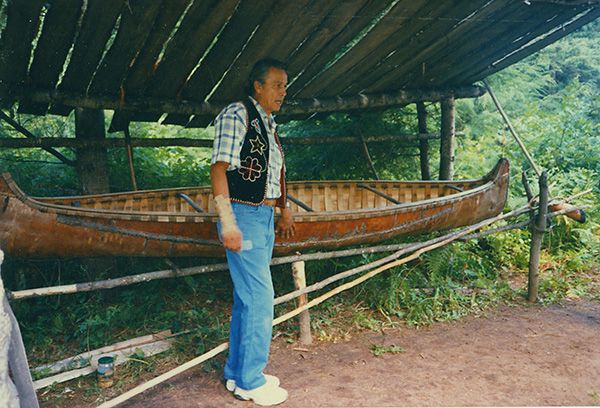
Nick learned from his stepfather how to cut birch bark for canoes at just the right depth so it popped off the tree trunk, leaving the tree healthy.
For a printable version, download a PDF of this article.
Bahá’í Faith546 Environment177 Nature176 Science206 Unity252 Race Unity224 Bahá’ís in History210 Native Americans16 American Indians12 Cultures141 Injustice77 Justice138 Prejudice144 Elimination of Prejudice118 Education58