
Shining Lamp: Sadie Oglesby (c. 1881–1955)
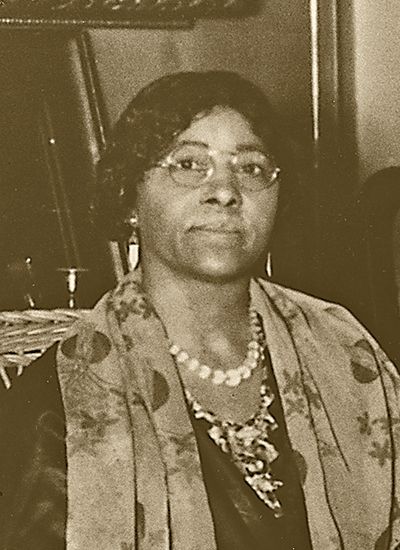
Sadie was a powerful teacher of race unity in North America.
When she first gazed at Shoghi Effendi, the head of the Bahá’í Faith at the time, Sadie Oglesby was filled with “wonder and astonishment.” But she soon felt “perfectly at home with him,” she later wrote. Sadie and her husband, Mabry, became Bahá’ís in Boston in 1914. Then, in 1927, she and her daughter, Bertha Parvine, were the first African American women to visit the Bahá’í holy places in Israel.
Persistent Prejudice
Shoghi Effendi asked Sadie a tough question: why weren’t there more African American Bahá’ís in North America?
The white Bahá’ís try to be kind, Sadie told him, but they don’t truly understand racial equality, even though Bahá’ís had held several race amity conferences. Recently the community had stopped focusing on race unity to promote world peace. Racial prejudice was common throughout the United States, and not all Bahá’ís had freed themselves from it. It had caused many African Americans to lose interest in the Faith.
Mabry spoke out about prejudice. But, seeking unity, Sadie had always been patient with prejudiced Bahá’ís. She hoped they would change eventually.
Mabry’s way was better, Shoghi Effendi said. He urged her to “use all your force and power” to help Bahá’ís understand “the paramount importance” of race unity.
At first, Sadie didn’t feel up to the task. “I have no strength or importance in America,” she said.
But Shoghi Effendi encouraged her to “be urgent and insistent”—a leader in facing what he would later call “the most vital and challenging issue” in America.
Over her 20-day visit, assured of Shoghi Effendi’s prayers, Sadie gained confidence. “I know what my work is now ...” she said.
Speaking Out
After she returned home, Sadie began speaking on race unity. She spoke at length to a convention for Bahá’ís in the United States and Canada to elect their leaders. She relayed Shoghi Effendi’s words: “The peace and tranquility of the world depend on” racial harmony. “People are talking about universal brotherhood ... Bahá’ís must be ... the ones who actually have it in practice.”
She urged them to “see that great centre of love that is yearning ... that you and I shall become like one body ...”
People at the convention were so stirred that they decided to spread her message. They were also moved by Shoghi Effendi’s letters during this period encouraging and supporting action to end prejudice. Soon the Bahá’í community focused on race unity again.
Sadie devoted herself to race unity for 10 years. She spoke at conventions and a Bahá’í school.
She exchanged letters with Shoghi Effendi. “Your constancy and zeal are assets that I greatly value ...” he wrote. He said, “Persevere with unfaltering faith ...” Through the work of Sadie and others like her, a much more diverse Bahá’í community now strives to eliminate racial prejudice throughout the world.
The spoken words of Shoghi Effendi reflect Sadie’s remembrances and may not be exact quotes.
Bahá’í Faith546 Shoghi Effendi41 Shining Lamp55 Shining Lamps124 Bahá’ís in History210 History53 Race Unity224 Race55 Racism106 WomenHistory29