
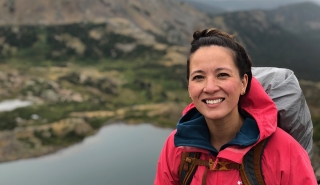
Stargazer: Dr. Mia Derstine
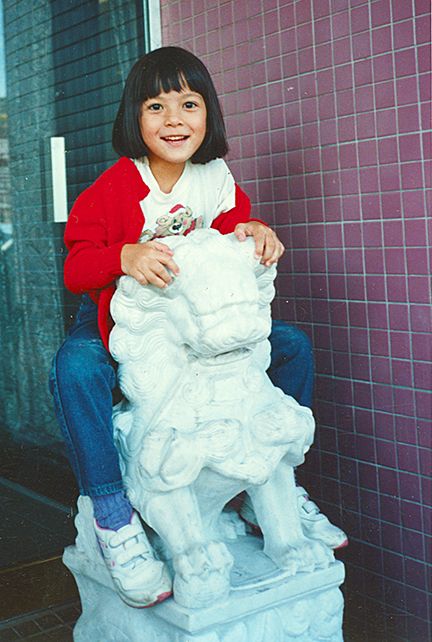
At age 6, Mia sat on a Chinese lion statue during a family visit to the Chinatown neighborhood in Chicago.
How intense would it be if you were a doctor, and you had to treat an injured person while flying in a helicopter? As an emergency room (ER) doctor in Chicago, Amelia “Mia” Derstine sometimes tended to patients while zooming through the sky. She loves flying, which she first did at age three, when her family came to Illinois, U.S., from Hong Kong.
Mia is passionate about helping others. After high school, she moved to Ecuador as a volunteer to teach virtues classes for kids. Later, she studied at Northwestern University and spent a spring break assisting people in Louisiana whose homes were damaged by Hurricane Katrina.
After earning a bachelor’s degree in math, Mia moved to Japan with her husband, Brian. While teaching English there, she realized she wanted to help people in crisis situations. She returned to the U.S., started medical school, and discovered a love for emergency medicine. Now she’s an ER doctor in Colorado. She’s also training in wilderness medicine so she can care for people with outdoor emergencies.
Q: What’s a favorite childhood memory?
Going to my grandparents’ house in Kansas in the summertime with my family. My brother and I would take this exercise mat and ride it down the stairs like a sled, which our grandparents allowed us to do only if we wore helmets.
Q: What was the most challenging experience for you as a kid?
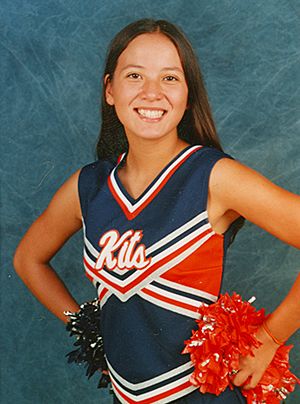
At age 16, Mia was a cheerleader for her school's basketball and football teams.
I used to get bullied for being Chinese ... I got pushed around and hit a couple of times ... I tried to talk to my teacher, who was not sympathetic, and ended up telling my parents. My mom, who is 4'10", stormed into the school and demanded that this issue be addressed. After that, it never happened again.
Q: What inspired you to pursue a career in medicine?
After college, I worked a bunch of part‑time jobs and was unhappy, and saw a job posting to teach English in Japan ... While we were in Japan, the earthquake in Haiti happened. I wanted to go and help ... And it kind of brought about a realization that I had no real skill set, and I wanted one ... that would be useful in emergency situations.
Q: What helps you persevere through challenges or gives you courage?
My friends and my family [and] my dog ... I call my dad. And he’ll often have something from the Bahá’í writings to say to me or something from his own personal experiences ... those things are always very helpful.
Q: What motivated you to work as a flight physician at University of Chicago Medical Center?
It was actually part of our residency program ... I loved it. I loved learning from the flight nurses ... They are so knowledgeable, so I learned a ton from them. I liked being able to go to other hospitals and see how medicine was practiced in other places ... But also just flying was cool.

As part of her medical training, Mia flew in the University of Chicago Medical Center helicopter to pick up emergency patients.
Q: What do you love about emergency medicine?
The diversity of medicine ... We [can] see everyone. No one gets turned away in the ER, so it doesn’t matter if someone has insurance ... Quite often we’re actually getting the people ... who are grossly underserved, so I like that I get to be with those people. I really like diagnosing a lot, and I like all the procedures.
Q: You're doing a fellowship in wilderness medicine. What's involved?
I get a lot of training on technical skills, which means I get to go rock climbing with my boss and just learn how to manage ropes. But then I also get to do cool stuff—like this weekend, I'm going to Mars space camp in Utah to film scenarios about astronaut emergencies.
Q: What virtues are important in your work?
Kindness and empathy ... I find that with some patients, really what they actually need is just to talk to somebody ... Sometimes that’s really more important than whatever medication you’re going to prescribe.
Q: What advice would you have for a kid who wants to be a doctor?
The best thing that you can do is do all the stuff that you love. The medical schools tend to admit people who have passions outside of medicine. So if you love playing guitar or if you love being on the chess team, do those things to the best of your ability ...
Q: This issue of Brilliant Star is about what it means to be a hero. What are some of the ways that kids can be heroic?
One of the things that is so gorgeous ... is when kids stand up to prejudice. Sometimes it happens among their own friends or even among their families and loved ones. When you see kids saying things like, “Hey, that’s not nice,” that’s really, really brave, and that’s being a hero, too.

Mia (back right) and her husband, Brian, enjoy a family reunion in January 2020 with her parents, Steve and Sabrina Townsend (front), her brother, Patrick (back left), and his fiancée, Hannah.
Images: Portrait by Brian Derstine; family photo by Nancy Wong; Mia with UCAN helicopter by University of Chicago Medical Center
Stargazers94 Discover553 Bahá’í Faith546 Doctors5 Medicine7 Flying11 Listening49 Careers215 Service308 Heroes53 Challenges257