
Parents and Teachers
Teaching Tools & Ruhi Classes
Teachers’ Guides & Resources
Adapting and Extending Brilliant Star Activities for Younger Kids
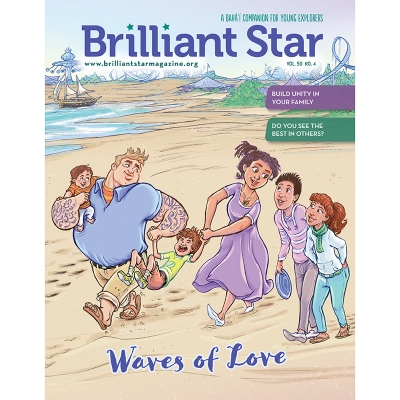
Kids of many different ages find Brilliant Star’s content engaging, educational, and fun. The content is targeted to kids aged 8-12, but it can be easily be adapted for younger kids aged 4-7. A variety of extension activities can be used with Brilliant Star to build lesson plans for the classroom or foster family and intergenerational unity.
Simplify the Story or Introduction
Read the key points of the story to young kids, omitting details that may be complex or confusing for their age group. Or retell the story in your own words, using the magazine as a prompt. Look for words that are unfamiliar, and give kids examples of those words used in a sentence. For example:
Khalil has grown and changed over the school year. He has transformed.
Keep Kids Engaged with Mid-Story Questions
As you read or tell the story, pause to ask the group questions about how it applies to their lives. For example, while reading a story connecting bees with kindness, you could ask kids:
- Have you ever seen a bee outside in your yard?
- What do bees do when they see flowers?
- How do you feel when someone is kind to you?
- What’s something you can do to be kind today?
Spark a Discussion with Questions
Invite kids to internalize and apply the virtues in the story by asking open-ended discussion questions. For example, using the same “Bee Kind” story, you could ask:
- What are some good qualities that you see in your friends?
- What are some good qualities you’d like people to see in you?
- Have you ever made a judgment about someone and later found out you were wrong? What happened?
Topic Exploration
Explore more entry points to the story with kids. If the story mentions specific locations, such as Ethiopia or Russia, use a map or globe to find those places. Talk about the climate, foods, language, and culture in those places. What would it feel like to live there?
If the story mentions various religions, show kids some pictures of people who follow that faith. What do the holy places associated with that faith look like? What are some of their prayers or beliefs?
Drawing Together
When studying a drawing activity, invite kids to each draw and color their own copy of the page, and then present them to the class. Ask each kid to explain why they chose the things that appear in their drawing. Or use a large roll of paper and ask kids to cooperate to create a classroom banner on the topic of the drawing activity.
You can extend the drawing experience by pairing kids up to do activities like these:
- Draw what you hear: Sitting with their backs to each other, one kid explains what they want drawn while the other kid draws it. Or instead of drawing, the listening kid can create the item with sculpting clay or LEGO bricks.
- Play a guessing game: Invite kids one at a time to draw on a board in front of the class, as their classmates try to guess what they’re creating.
- Draw pictures and cut them into puzzle pieces. Then exchange puzzles and put them together.
- Invite kids to draw their own maze based on concepts in the drawing activity.
Writing Activities
Writing about a topic can help kids internalize the concepts in a deeper way. Extend a story or activity by inviting kids to write about it.
- Write a letter sharing the concepts or virtues in the story with a friend or family member.
- Write a poem or song about the concepts or virtues in the story.
- Write a skit or short story where characters act out a scenario based on concepts or virtues in the story.
- Ask kids to create a word search puzzle using key words or concepts in the story, and exchange puzzles with friends to solve them.
Turn Paper Activities into Hands-On Experiences
Some activities are word puzzles that can be adapted to become hands-on classroom activities.
With a “word fragments” activity, you can cut out paper shapes (such as hearts) and put a word fragment on each one (such as “friend” and “ship”). Then hand out the hearts and ask kids to find the partner with the second part of their word.
If the activity involves scrambled words, use cut-outs of letters and ask kids to physically work with them to create the correct word. Pairs of kids can visit stations around the room, with a different scrambled word to solve at each one.
If the activity is a picture find, you can print out pictures of each item (or examples of the actual items) and hide them around the room for kids to discover. Then invite kids to draw their own “virtue items,” such as a patient pencil or a compassionate crayon.
Use a "What Do You Say?" activity as a prompt for role-playing. Kids can act out scenarios to get practice responding to challenging situations.
Craft Projects
The time and space available for craft projects can vary widely. You can simplify craft projects, to make them less time-consuming or less challenging for young kids, by completing some of the steps ahead of time.
- Create a sample of the craft ahead of time, to show kids the final product and practice any tricky steps.
- Draw and cut out any papers, shapes, or other components ahead of time.
- If a component of the craft is painted, try using a version that’s already colored, or paint the components yourself before class.
- Give kids limited options for colors and styles of materials to use (for example, everyone gets blue or green paper).
- Invite kids to add optional decorative touches at a later time.
Radiant Stars or Stargazer Interviews
Brilliant Star’s interview features enable readers to get to know other kids around the world, or learn about an adult role model. Explore the interviews in class by using the questions to prompt group projects or discussions.
- Divide kids into pairs and have them ask each other the Radiant Stars questions or some of the Stargazer questions. Then ask kids to share what they learned about their partner.
- Ask kids to draw a picture that reflects their answer to a virtue-related question, such as “How do you show your family you love them?”
- Ask each kid to create a poster or collage that reflects their answers to the questions.
- Ask questions of the group and write their answers on a whiteboard or poster.
Add a Related Hands-on Activity
The opportunities for related hands-on activities are endless. Reflect on the topics in the story or activity, and invite kids to try options like these:
- Create glasses or a paper hat that reflects a virtue in the activity (such as grateful glasses or a helpful hat).
- Make paper bag puppets and act out scenarios based on virtues in the activity.
- Create a sensory bin full of items related to the story, and invite kids to reach their hand in the bin and guess what the item is based on how it feels.
- Make a simple recipe related to the topic (such as trail mix to take on a nature walk or a decorated cookie to give as a gift).
- Create a sculpture related to the topic using recyclable materials (such as a time machine made out of paper tubes and cardboard boxes).
- Create a shoebox diorama with paper cut-outs that illustrates a scene related to the story or activity.
- Act out an action that illustrates a virtue in the story (such as giving someone flowers to illustrate kindness).
- Create a skit related to the story and act it out as a group.
Play a Game
Many children’s games are timeless and can be adapted to illustrate a theme or concept in a story or activity.
- Bingo – Create bingo cards where each square is an object, action, or virtue related to the story.
- Freeze Dance – Play a song related to the story and ask kids to dance, then freeze when the music stops.
- Hot Potato – Use an item related to the theme as the object being passed around during Hot Potato (such as a plush animal for an activity related to that animal).
- ABCs – Play a group game where each kid names something related to the topic that starts with a given letter of the alphabet (such as something to be grateful for, or a quality you like in a friend).
- I’m Going to ______ and I’m Bringing ______ – Play a group game where each kid repeats “I’m going to (a place, such as Baha’i school) and I’m bringing (an item, such as my prayer book). The next kid in line repeats the same statement and adds their own item at the end (I’m bringing my prayer book and my bicycle).
- Pin the Tail on the Donkey – Adapt this game to relate to a given theme. For example, kids could pin a fruit on a tree or pin a raindrop on a cloud.
Additional Resources
New World Order Games Manual from Linden Qualls
Over 150 unity-building games. This is an incredible resource. Look through the Table of Contents for unity-themed games.
Skits and Dramatic Activities from Linden Qualls
Look through the Table of Contents for unity-themed skits.
For more resources, sign up for
Brilliant Star's Parents & Teachers Newsletter!
Updated on 6.02.22