
Parents and Teachers
Teaching Tools & Ruhi Classes
Teachers’ Guides & Resources
Teachers’ Guide, “Creating Art with Heart,” Part 3
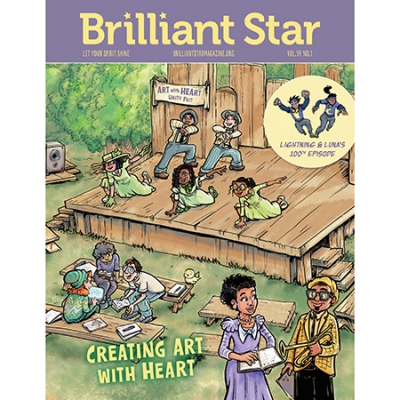
This guide is a tool to assist teachers of children’s classes and junior youth animators in using Brilliant Star’s “Creating Art with Heart” issue in the classroom. While Brilliant Star is developed for kids aged 7-12, many younger and older kids enjoy learning from it. Activities can be adapted and expanded to engage ages 4-14. You’re invited to explore this guide and to share your own ideas in our Facebook group, Brilliant Star Idea Exchange.
Key themes in this issue:
- Tips for using the power of the arts to uplift our spirits and our communities
- Using arts to share spiritual truths and bring people together
- Enkindling love and reinforcing our shared identify as one human family
- Applying creativity to various aspects of life, including the sciences
- Practicing curiosity, learning, and a growth mindset with the arts
- Seeing mistakes as a natural part of learning and reflecting on them to grow
- Getting inspiration from spending time in nature, relaxation, play, and meditation
- Celebrating diversity and collaboration in creative endeavors
- Virtues of creativity, perseverance, courage, learning, joyfulness, and cooperation
You can search, download, or print the full issue here.
Copies are available for purchase at bahaibookstore.com.
We recommend Google Chrome for viewing and downloading PDFs.
For each page, you’ll find discussion questions and activities to enhance learning.
“Creating Art with Heart” Pages, Part 3
20 – Radiant Stars
23 – Festival of Flavor
24 – Stargazer: Masud Olufani
26 – Shining Lamp: Hazel Scott
27 – Creative Colony
29 – A-MAZE-ing Adventure: Wander-ful Creativity
You Can Find Part 1 Here (pages 1-10)
You Can Find Part 2 Here (pages 11-19)
AGE GROUPS:
Pre-K/Kindergarten (4-5)
Early Elementary (6-7)
Late Elementary (8-10)
Junior Youth (11-14)
PAGE 20: RADIANT STARS
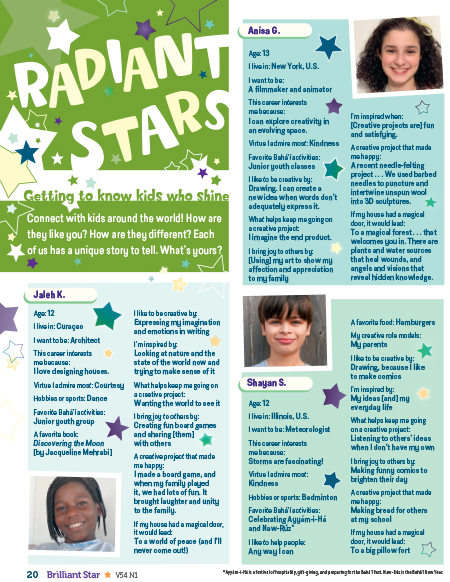
Get to know cool kids!
> PURPOSE
To facilitate a feeling of community among Brilliant Star’s readers (from around the U.S. and the world). In their responses to our reader surveys, kids who are the only Bahá’í in their school or one of just a few Bahá’ís in their area say that Radiant Stars reminds them that they’re not alone, and there are kids like them around the world.
Quote: “God has crowned you with honor and in your hearts has He set a radiant star; verily the light thereof shall brighten the whole world!” — ‘Abdu’l-Bahá
> QUESTIONS FOR DISCUSSION
Pre-K/Kindergarten (4-5) | Early Elementary (6-7)
- What virtue do you admire most? Why?
- What’s your favorite way to be creative? What do you like about it?
- Who or what inspires you?
- How do you use your creativity to bring joy to others?
- If your house had a magical door, where would it lead?
Late Elementary (8-10) | Junior Youth (11-14)
- What career would you like to pursue? Why? How would that career allow you to express your creativity?
- Who or what inspires you?
- When you’re working on a creative project, what helps keep you going?
- How do you use your creativity to bring joy to others?
- What’s a creative project you’ve done that made you happy?
- If your house had a magical door, where would it lead?
> ACTIVITIES TO ENHANCE LEARNING
Pre-K/Kindergarten (4-5) | Early Elementary (6-7)
> Play the song “I’ve Got Creativity” by Mr. Reed: https://www.youtube.com/watch?v=s-Lwal4gHXk
Invite students to learn to sing the song and make up dance moves to go with it.
> Ask kids to draw (or paint) a picture or make up a poem, song, dance, or skit that reflects their answer to either of these questions:
- How do you use your creativity to bring joy to others?” OR
“If your house had a magical door, where would it lead?”
> If possible, read the book Art Is... to the class. (It the book is not available but you have an iPad or a laptop computer, you can play a YouTube video: https://www.youtube.com/watch?v=sDhPjl-N-8I.
Before you begin reading, ask kids to raise their hand when something they see in the book reminds them of an artwork they’ve made or gives them an idea for an art project they’d like to do (e.g., designing a prayer rug or building a cool structure with LEGO bricks).
> Take the class on a nature walk. Give each kid a paper lunch bag so they can collect leaves, seeds, stones, twigs, and flowers they find on the ground. When you return to the classroom, provide paper, glue, and modeling clay so they can make art with the nature items they found.
Late Elementary (8-10) | Junior Youth (11-14)
> Divide the group into pairs and ask each person to interview their partner, asking them the discussion questions above and these standard Radiant Star questions:
Name:
Age:
I live in (state, country):
I want to be (future career):
This career interests me because:
The virtue I admire most in people:
Hobbies or sports:
Favorite Bahá’í activities:
Favorite animal or pet:
Places I’d love to visit:
I like to help people by:
A favorite book or song:
A favorite food:
A hero or role model:
Once they’ve interviewed each other, have each person in the pair tell the larger group one cool thing they learned about their partner.
> Ask kids to draw (or paint) a picture or make up a poem, song, dance, or skit that reflects their answer to either of these questions:
- How do you use your creativity to bring joy to others? OR
If your house had a magical door, where would it lead?
> Invite the class on a nature walk. Give each student a paper lunch bag so they can collect leaves, seeds, stones, twigs, and flowers they find on the ground. When you return to the classroom, provide white and colorful paper, colored pencils, scissors, glue, cotton string, and clay so they can make art with the nature items they found.
PAGE 23: FESTIVAL OF FLAVOR
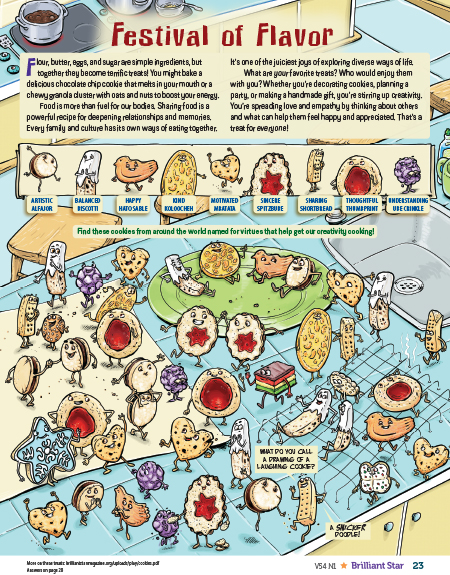
Dig into some delicious treats!
> PURPOSE
Baking festive cookies is tasty expression of creativity. This page explains how sharing food can deepen relationships and create memories. It introduces cookies from diverse cultures around the world.
> QUESTIONS FOR DISCUSSION
Pre-K/Kindergarten (4-5) | Early Elementary (6-7)
- Do you ever bake with your family? What is it like?
- What are some foods that your family and friends enjoy when you have a celebration?
- Do you think baking is a creative or artistic activity? Why or why not?
- Have you ever had any of the cookies on this page? Which ones? What do you think of them?
Late Elementary (8-10) | Junior Youth (11-14)
- What are some ways that sharing food can impact our relationships?
- Do you have memories of special foods or meals you enjoy at celebrations?
- Do you ever bake a special treat? What treats do you like to make?
-
Have you ever had any of the cookies on this page? Which ones? What do you think of them?
> ACTIVITIES TO ENHANCE LEARNING
Pre-K/Kindergarten (4-5) | Early Elementary (6-7)
> Cookies of Many Cultures
Discuss the different types of cookies in this activity. Use the resource page below to explain what cultures are related to these treats.
https://brilliantstarmagazine.org/uploads/play/cookies.pdf
Invite kids to talk about their experiences with the cultures and to share if their background is represented on the page. You may want to share some samples of cookies, if practical for your class setting. (Check with parents or guardians about food limitations for students.)
> Favorite Cookies
Ask students to share their favorite cookies or treats that aren’t pictured on the page. Make a list on a poster. Are they special family recipes? Can you match a virtue word to each cookie name the kids suggest? (For example, Cheerful Chocolate Chip or Sharing Sugar Cookies)
> Cookie Cards
Give each kid a folded piece of card stock to make a greeting card for a loved one (such as a thank-you card for someone who bakes for them). Offer a variety of art supplies, and ask kids to draw their favorite baked treat on the front or cut out construction paper in cookie shapes. Kids could add glitter, gems, sequins, stickers, and other embellishments to decorate the cookies and the card. After kids deliver their cards, ask them to share how it went.
Late Elementary (8-10) | Junior Youth (11-14)
> Cookies of Many Cultures
Discuss the different types of cookies in this activity. Use the resource page below to explain what cultures are related to these treats. How are the cookies similar? How are they different?
https://brilliantstarmagazine.org/uploads/play/cookies.pdf
Invite students to find the countries mentioned on a globe or map. What do they know about the cultures? Ask them to interview someone to learn more. Or provide resource books or online tools and ask them to find a few facts about one of the countries or cultures.
> Diverse Desserts
Ask students to complete this activity about desserts from around the world. Talk about which cultures are represented. Have your students tried any of these desserts? Which ones? Do they know anyone from these countries, or have they visited the countries?
https://brilliantstarmagazine.org/uploads/play/Luminous_Library_2019/v51n3p2_Desserts_RS.pdf
PAGE 24: STARGAZER: MASUD OLUFANI
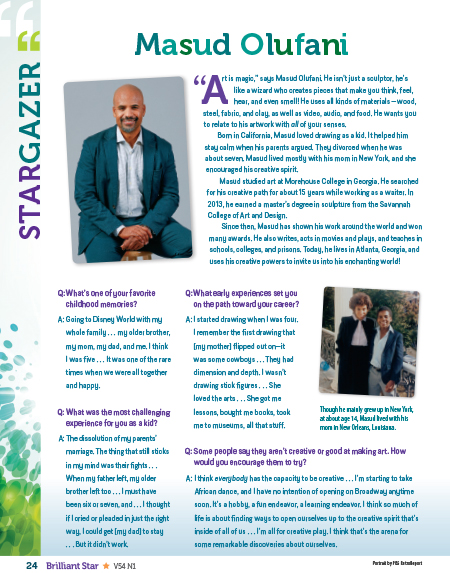
Get to know an awesome artist!
> PURPOSE
As the tagline (“Questions and Answers with an Inspirational Bahá’í”) suggests, Stargazer spotlights the life, work, and perspectives of an adult Bahá’í who can be a role model. Stargazers work in fields that are relevant to the theme of each issue. In this issue about creativity, artist, actor, and writer Masud Olufani talks about his mother’s encouragement, the importance of creative play, the impact of art on social change, and how the Baha’i teachings may be manifested in artistic works.
> QUESTIONS FOR DISCUSSION
Pre-K/Kindergarten (4-5) | Early Elementary (6-7)
- What is one thing you learned from this interview?
- What are some virtues you see in Masud?
- Do you agree that “everybody has the capacity to be creative”? How can you learn to be patient with yourself when something you’re making isn’t turning out the way you want it to?
- How do you think the arts can help us imagine a different future?
Late Elementary (8-10) | Junior Youth (11-14)
- What’s your biggest takeaway from this interview?
- Is there a skill or ability that a parent, teacher, or other adult encouraged you to develop? How did it feel? Do you continue to practice that skill?
- Do you agree that “everybody has the capacity to be creative”? What’s an example from your own life?
- What helps you be patient with yourself when a creative project isn’t turning out the way you want it to? What tips would you give someone who struggles with that?
- What impact do you think art can have on promoting social change?
> ACTIVITIES TO ENHANCE LEARNING
Pre-K/Kindergarten (4-5) | Early Elementary (6-7)
> Play Brady Rymer’s “So Many Ideas”:
https://www.youtube.com/watch?v=h1mzH-E7ZV8
Lyrics and sheet music: https://brilliantstarmagazine.org/uploads/play/Luminous_Library_2012/Music_So_Many_Ideas_JF12p20.pdf
Teach the kids to sing the first verse and the chorus OR invite them to make up a dance for the song.
> Divide the class into groups of 2-3 kids. Give groups 2 minutes to create a fun dance move. Then pair up groups, give them 8 minutes, and have each group teach the other group their dance move and put both together in one dance. Then ask each larger group to teach its dance to the other. If you wish, combine both dances into one.
Late Elementary (8-10) | Junior Youth (11-14)
> Ask students to create a poem, song, story, or skit about a) overcoming a negative attitude about one’s creative abilities, b) the power of art to create social change, or c) the importance of practicing virtues like perseverance and courage when you’re making art. Invite them to work alone, with a partner, or in a group.
Invite students to perform their creations for one or more classes of younger kids (or all the attendees of that camp or summer school, if the students are willing).
> Not for performance but just for fun: Divide the class into groups of 2-3 kids. Give groups 2 minutes to create a fun dance move. Then pair up groups, give them 8 minutes, and have each group teach the other group their dance move and put both together in one dance. Then ask each larger group to teach its dance to the other. If you wish, combine both dances into one.
PAGE 26: SHINING LAMP: HAZEL SCOTT
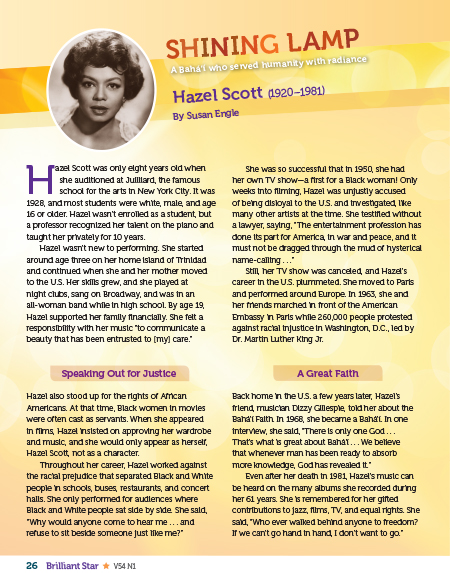
What can we learn from Hazel Scott?
> PURPOSE
The Shining Lamp feature introduces readers to a heroic Bahá’í from history. This page describes the life and career of Hazel Scott, a pioneering musician, TV personality, and racial justice advocate. Hazel Scott's ideas, experiences, and some inspiring quotes are included.
> QUESTIONS FOR DISCUSSION
Pre-K/Kindergarten (4-5) | Early Elementary (6-7)
- After reading the story together, what are some strengths and virtues you see in Hazel Scott?
- Why do you think Hazel would only perform for audiences where Black and White people sat together?
- Do you play any musical instruments? How do you feel when you’re playing?
- How do you think Hazel felt when she moved from her home country of Trinidad to the U.S.? Have you ever moved somewhere new? What was it like?
Late Elementary (8-10) | Junior Youth (11-14)
- After reading the story, what are some strengths and virtues you see in Hazel Scott?
- Why do you think Hazel would only perform for integrated audiences, where Black and White people sat together?
- Why do you think Hazel insisted on approving her wardrobe in movies and would only appear as herself, Hazel Scott, instead of a character?
- Have you ever taken action to support justice or the oneness of humanity, like Hazel did? What did you do?
> ACTIVITIES TO ENHANCE LEARNING
Pre-K/Kindergarten (4-5) | Early Elementary (6-7)
> Two Pianos at Once
Show students this video of Hazel playing two grand pianos at once (from the movie The Heat’s On):
https://www.youtube.com/watch?v=1HdnjTCMzpg
Hazel was also famous for doing “jazz versions” of classical music pieces. What are some ways your class can take a fresh, creative approach to the arts? (Examples: Doodle with your opposite hand (or both hands at once), then color the design; make crumpled paper art; do group art where everyone takes turns adding something to other people's drawings, etc.).
> Make What You Hear
Divide into pairs. Each partner gets the same set of 20 LEGO pieces. Sit so partners can’t see each other’s work. One person builds something, then explains to the other how to assemble it, without saying what it is. No LEGO bricks? Draw a picture and describe it instead. Compare your art, then switch roles.
> Faith in Harmony
Ask students to complete this activity, then discuss the answers. What are some sacred songs that lift your spirit?
https://brilliantstarmagazine.org/uploads/play/Luminous_Library_2010/Hidden_Harmonyv2_ND10p7.pdf
Late Elementary (8-10) | Junior Youth (11-14)
> Two Pianos at Once
Show students this video of Hazel playing two grand pianos at once (from the movie The Heat’s On):
https://www.youtube.com/watch?v=1HdnjTCMzpg
Hazel was also famous for doing “jazz versions” of classical music pieces. What are some ways your class can take a fresh, creative approach to the arts? (Examples: Doodle with your opposite hand (or both hands at once), then color the design; make crumpled paper art; do group art where everyone takes a turn adding something to others’ drawings, etc.).
> Homemade Instruments
Make some homemade instruments and have a concert together. Why do you think the Bahá’í writings say music is “a ladder for the soul”?
Instrument examples:
Cardboard Ukulele
https://brilliantstarmagazine.org/uploads/play/Luminous_Library_2016/Nur_Ukulele_ND16.pdfa
Harmonica
https://brilliantstarmagazine.org/uploads/play/Luminous_Library_2012/JA12_Nur.pdf
> Mindful Music
Ask students to complete this activity with two students who are preparing for a band concert. Then discuss the answers. Why is it important to have a positive attitude when you’re learning an instrument or getting ready to perform?
PAGE 27: CREATIVE COLONY
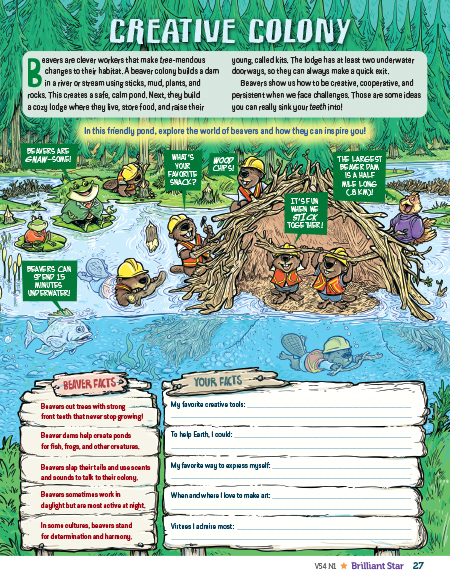
Beavers are creative creatures!
> PURPOSE
This page introduces the amazing and creative behavior of beavers and shows illustrated beavers creating their lodge. We can learn a lot from beavers! In the activity, facts about these animals are presented, and readers are asked to write about their own creative experiences.
> QUESTIONS FOR DISCUSSION
Pre-K/Kindergarten (4-5) | Early Elementary (6-7)
- Have you ever seen a beaver or a beaver lodge in real life? What did you think of it?
- Beavers create unique lodges that are suited to their lives. What are some things you love about your home or city?
- Beavers are persistent and keep going until they finish. Talk about a time you needed persistence to finish a project. What helped you keep going?
- What was a time you cooperated with someone else to build something or make something? What’s helpful about working with others?
Late Elementary (8-10) | Junior Youth (11-14)
- Beavers create unique lodges that are suited to their lives. What are some things you appreciate about your home or your community?
- Talk about a time you needed persistence to finish a project. What helped you keep going?
- What was a time you cooperated with someone else to build something or make something? Why do you think people who work in groups are often more creative?
- What’s a way you like to be helpful to your neighborhood or community?
> ACTIVITIES TO ENHANCE LEARNING
Pre-K/Kindergarten (4-5) | Early Elementary (6-7)
> Beaver Craft
Make a fun beaver craft using a cardboard paper roll. You also need scissors, glue, colored paper, and pipe cleaners. Invite kids to work together and help each other, just as the beavers work together when building their lodge.
https://www.youtube.com/watch?v=yTKGlYRCkvI
> Handshake Game
To practice cooperation, ask everyone to pair up. Each pair invents a handshake-type greeting that includes three moves or gestures and a sound effect or phrase. After a few minutes, each pair teams up with another pair and puts their greetings together (for a six-part handshake with two sound effects). If it’s a large group, try combining foursomes for even more fun.
https://brilliantstarmagazine.org/uploads/play/Luminous_Library_TAB/TAB_MA_16_FG_Celebrations.pdf
Late Elementary (8-10) | Junior Youth (11-14)
> Beaver Dam Cookies
Work with students to make these no-bake beaver dam cookies. Serve them with your families or community, and share what you learned about beavers from this activity.
http://keepinglifecreative.com/creative-foods/no-bake-beaver-dam-cookies
> Quiz: Are You Cooperative?
After completing the beavers activity, invite students to take this quiz on being cooperative. Then discuss items from the quiz that can be used as goals to focus on (Example: “I encourage others if they’re having a hard time.”). Students can create and decorate a mini poster with a reminder about this goal and keep it handy at home.
Online quiz:
https://brilliantstarmagazine.org/articles/quiz-are-you-cooperative
PDF version:
https://brilliantstarmagazine.org/uploads/play/Luminous_Library_2018/Quiz_Cooperative_v50n5.pdf
PAGE 29: A-MAZE-ING ADVENTURE: WANDER-FUL CREATIVITY
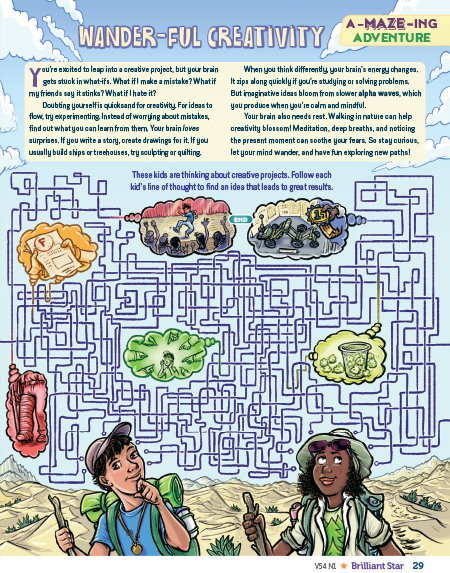
Our brains are powerful!
> PURPOSE
This piece explores different types of brain waves and how they relate to different activities. In the maze, readers choose the correct path that leads from each kid to their positive idea about the creative process.
> QUESTIONS FOR DISCUSSION
Pre-K/Kindergarten (4-5) | Early Elementary (6-7)
- What are some arts or hobbies you’d like to try that you haven’t done before?
- When you're making art, what helps you have fun and not worry about making mistakes?
- What are some ways you like to let your brain rest? (Examples: meditation, nature walk, listen to music, etc.)
Late Elementary (8-10) | Junior Youth (11-14)
- What are some arts or hobbies you’d like to try that you haven’t done before?
- When you're making art, what helps you have fun and not worry about making mistakes or being judged by others?
- What are some ways you like to let your brain rest? (Examples: meditation, nature walk, listen to music, etc.)
> ACTIVITIES TO ENHANCE LEARNING
Pre-K/Kindergarten (4-5) | Early Elementary (6-7)
> Taking the Stage
Read this activity with students and invite them to draw themselves doing something they love, then share their drawing with the group.
https://brilliantstarmagazine.org/uploads/play/Luminous_Library_2016/Taking_the_Stage_MA16_p19.pdf
> Creativity Challenge
Read this activity and discuss the creativity challenge with students. Which ideas excite them most? Can you start trying some right away?
https://brilliantstarmagazine.org/uploads/play/Luminous_Library_2018/Maya_v50n5.pdf
Late Elementary (8-10) | Junior Youth (11-14)
> Taking the Stage
Read this activity with students and invite them to draw themselves doing something they love, then share their drawing with the group.
https://brilliantstarmagazine.org/uploads/play/Luminous_Library_2016/Taking_the_Stage_MA16_p19.pdf
> Quiz: Unlock Your Creativity
Invite students to take the quiz about creativity. Then reflect on the quiz together and discuss which elements from the quiz are areas students could work on in the future.
https://brilliantstarmagazine.org/articles/quiz-unlock-your-creativity
Printable PDF:
https://brilliantstarmagazine.org/uploads/play/pdf-play/Quiz_Creativity_JF12_op.pdf
Updated on 5.19.25