
Parents and Teachers
Teaching Tools & Ruhi Classes
Teachers’ Guides & Resources
Teachers’ Guide, “Creating Art with Heart,” Part 2
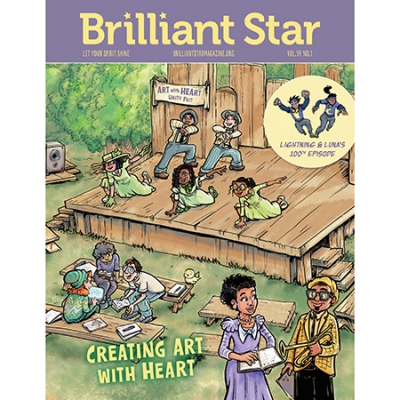
This guide is a tool to assist teachers of children’s classes and junior youth animators in using Brilliant Star’s “Creating Art with Heart” issue in the classroom. While Brilliant Star is developed for kids aged 7-12, many younger and older kids enjoy learning from it. Activities can be adapted and expanded to engage ages 4-14. You’re invited to explore this guide and to share your own ideas in our Facebook group, Brilliant Star Idea Exchange.
Key themes in this issue:
- Tips for using the power of the arts to uplift our spirits and our communities
- Using arts to share spiritual truths and bring people together
- Enkindling love and reinforcing our shared identify as one human family
- Applying creativity to various aspects of life, including the sciences
- Practicing curiosity, learning, and a growth mindset with the arts
- Seeing mistakes as a natural part of learning and reflecting on them to grow
- Getting inspiration from spending time in nature, relaxation, play, and meditation
- Celebrating diversity and collaboration in creative endeavors
- Virtues of creativity, perseverance, courage, learning, joyfulness, and cooperation
You can search, download, or print the full issue here.
Copies are available for purchase at bahaibookstore.com.
We recommend Google Chrome for viewing and downloading PDFs.
For each page, you’ll find discussion questions and activities to enhance learning.
“Creating Art with Heart” Pages, Part 2
11 – We Are One
12 – Riley’s Rainforest
13 – Magical Mistakes
14 – Lightning & Luna: Episode #100
18 – _____'s Heroic Journal
19 – Cosmic Creativity
You Can Find Part 1 Here (pages 1-10)
You Can Find Part 3 Here (pages 20-29)
AGE GROUPS:
Pre-K/Kindergarten (4-5)
Early Elementary (6-7)
Late Elementary (8-10)
Junior Youth (11-14)
PAGE 11: WE ARE ONE
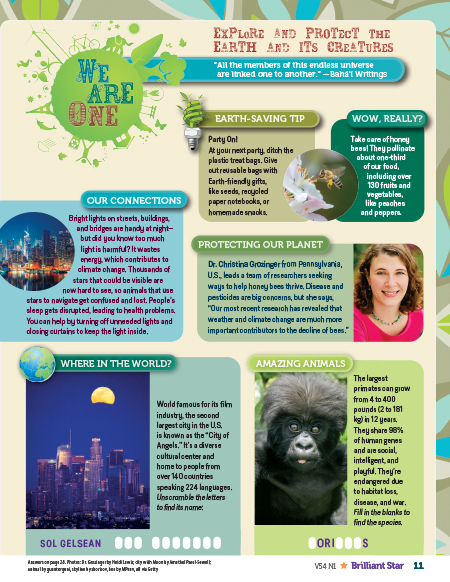
Explore and care for our planet.
> PURPOSE
“We Are One” inspires us to explore and protect the Earth and its creatures by learning more about the environment and our connections with it and each other.
Quote: “All the members of this endless universe are linked one to another.”
—Bahá’í Writings
> QUESTIONS FOR DISCUSSION
Pre-K/Kindergarten (4-5) | Early Elementary (6-7)
- Where is the Sun at night?
- Where do the stars go in the day?
- Can you see the stars from your yard?
Late Elementary (8-10) | Junior Youth (11-14)
- Can you name some animals that sleep in the day and come out at night?
- What do you think happens to them if it’s too bright at night?
- Can you see the stars from your yard?
- Have you ever seen the Milky Way?
> ACTIVITIES TO ENHANCE LEARNING
Pre-K/Kindergarten (4-5) | Early Elementary (6-7)
> Day and Night Craft
Make a day and night craft to tie into the information on this page about light pollution. You need: Two paper plates, craft paint, paint brush, water, scissors, pencil, glue, hole punch, and a paper fastener.
https://nontoygifts.com/day-and-night-craft/
> Sing: Sun Will Shine Again
https://brilliantstarmagazine.org/videos/sun-will-shine-again
> Pollination Activity
Discuss the pollination process to tie into the information about bees on this page. Here's one resource:
https://www.insectlore.com/blogs/butterflies/pollination-for-kids
Then demonstrate with this pollination activity. You need: Pom poms, jumbo craft sticks, black pipe cleaners, construction paper, scissors, cheese puffs, small round container, jar lid, and glue.
https://blog.kaplanco.com/ii/pollination-steam-craft
Late Elementary (8-10) | Junior Youth (11-14)
> Learn about Light Pollution
Have students talk about what they can see at night from their yard. Compare it to the pictures on the Bortle scale, which measures light pollution. Are they are missing some stars in their area?
https://starwalk.space/en/infographics/bortle-scale
Discuss what light pollution is and what kids and families can do about it:
https://rwtadventures.com/astrotourism-education/light-pollution-for-kids-get-involved/
> Make Rocket Kebabs
Fill a wooden skewer with alternating fruits, such as bananas, blueberries, melon chunks, or grapes. Put a whole strawberrie on the end of the skewer to represent the nose of the rocket. Add curling ribbon to the end of the skewer for the rocket's tail.
NOTE: Check with parents or guardians for dietary restrictions.
> Bee Creative
Ask students complete these bee-themed activities. Then invite them to put their favorite bee jokes on a poster and share them with friends and family.
Bee Creative
https://brilliantstarmagazine.org/uploads/play/Luminous_Library_2015/Bee_Creative_JFMA15.pdf
Bee Kind
https://brilliantstarmagazine.org/uploads/play/Luminous_Library_2018/V50N3_Bee_Kind.pdf
Bee-ing Together
https://brilliantstarmagazine.org/uploads/play/Vol51/v51n6p29_Maze_Beeing_Together_opt.pdf
PAGE 12: RILEY'S RAINFOREST
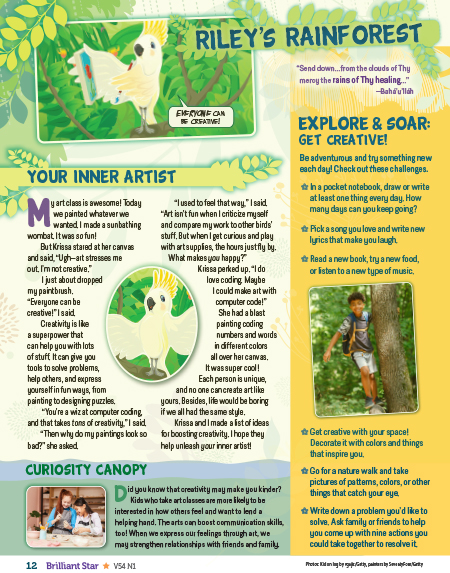
Express your creativity and encourage others!
> PURPOSE
This piece explores how we’re all creative in different ways, from painting portraits to coding computer programs. Readers learn fun tips to let go of their inner critics and power up their creativity.
Quote: “Send down ... from the clouds of Thy mercy the rains of Thy healing ...”
—Bahá’u’lláh
> QUESTIONS FOR DISCUSSION
Pre-K/Kindergarten (4-5) | Early Elementary (6-7)
-
What does it mean to be creative?
-
What are some things you have created?
-
Do you think everyone is creative, or only some people?
-
If you could create anything in the world, what would you make?
Late Elementary (8-10) | Junior Youth (11-14)
-
How do you like to express your creativity?
-
Why do you think some people think they’re not creative?
-
How can we keep an open mind and not be harsh to ourselves about our creations?
-
What is the first activity you would like to do on the “Explore & Soar” list on this page?
> ACTIVITIES TO ENHANCE LEARNING
Pre-K/Kindergarten (4-5) | Early Elementary (6-7)
> Natural Inspiration
Take students on a nature walk and encourage them to soak up the sights, sounds, and scents. Point things out to help increase their awareness and curiosity, as these traits boost creativity! After the walk, ask kids to share something cool they noticed or enjoyed.
> Musical Art
Give each kid a paper and colored pencils or markers. Play a song, then ask them to draw something that reminds them of the song in some way. It can be anything, from objects to abstract lines. Repeat with two songs of different genres. Invite kids to share their creations at the end. This boosts kids’ power of perception and their ability to express their feelings in a creative way.
> Free-Form Crafting
Set up a craft table where kids can practice their self-expression and create anything they want! You could include various colors of paper, stickers, markers, colored pencils, yarn, buttons, pipe cleaners, clay, etc. When everyone is finished, invite kids to share their creations and talk about what inspired them.
Late Elementary (8-10) | Junior Youth (11-14)
> Brainstorming
Pick a topic, like animals, fruits, friendship, summer, community, etc. Give students two minutes to write down as many things as they can think of that are related to that topic. The goal is to not edit themselves and just let ideas flow! Invite students to choose a few of the items from their list to put in a drawing, poem, or story. Then ask them to swap lists with someone else and see if their list inspires even more fun combinations.
> Recycled Crafting
Provide participants with a bunch of recyclable materials (boxes, cartons, cans, paper, jar lids, cardboard, etc.). Ask them to get creative and build something fun or useful with it. You can form pairs or groups of students if you have a large class, and encourage them to collaborate. Invite everyone to share their creations when they’re complete.
> Timed Freewriting
Set a timer for five minutes and ask students to write a short story or poem about a funny or imaginative topic of your choosing. (Examples: Describe a time you couldn't stop laughing. If you were magically turned into an animal, what would you do? If a dragon was in our classroom, what virtues would we teach him?) You can find lots of ideas online. Encourage kids not to overthink it and to write the first things that pop into their head. The goal is to let ideas flow. When they’re finished, invite them to share their stories with the class or with a partner. If they would prefer not to read them out loud themselves, you could offer to read it for them.
PAGE 13: MAGICAL MISTAKES

Mistakes can be enchanting.
> PURPOSE
This piece explores how mistakes can actually lead to magical discoveries—if we keep an open mind and practice the power of creativity. Readers find 10 potentially “happy accidents” that are about to occur in a wizards’ workshop. Then they discover tips for making the most of mistakes.
> QUESTIONS FOR DISCUSSION
Pre-K/Kindergarten (4-5) | Early Elementary (6-7)
- What are mistakes?
- Are mistakes always bad?
- Can making a mistake help you learn?
- If you make a mistake, what do you do?
Late Elementary (8-10) | Junior Youth (11-14)
-
Can we learn from any mistake?
-
How can we help ourselves view mistakes as opportunities to learn and grow?
-
What’s a mistake you’ve experienced that helped you learn something?
-
Can we learn from other people’s mistakes too?
-
Can we learn from fictional characters in books and movies?
> ACTIVITIES TO ENHANCE LEARNING
Pre-K/Kindergarten (4-5) | Early Elementary (6-7)
> Wands of Wonder
Create magic wands as reminders to see mistakes as magical opportunities to learn! Examples:
Nature wands
https://minimadthings.com/blogs/news/magic-wands
Star wands
https://www.happyfamilyart.com/craft-tutorials/magic-wand-craft-tutorial/
Encourage kids to use them as mindful tools when they make a mistake. They could wave their wands and ask themselves a question, such as: what can I do to make it better?
> More Magical Mistakes
Invite students to tell a story inspired by one or more of the mistakes they find in the activity. (For example, what happens when the bird eats a magical “morph wafer”? What about when the purple potion in the cauldron bubbles over?) What do the wizards and their animal friends do? What kind of virtues do they use to learn from their mistakes and change their approach next time? Ask students to draw a picture to accompany their story.
Late Elementary (8-10) | Junior Youth (11-14)
> Growth Mindset
Talk about the concept of having a growth mindset, which relates to having a humble posture of learning. Invite students to test their growth mindset and learn tips for growing from mistakes with this quiz:
Quiz: Do You Have a Growth Mindset?https://brilliantstarmagazine.org/articles/quiz-growth-mindset
Printable PDF: https://brilliantstarmagazine.org/uploads/play/Luminous_Library_2017/ND17p2_Quiz_Growth.pdf
> Learning Together Skits
Break students into groups and ask them to create and act out a skit in which a character makes a mistake and learns something from it. The skit can be magic-themed if they want, or it can involve learning a skill or a virtue.
> Wands of Wonder
Help students create magic wands as reminders to see their mistakes as magical opportunities to learn!
Wooden wands:
https://www.darcyandbrian.com/diy-wizard-wand-craft/
https://minivanadventures.com/easy-diy-harry-potter-wand-craft/
Encourage students to use them as mindful tools when they make a mistake. They could wave their wands and ask themselves questions like these:
- What can I do to make it better?
- What can I learn from this?
- How could I avoid this mistake next time?
> Reframe It!
Talk about the concept of “reframing,” which is looking at a situation in a new way. This ties into the idea of learning from mistakes. Invite students to do this activity on reframing:
PAGE 14: LIGHTNING & LUNA: EPISODE #100
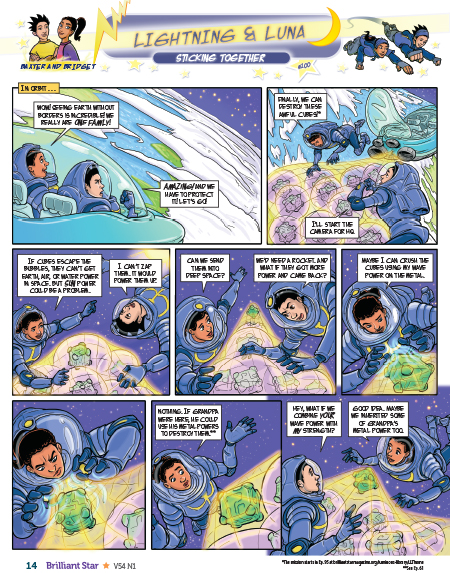
Will Lightning & Luna save the world from the Erasers’ cubes?
> PURPOSE
Brother and sister Lightning & Luna are part of a league of young superheroes called the Uplifters. They use their virtues and superpowers to save the world. When Lightning & Luna aren’t on a mission, they keep their superhero identities secret, cope with middle school, and have fun with friends. This special four-page episode concludes the “CubeMaker Adventure” and celebrates the 100th episode of Lightning & Luna.
> QUESTIONS FOR DISCUSSION
Pre-K/Kindergarten (4-5) | Early Elementary (6-7)
- Can anyone be a hero?
- Who are some real people that you consider heroes, and why?
- What are some virtues that you try to practice in heroic ways?
- What is a superhero?
- If you were a superhero, what powers would you like to have and why?
Late Elementary (8-10) | Junior Youth (11-14)
-
Who are some people that you consider heroes or role models? What do you admire about them?
-
How do stories about heroes help us in our own lives?
-
What are some qualities or virtues that help you with everyday challenges?
-
If you were a superhero, what powers would you like to have and why?
> ACTIVITIES TO ENHANCE LEARNING
Pre-K/Kindergarten (4-5) | Early Elementary (6-7)
> Knock out negative qualities and plant positive virtues
Collect paper cups or seedling cups and turn them upside down. Write negative qualities on them, such as impatience, greed, etc. Draw a small picture for non-readers. Set them on a table and put a minifig or other character on top of each cup.
Ask students study the cups. Ask them what qualities are needed to fix each negative quality. Then write or draw those qualities on ping-pong balls. Have the students stand far enough away to make it challenging and then toss the ping pong ball at the correct cup. The goal is to help the character escape by knocking it off the cup. Then the character can be moved to stand in a positive place (such as on a poster that lists virtues or a drawing that represents a garden). For more excitement, build up a structure of cups and characters.
Afterward, plant seeds in the cups. Cover the negative words with a label that ties into the positive seed names, like respectful radish or caring cucumber.
> Build a Superhero Headquarters
If the space is appropriate, have the students build a superhero headquarters from chairs, blankets, cardboard boxes, pillows, etc. Inside, they can work together to make a super service plan of ways they can each be of service to their family or community. Check out these activities for service ideas:
Be an Uplifter: Checklist Challenge
brilliantstarmagazine.org/uploads/play/Luminous_Library_2017/JA_17_Uplifter_Checklist_Challenge.pdf
Kindness Quest
brilliantstarmagazine.org/uploads/play/Luminous_Library_2017/SO17p19_Kindness_Quest.pdf
> Superhero Wristbands
Ask kids to make a superhero wristband and write a favorite virtue on it. Here's one example that uses a cardboard roll, paint, stickers, and glitter:
https://www.firstpalette.com/craft/superhero-bracelets.html
> Super Snacks
Provide snacks with superhero labels, such as Flying Fruit Skewers, Dynamic Dip, Invisibility Ice Cream, cookies decorated to look like Super Shields, Powerful Punch, Wonder Watermelon, Heroic Hummus, Courageous Carrots, etc.
NOTE: Check with parents or guardians for allergies/dietary restrictions.
> Sing a Superhero Song
Sing “The Hero in You,” by Ellis Paul, and watch the video on Brilliant Star’s website.
> For activities related to the seed vault that appears in this Lightning & Luna adventure, see the Lightning & Luna content in our “Hope for Our Future” Inspiration & Resource Guide, Part 2.
Late Elementary (8-10) | Junior Youth (11-14)
> CubeMaker Adventure
Read together or act out the CubeMaker adventure, Lightning & Luna episodes 93-100.
Discuss key events in the adventure:
- Why does Colin give Baxter the compass? Did he really expect him to use it?
- What do you think the mystery ball is?
- Do you think the characters get scared from all the dangers they face? How would you cope with that in real life?
- What virtues do Lightning, Luna, Minnah, and Colin practice in this adventure?
- In what ways is being a person (or Bahá’í) with virtues similar to being an Uplifter like Lightning & Luna?
> Uplift Posters
“Carefully nurtured bonds of love and unity among siblings offer a lifetime of support and upliftment ...”—Bahá’í Writings
Give each student a piece of poster board. Ask them to write this quote or a similar title or saying at the top. Below it, list of 20 or more ways they can support and uplift siblings (or cousins or close friends). Decorate the poster with designs or drawings related to friendship and joy.
> Make a Compass
Craft a “Moral Compass” from Maya’s Mysteries. You need: 7" (18 cm) sturdy paper plate, hardcover book, ruler, hole punch, four 10" (25 cm) wooden skewers, rubber band, large metal paper clip, small magnet,10" (25 cm) thread, tape, scrap paper,scissors, plastic needle.
Discuss the concept of a moral compass and what concepts or teachings students rely on to guide their actions.
> Find a Treasure
Make a treasure map using North, South, East, and West directions. Students can follow the map using a compass, landmarks, the sun, or an app. The map leads to a treasure (and maybe a snack), which could include a ball decorated to look like the one in the Lightning & Luna episode. If the teacher prefers, students can break into two teams, and each group can create a treasure map for the other group.
> Superhero Relay Race
Divide students into two even teams. The first racer has a cape (could be made of a bed sheet, towel, or piece of fabric). They race to a line or object that represents HQ, then back to their team. They cooperate with the second racer to transfer the cape. When it's fastened to the second racer, they run to HQ and back and transfer the cape to he third racer. Continue until everyone on the team has run wearing the cape.
> Superhero Virtue Cards
Invite kids to create a set of cards with words and designs that represent strong superhero virtues (such as courage, determination, love, respect, patience, perseverence, truthfulness, etc.). Students can take turns choosing a card and acting out the virtue that goes with it, while others guess the virtue. (They may need to work together to act out scenarios that show the virtue in action.) Kids may also want to draw themselves as superheroes on the other side of the cards.
> For activities related to the seed vault that appears in this Lightning & Luna adventure, see the Lightning & Luna content in our “Hope for Our Future” Teachers’ Guide, Part 2.
PAGE 18: _____'S HEROIC JOURNAL
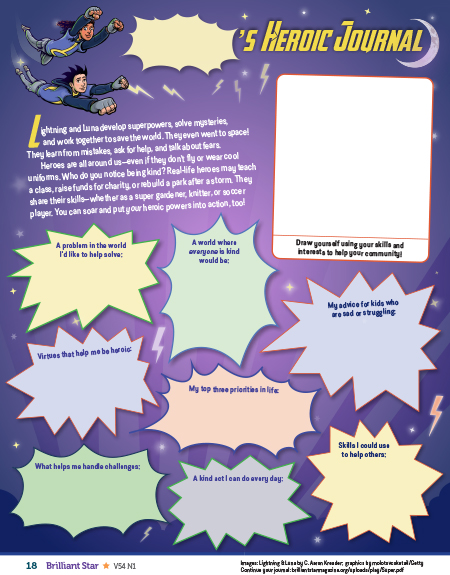
Explore your heroic goals!
> PURPOSE
This page invites kids to imagine themselves as superheroes inspired by the Lightning & Luna comic. (Note that in the comic, Lightning & Luna use their virtues and their superpowers; their power only work if they’re using them to be of service.) Kids write their responses to prompts about facing challenges, helping others, kind actions they can do, etc. They also draw themselves using their skills and interests to help their community.
> QUESTIONS FOR DISCUSSION
Pre-K/Kindergarten (4-5) | Early Elementary (6-7)
- What does it feel like to be a hero or do something heroic?
- What are some ways we can be kind to others?
- What are some ways you like to help your community?
- What are some problems you’d like to help solve in your community or the world?
Late Elementary (8-10) | Junior Youth (11-14)
- What does it feel like to be a hero or do something heroic?
- Can we be heroes every day, or only in special or dangerous situations?
- Why do you think superhero movies and comics are popular?
- What are some virtues that superheroes show in movies and comics (including Lightning & Luna)?
> ACTIVITIES TO ENHANCE LEARNING
Pre-K/Kindergarten (4-5) | Early Elementary (6-7)
> More Heroic Journaling
Share color copies of “Super Journal” activity with students, so they can continue their superhero-themed journal. (This page appears in the “Heroic Spirit” issue, Volume 52, No. 2. Students or teachers may own copies.)
Invite students to add more pages of their own design to their journals. They can include drawings, write about life events, or make up stories, poems, or plays. Kids can make covers for their journals using cardboard that’s painted or decorated. Punch holes in the cardboard and fasten the pages together with string or copper fasteners.
Another option is to store the journal in a sturdy folder with prongs or in a three-ring binder.
> Create a Paper Superhero Gift
Create a superhero gift from Nur’s Nook. You need: Four 4 ¾" (12.1 cm) circles cut from copies of “Lightning & Luna” or other comic (trace a bowl as guide), pencil, scissors, ruler, double-sided tape, ten 4 ½" (11.4 cm) colorful paper stars, one 2 ¾" (7 cm) star, marker, 27" (68.6 cm) piece thin ribbon, hole punch, and small, shiny stickers.
brilliantstarmagazine.org/uploads/play/Luminous_Library_2014/Nur_Superhero_Gifts_MA14p6.pdf
> Uplift the World: Picture Find
Invite kids to do this picture find activity based on Lightning & Luna:
https://brilliantstarmagazine.org/uploads/play/Luminous_Library_2017/JA_17_Uplift_the_World.pdf
Late Elementary (8-10) | Junior Youth (11-14)
> More Heroic Journaling
Share color copies of “Super Journal” activity with students, so they can continue their superhero-themed journal. (This page appears in the “Heroic Spirit” issue, Volume 52, No. 2. Students or teachers may own copies.)
Invite students to add more pages of their own design to their journals. They can include drawings, write about life events, or make up stories, poems, or plays. Kids can make covers for their journals using cardboard that’s painted or decorated. Punch holes in the cardboard and fasten the pages together with string or copper fasteners.
Another option is to store the journal in a sturdy folder with prongs or in a three-ring binder.
> Which Uplifter Are You?
Ask kids to take this quiz and find out which Uplifter they identify with. Do they agree with the results of the quiz?
> Uplift Equality
Read together this activity about standing up for justice. Discuss some ways we can stand up for justice in our everyday lives. Ask kids to find the hidden letters and complete the virtue words. Then invite them to give examples of behavior that reflects each virtue.
https://brilliantstarmagazine.org/uploads/play/Vol53/Uplift_Equality_V53N1.pdf
PAGE 19: COSMIC CREATIVITY
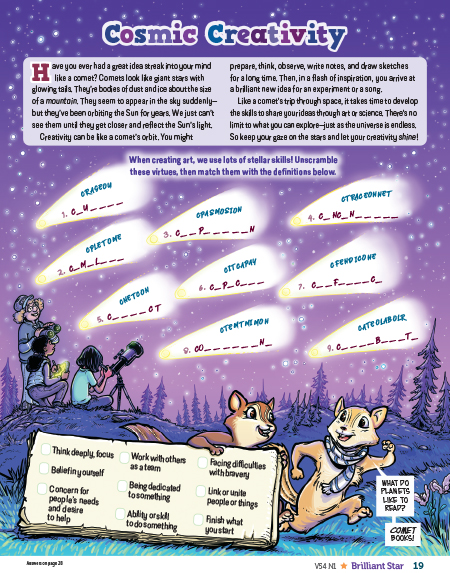
How is creativity like a comet?
> PURPOSE
The purpose of this page is to educate readers about the wonders of comets in space and encourage them to reflect on the virtues and skills that are part of any creative project. Classes can discuss how to develop the skills and virtues that help them express their creativity.
> QUESTIONS FOR DISCUSSION
Pre-K/Kindergarten (4-5) | Early Elementary (6-7)
- What is creativity? (review if discussed earlier)
- How are you creative?
- What creative skills would you like to learn?
- What are some skills that you’ve already learned?
- Was the learning process challenging? Are you happy you learned them?
Late Elementary (8-10) | Junior Youth (11-14)
- Do the activity together and help explain the words first. Then ask if the students are dedicated to something and what it is (such as a creative practice, a team, a service project, a hobby, a goal, etc.).
- What is your favorite way to express creativity?
- What are some skills you practiced to be creative?
- What are some things that can be challenging when you’re working on a creative project?
- What skills would you like to learn next?
> ACTIVITIES TO ENHANCE LEARNING
Pre-K/Kindergarten (4-5) | Early Elementary (6-7)
> C is for Creative
Invite kids to express their creativity, and talk about how to practice the virtues and skills in the word scramble activity, such as collaborate, complete, and connect. Some ideas:
- Take sidewalk chalk outside and make up your own a game
- Make up an obstacle course and take turns running through it
- Build something creative and fun from blocks or recycled materials
- Draw or craft colorful comets (one approach from NASA is below)
- Write a story that includes comets being spotted in the sky
- Go on a nature walk and make art or patterns with nature items
More ideas here:
https://brilliantstarmagazine.org/uploads/play/Luminous_Library_2018/Maya_v50n5.pdf
> Make Your Own Comets
Make comets on a stick with this NASA activity. You need:
- Chopsticks or a popsicle stick
- Metallic ribbon
- Scissors
- Tin foil
https://spaceplace.nasa.gov/comet-stick/en/
> Sing: So Many Ideas
https://brilliantstarmagazine.org/uploads/play/Luminous_Library_2012/Music_So_Many_Ideas_JF12p20.pdf
Hear the song: https://www.youtube.com/watch?v=h1mzH-E7ZV8
Late Elementary (8-10) | Junior Youth (11-14)
> Creative Comets
Have each student draw a large comet on posterboard and decorate it. Add their favorite words about creativity. Post the comets around the room for inspiration.
> Creativity Quiz
Invite students to take a quiz to unlock their creativity. Discuss the questions and how they can be used as tips for boosting creativity.
https://brilliantstarmagazine.org/uploads/play/Luminous_Library_2012/Unlock_Creativity_JF12p5.pdf
> Nature Art
Go on a nature walk and make art or patterns with nature items
https://brilliantstarmagazine.org/uploads/play/Vol52/Maya_Outdoor_Art_V52N4_Opt.pdf
> Make Music
Gather 5 objects that are not musical instruments and make music. More ideas here:
https://brilliantstarmagazine.org/uploads/play/Luminous_Library_2018/Maya_v50n5.pdf
> Make Cookies
Make these no-bake moon cookies. Turn them into comets by adding tails made of sliced fruit leather or cheese.
https://spaceplace.nasa.gov/moon-cookies/en/
*Check with parents or guardians about food sensitivities.
> Draw an Alienaut
Draw a fun “alienaut” using this “How to Draw” video by C. Aaron Kreader:
https://brilliantstarmagazine.org/videos/how-to-draw-an-alienaut
> Comet Resources
Share more fascinating comet facts for kids from NASA:
https://spaceplace.nasa.gov/comets/en/
Updated on 5.20.25