
Parents and Teachers
Teaching Tools & Ruhi Classes
Teachers’ Guides & Resources
Teachers’ Guide: “Join Together,” Part 3

This guide is a tool to assist teachers of children’s classes and junior youth animators in using Brilliant Star’s “Join Together” issue in the classroom. While Brilliant Star is developed for kids aged 7-12, many younger and older kids enjoy learning from it. Activities can be adapted and expanded to engage groups ranging from ages 4-14. You’re invited to explore this guide and to share your own ideas in our Facebook group, Brilliant Star Idea Exchange.
These are some key themes in this issue; the discussion questions for each page can help to encourage dialogue:
- Acknowledging the nobility of the soul and the commonalities among all members of the human family;
- Understanding the meaning and impact of prejudice and racism, and using practical tools to overcome these negative forces;
- The importance of putting prayer and study of holy writings into concrete action against prejudice and racism;
- Building unity in our families, neighborhoods, and communities by getting out of our comfort zone and reaching out to others with kindness and friendship;
- Emphasizing a sense of hope that creating a unified world is possible and inevitable;
- Developing virtues of patience, perseverance, service, and initiative.
You can search, download, or print the full issue here.
We recommend Google Chrome for viewing and downloading PDFs.
For each page, you’ll find discussion questions and activities to enhance learning.
21 - Thoughtful Transformations
22-23 - Stargazer: Questions and Answers with Deltin Sejour
24 - Riley’s Rainforest: Are Brains Biased?
25 - See Clearly
26 - Shining Lamp: Coralie Franklin Cook (1861-1942)
27 - Unity at Green Acre
29 - aMAZEing Adventure—Zeke & Rhombus: Launch Peace
You Can Find Part 1 Here (pages 2-10)
You Can Find Part 2 Here (pages 11-20)
Age Groups:
- Pre-K/Kindergarten (4-5)
- Early Elementary (6-7)
- Late Elementary (8-10)
- Junior Youth (11-14)
PAGE 21: THOUGHTFUL TRANSFORMATIONS
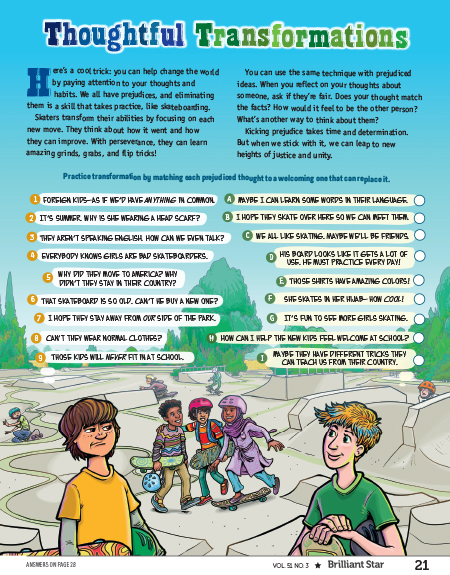
Practice new moves to kick prejudice
> PURPOSE
This page explores the powerful impact our thoughts have on our ability to create change. Through a thought matching activity, readers practice and strengthen their ability to transform their thoughts and their interactions.
> QUESTIONS FOR DISCUSSION
Pre-K/Kindergarten | Early Elementary
- What skills or tricks have you learned? (Examples: sports, music, art, etc.) How long did it take? What helped you stick with it?
- What are some new skills you want to learn? How are you going to do it?
- Have you ever been the new kid in a group or felt out of place? What helped you feel welcome?
- What do you say and do to help new kids you meet feel welcome?
- Some things that might seem weird at first are really just new to us. Can you think of something, like new food, clothes, music, or a show, that seemed unusual at first, but you grew to really like it?
Late Elementary | Junior Youth
- What skills or tricks have you learned? (Examples: sports, music, art, language, gaming, etc.) How long did it take? What helped you stick with it?
- Think of a time you were able to adjust your thoughts. What helped you notice your own thoughts? What helped you change how you were thinking?
- What is a habit or pattern of thinking you’d like to improve or change? How will you work on it?
- Have you ever noticed a friend sharing a negative or harmful thought? How did you handle it? What could you try the next time it happens?
- What helps you change your own biased thinking?
- Some things that might seem weird at first are really just new to us. Can you think of something, like new food, clothes, music, or a show, that seemed unusual at first, but you grew to really like it?
> ACTIVITIES TO ENHANCE LEARNING
Pre-K/Kindergarten | Early Elementary
> New Moves
Encourage students to practice perseverance while learning new skills. Ask them to stand in a circle. Give each kid a moment to come up with a simple, quick motion or dance move. The first person starts by sharing their move. Everyone does the move. The second person does the first move, then adds their own motion. Everyone repeats both moves. The game continues around the circle with each student adding their move to the chain. After the last person’s turn, the class goes through all the moves, creating their own unique class dance.
> Try Meditation
Meditation is a great way to strengthen your ability to notice your own thoughts. Share this article about meditation with your class, then practice some of the different meditation activities.
Riley’s Rainforest: Peaceful Practices
https://brilliantstarmagazine.org/uploads/play/Luminous_Library_2018/V50N3_Riley_Peaceful_Practices.pdf
Meditation Station
https://brilliantstarmagazine.org/uploads/play/Luminous_Library_2011/MA11_Meditation_Station.pdf
Meditation Magic
https://brilliantstarmagazine.org/uploads/play/Luminous_Library_2016/Meditation_Magic_SO16_p27.pdf
Late Elementary | Junior Youth
> Thought Partners
Print each thought from the article activity on separate slips of paper. Give each student one of the positive or negative thoughts. Ask students to stand up and mingle. Students share the thoughts on their slips of paper, and search for the positive or negative thought it matches. When everyone has found their thought partner, each pair reads their thought matches aloud to the class and shares what impact they think the different thoughts would have on them and in their communities.
> Riley’s Rainforest: Peaceful Practices
Meditation is a great way to strengthen your ability to notice your own thoughts. Share this article about meditation with your class, then practice some of the different meditation activities.
https://brilliantstarmagazine.org/uploads/play/Luminous_Library_2018/V50N3_Riley_Peaceful_Practices.pdf
Meditation Station
https://brilliantstarmagazine.org/uploads/play/Luminous_Library_2011/MA11_Meditation_Station.pdf
Meditation Magic
https://brilliantstarmagazine.org/uploads/play/Luminous_Library_2016/Meditation_Magic_SO16_p27.pdf
BACK TO TOP
PAGES 22-23: STARGAZER: QUESTIONS AND ANSWERS WITH DELTIN SEJOUR
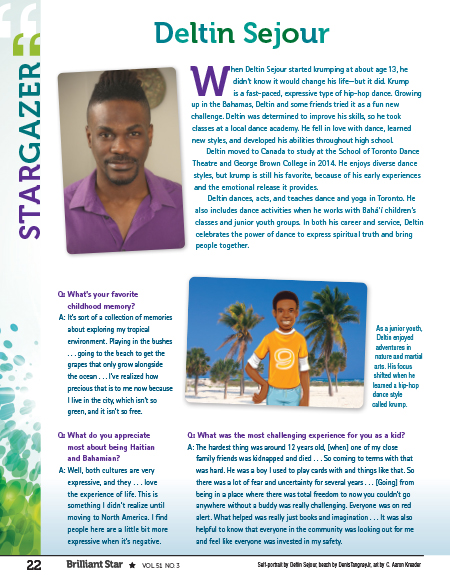
He builds unity through expressive dance
> PURPOSE
As the tagline (“Questions and Answers with an Inspirational Bahá’í”) suggests, Stargazer articles spotlight the life, work, and kid-friendly perspectives of an adult Bahá’í who kids can look to as a role model. Stargazers work in fields that are relevant to the theme of each issue. In this issue about racial justice and unity in diversity, “Join Together,” dancer/yoga instructor/actor Deltin Sejour discusses using dance to build community among people of different backgrounds.
> QUESTIONS FOR DISCUSSION
Pre-K/Kindergarten | Early Elementary
- What is one thing you learned from this interview? (Answers can be summarized if they’re too long to hold young kids’ attention.)
- Do you enjoy exploring in nature? What is your favorite place in nature to explore?
- Do you like to dance? Why or why not? What kind of dancing do you like best? (If you don’t like dancing, talk about art forms you do enjoy.)
- Deltin quoted ‘Abdu’l-Bahá’ as saying, “Let your heart burn with loving kindness for all who may cross your path.” What does that mean to you? What does it look like in practice?
Late Elementary | Junior Youth
- What is one thing you learned from this interview?
- Which one of Deltin’s answers was most interesting to you? Why?
- Do you agree that in North America, people are more likely to express their feelings about negative things than about positive things? Do you think that’s true of you? What’s one way you could express more love, joy, or other positive feelings in your daily life?
- Is there a certain type of dance or movement you enjoy doing? What is it and why do you enjoy it?
- What is your favorite art form? Is it something you’d like to pursue as a career, or just as a hobby? Why?
- Deltin said he wishes for young people “to not be bound by the rules and ideas about the world that we live in now, [to know] that they have the power to positively contribute to a better future if they are willing to put in the effort and commit time.” How do you feel about that, and what does it mean to you?
> ACTIVITIES TO ENHANCE LEARNING
Pre-K/Kindergarten | Early Elementary
> Practice a few basic yoga poses—such as Mountain, Tree, Chair, and Happy Baby—with the kids. Find some poses and instructions here:
Meditation Station
https://brilliantstarmagazine.org/uploads/play/Luminous_Library_2011/MA11_Meditation_Station.pdf
Meditation Magic
https://brilliantstarmagazine.org/uploads/play/Luminous_Library_2016/Meditation_Magic_SO16_p27.pdf
Yoga Poses for Kids
https://www.purewow.com/family/yoga-poses-for-kids
Late Elementary | Junior Youth
> Working in groups of 3-4 people, choose a virtue and create a simple dance that expresses that virtue or how it is put into action. If possible, teach that dance to others in your class or in a different class.
> Practice a few basic yoga poses—such as Mountain, Tree, Chair, and Happy Baby—with the kids. Find some poses and instructions here:
Meditation Station
https://brilliantstarmagazine.org/uploads/play/Luminous_Library_2011/MA11_Meditation_Station.pdf
Meditation Magic
https://brilliantstarmagazine.org/uploads/play/Luminous_Library_2016/Meditation_Magic_SO16_p27.pdf
Yoga Poses for Kids
https://www.purewow.com/family/yoga-poses-for-kids
BACK TO TOP
PAGE 24: RILEY’S RAINFOREST
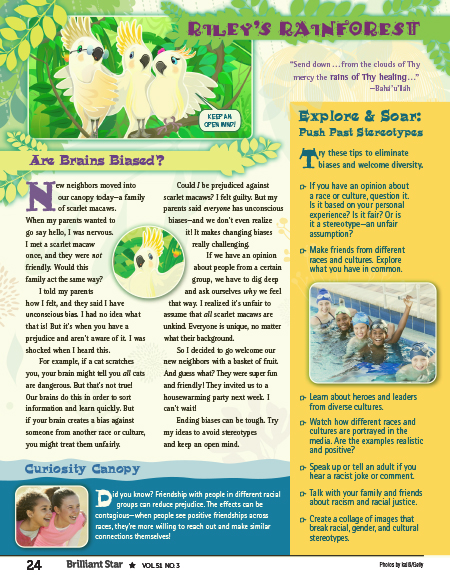
Can you have a prejudice without knowing it?
> PURPOSE
This piece discusses implicit biases and how they can harm our perception of people from diverse cultures and backgrounds. Kids learn creative ways to battle their biases and be open-minded toward all peoples.
Quote: “Send down ... from the clouds of Thy mercy the rains of Thy healing ...” —Bahá’u’lláh
> QUESTIONS FOR DISCUSSION
Pre-Kindergarten | Early Elementary
- Do you know anyone that moved to your country or neighborhood from another country?
- Do you know anyone who has different colored skin than you?
- What are ways we can we help our neighbors feel happy and welcome?
- What do you do to try to make friends with someone new?
- Think of a garden. Is it prettier to have one type of flower, or many types of flowers?
Late Elementary | Junior Youth
- What do you do when you notice you have an unconscious bias? How do you try to overcome it?
- What qualities can we strengthen to help us overcome our unconscious biases?
- How do you feel when you meet someone from a different culture or background than you?
- Why is stopping stereotypes important for building a unified community?
- What cultures make up your neighborhood or community?
- What are some ways you can get to know more diverse people?
> ACTIVITIES TO ENHANCE LEARNING
Pre-Kindergarten | Early Elementary
> Invite kids to color “Our Global Family” and ask them what they enjoy about other cultures. https://brilliantstarmagazine.org/uploads/play/Luminous_Library_2013/JF13_Our_Global_Family.pdf
> Divide kids into pairs. Ask each pair to perform a simple skit, pretending they are neighbors meeting each other for the first time. Encourage kids to treat each other with kindness and respect.
Late Elementary | Junior Youth
> As a class, create a list of some unconscious biases that people may have. Encourage students to share ideas for overcoming them.
> Choose one of the Explore and Soar activities to do with your class.
> Read a story from another culture, then talk about how that culture is similar to or different from yours. Here are some options:
https://brilliantstarmagazine.org/articles/the-amazing-orchard
https://brilliantstarmagazine.org/articles/song-of-the-heart-adapted-from-a-yoruba-folktale
https://brilliantstarmagazine.org/articles/great-escapes
BACK TO TOP
PAGE 25: SEE CLEARLY
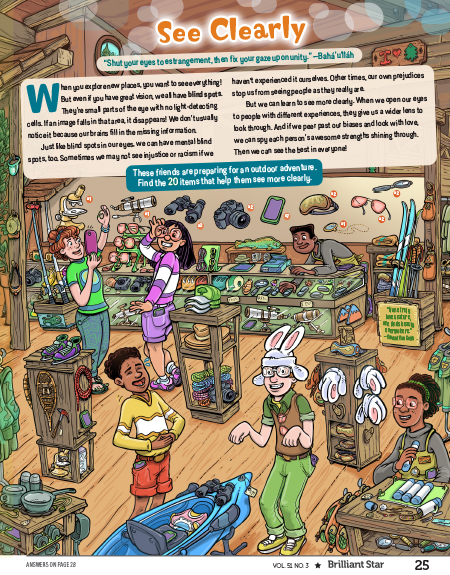
Discover tools for overcoming blind spots
> PURPOSE
This page introduces the concept of blind spots and explores how they can become barriers to unity. It gives readers tips for identifying and overcoming their own blind spots so they can learn from others and become champions of unity and justice.
Quote: “Shut your eyes to estrangement, then fix your gaze upon unity.” —Bahá’u’lláh
> QUESTIONS FOR DISCUSSION
Pre-K/Kindergarten | Early Elementary
- What’s a time you thought a toy or other item was lost forever until a family member helped you find it right away? Was it hidden, or did your eyes just miss it? How did it feel to have someone help you?
- What are some objects that help people see better?
- Have you ever looked through a microscope, a magnifying glass, or a pair of binoculars? What were you looking at? Did it help you see it better?
- What qualities and virtues do you see in your family and friends?
Late Elementary | Junior Youth
- Can you remember a time you realized you had a mental blind spot? What helped you realize it?
- When you learn something new, how does it impact the way you see the world around you?
- What happens if we don’t strive to identify and overcome blind spots?
- This page shows different lenses that help us see with our eyes. What are qualities that help improve our spiritual sight?
> ACTIVITIES TO ENHANCE LEARNING
Pre-K/Kindergarten
> Goofy Glasses
Ahead of class, make pipe cleaner glasses frames for each kid. Bend each end of a long pipe cleaner toward the center and wrap ends to make two lens frames. For ear pieces, twist two pipe cleaners together and cut in half. Attach to the lens frames and bend the end to curve around ears.
In class, give each kid a pair of pipe cleaner glasses and some more colorful pipe cleaners. Invite them to have fun twisting the pipe cleaners into fun shapes and attaching them to the frames. When finished, give kids a chance to share their creations with the class. Examples:
https://curiousandgeeks.com/valentines-pipe-cleaner-glasses/
> Rainbow Binoculars
Give each kid two empty paper rolls, squares of colored plastic wrap, and rubber bands. Show them how to cover one end of the tube with a square of colorful plastic, then use a rubber band to attach it. Let them explore looking through their binoculars with different colors. They can change the lens colors, or layer plastic squares to see how the colors change.
https://teachpreschool.org/2010/09/29/we-explored-our-five-senses-in-preschool-sight/
Early Elementary
> Find Your Blind Spot
Do some of these visual activities with students to find and explore their blind spots.
https://faculty.washington.edu/chudler/chvision.html
> I Spy Kindness
Help kids strengthen their ability to spot good qualities by creating their own fun “I Spy” activity.
https://brilliantstarmagazine.org/articles/mayas-mysteries-i-spy-kindness
Late Elementary | Junior Youth
> Make a Vision Board
Give kids 2-3 questions to encourage them to think about their vision for their community. For example:
- What would your community look like if people of all races and backgrounds felt truly welcome?
- What are some ways that prejudice and racism might impact your community?
- What can you do to help make your community more welcoming?
- What are some cultures in your community that you enjoy learning about?
- After students have time to answer the questions on their own, give them a few minutes to share their answers and discuss ideas with the class.
Then give each student a blank sheet of paper, markers, old magazines, scissors, and glue. On the piece of paper, draw a dividing line down the center. In the right column, have them draw and cut out words and images inspired by their answers to the questions. In the left column, have them add images and words for the qualities and skills that will help them contribute to that vision.
https://www.imom.com/creating-vision-board-teens-15-minutes/
> I Spy Kindness
Help students strengthen their ability to spot good qualities by creating their own fun “I Spy” activity. For older kids, encourage them to create the activity as a gift for someone younger.
https://brilliantstarmagazine.org/articles/mayas-mysteries-i-spy-kindness
BACK TO TOP
PAGE 26: SHINING LAMP: CORALIE COOK
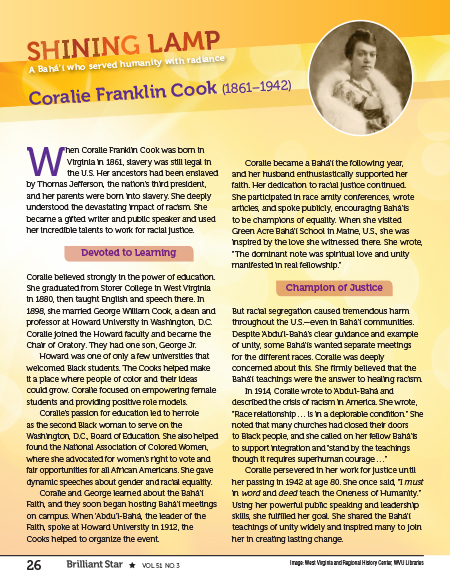
She was a passionate champion of racial justice
> PURPOSE
This feature shares stories of inspirational Bahá’ís throughout the history of the Faith. Coralie Franklin Cook was a dynamic public speaker and writer who spoke out against injustices and advocated for positive change in the Bahá’í community and throughout Washington, D.C.
> QUESTIONS FOR DISCUSSION
Pre-K/Kindergarten | Early Elementary
- Think of a time when you noticed someone being treated unfairly. How did you feel? What did you do?
- What do you do to make sure everyone feels welcome and heard in your school or neighborhood?
- What qualities did Coralie Franklin Cook use in her work for race unity?
- Coralie Cook believed in the power of education. What do you want to learn more about? How would you feel if someone said you weren’t allowed to learn about it because of the color of your skin?
- The Cooks helped with ‘Abdu’l-Bahá’s visit to Howard University. If you could meet ‘Abdu’l-Bahá, what would you want to ask him?
Late Elementary | Junior Youth
- Is there a time you spoke up for justice, or saw someone else advocate for it? What happened? What impact did it have?
- What qualities did you notice Coralie Franklin Cook demonstrate in the story? What are some ways you can develop and strengthen those qualities in yourself?
- Imagine that you could tell ‘Abdu’l-Bahá about race relations in America today. What would you tell him?
- What has changed for race relations in America since the early 1900s when Coralie Cook wrote to ‘Abdu’l-Bahá? What hasn’t changed?
- What is one thing you can do to help build racial equality and race unity in your community?
> ACTIVITIES TO ENHANCE LEARNING
Pre-K/Kindergarten | Early Elementary
> Make Cards
Print quotes from the Bahá’í Writings about themes from the story, such as race unity, equality, love, or justice. Give each kid a blank card and let them choose one of the quotes. Kids glue the quotes on the card, then use crayons, markers, and stickers to decorate the border or inside. If they are able to write, they can add a note inside to a loved one. Otherwise, they can draw a picture, and give the card to someone they love.
> Dear ‘Abdu’l-Bahá
People from all over the world loved ‘Abdu’l-Bahá, and wrote to him to share their love and hopes. If you wrote to ‘Abdu’l-Bahá, what would you want to tell him? As a class, write a letter to ‘Abdu’l-Bahá, telling him what you love and find beautiful in your community, and what you want to do to help it grow.
Late Elementary | Junior Youth
> Dear ‘Abdu’l-Bahá
People from all over the world loved ‘Abdu’l-Bahá and wrote to him to share their love and hopes. If you wrote to ‘Abdu’l-Bahá, what would you want to tell him? Write a letter to ‘Abdu’l-Bahá, telling him what you love and find beautiful in your community, what you hope will change, and what skills and qualities you want to develop to help your community grow.
> Class Presentation
Coralie Franklin Cook developed her dynamic writing and public speaking skills through study and practice. Her speeches on justice and equality inspired listeners to think deeply about the enormous issues facing their country. As a class, work together to create a presentation on the harms of racism and the need for race unity. Coralie’s strength was public speaking. Identify some of the strengths you have as a class, and use them to create music/art/poetry/dance/a speech that inspires others to think about America’s most challenging issue.
BACK TO TOP
PAGE 27: UNITY AT GREEN ACRE
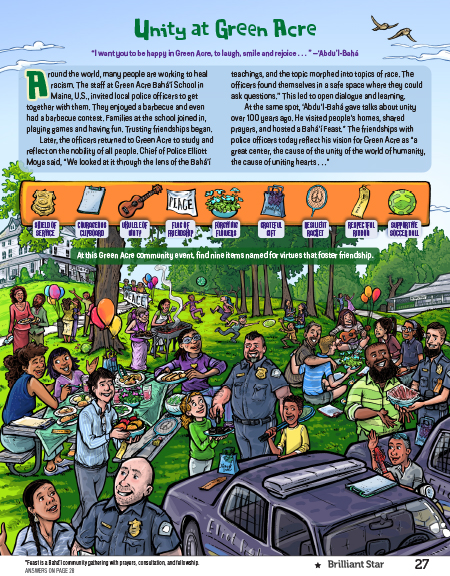
Trusting friends learn and grow together
> PURPOSE
This page describes an initiative at Green Acre Bahá’í School to study the oneness of humanity with local police officers, and it mentions ‘Abdu’l-Bahá’s visit to Green Acre in 1912. The activity is a picture find set at Green Acre.
Quote: “I want you to be happy in Green Acre, to laugh, smile and rejoice ... ”
— ‘Abdu’l-Bahá
“In the future, God willing, Green Acre shall become a great center, the cause of the unity of the world of humanity, the cause of uniting hearts and binding together the East and the West.”—‘Abdu’l-Bahá
> QUESTIONS FOR DISCUSSION
Pre-K/Kindergarten | Early Elementary
- Have you visited Green Acre or another Bahá’í school (other than seasonal school)? What was it like?
- What are some things that make going to your seasonal school special? How do people treat each other?
- When you trust someone, you know you can count on them to be kind and do what they say they’re going to do. What are some things friends do when they trust each other?
- Have you ever made friends with someone who was different from you? They could be a different race, religion, age, gender, or have different physical abilities. What did you learn from that person?
- If you haven’t made friends with someone who is different from you, what are some ways you could try to do that in the future?
Late Elementary | Junior Youth
- What are some prejudices that people might have about police officers? What could they do to find out if these things are true?
- The officers and the Green Acre staff studied the nobility of all people. What does it mean to you that all people are noble?
- Have you ever made friends with someone who is different from you? Have you ever invited them to learn about the Bahá’í teachings? What was that like?
- What are some ways that the police officers might express the nobility and oneness of all people in their work? How can you express the nobility and oneness of all people?
- ‘Abdu’l-Bahá said he hoped that Green Acre would be “the cause of uniting hearts.” What would a place be like if its goal was to unite hearts?
> ACTIVITIES TO ENHANCE LEARNING
Pre-K/Kindergarten | Early Elementary
> Collect real objects to represent the items in the picture find (a racket, a soccer ball, etc.). Hide them for the students in an outdoor area and challenge them to find the items in a set time period (maybe five or ten minutes).
> Find nine other items in the picture and think of virtues that could describe them. Examples:
- Brave, Beautiful Balloons or Bowl
- Caring, Compassionate, Confident Car
- Giving, Gentle Glass or Grill
- Noble Necklace
- Patient, Persevering Plate
- Service, Steadfast Sunglasses
- Trustworthy, Truthful Table, Tree
> There really is a “Peace” flag at Green Acre Bahá’í School. The first one was created in 1894 by the school's founder, Sarah Farmer. Here’s the story:
In 1894 at the start of the learning sessions at Green Acre, Sarah Farmer raised the first known peace flag—a 36-foot long banner with the word “PEACE” in green letters against a white background, flying on an 85-foot flagpole made from two ships’ masts.
https://www.greenacre.org/about/early-history/
Obtain a large piece of white fabric and create your own “Peace” flag for the seasonal school. Add designs or symbols with fabric paint if you like. Invite students to cooperate on a flag or to each make their own. Another option would be to draw “Peace” flags on paper.
Late Elementary | Junior Youth
> What do you think it would be like if all police departments studied the Bahá’í teachings on the nobility and oneness of all people? Write a story or skit where this happens, and include the results for the community.
> ‘Abdu’l-Bahá envisioned Green Acre as “a great center, the cause of the unity of the world of humanity ...” Imagine you’ve been asked to create a center like this. What would happen at your center (such as educational programs, service projects, arts, etc.)? Draw a picture of your center, then share the pictures and describe them to the class.
> There really is a “Peace” flag at Green Acre Bahá’í School. The first one was created in 1894 by its founder, Sarah Farmer. Here’s the story:
In 1894 at the start of the learning sessions at Green Acre, Sarah Farmer raised the first known peace flag—a 36-foot long banner with the word “PEACE” in green letters against a white background, flying on an 85-foot flagpole made from two ships’ masts. She explained: “In looking for an emblem, we wanted something that would be a call to everybody and fit everybody—and we felt that the Message that had been brought to the world by prophet after prophet was the message of ‘Peace.’ So we have put on a large banner over our heads: PEACE.”
https://www.greenacre.org/about/early-history/
Obtain a large piece of white fabric and create your own “Peace” flag for the seasonal school. Add designs or symbols with fabric paint if you like. You can cooperate on a flag with someone or make your own. Another option would be to draw “Peace” flags on paper.
BACK TO TOP
PAGE 29: AMAZING ADVENTURE—ZEKE & RHOMBUS: LAUNCH PEACE
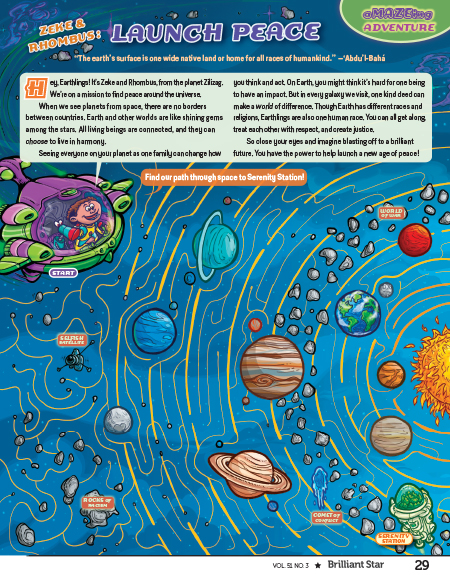
Help Zeke and Rhombus fly toward peace
> PURPOSE
This maze is introduced by our recurring space explorer characters, Zeke and Rhombus, from the Planet Zilizag. It describes how all people on Earth are part of one human family and can treat each other with respect.
Quote: “The earth’s surface is one wide native land or home for all races of humankind.” —‘Abdu’l-Bahá
> QUESTIONS FOR DISCUSSION
Pre-K/Kindergarten | Early Elementary
- If you met Zeke and Rhombus in person, what would you tell them about Earth?
- Zeke and Rhombus are from Planet Zilizag, where people live in peace. What would Earth be like if it was peaceful?
- What can you do to show kindness to other people?
- Describe a time when someone was kind to you. How did you feel?
Late Elementary | Junior Youth
- Zeke and Rhombus are from the fictional Planet Zilizag, where people live in peace. What would Earth be like if we achieved peace? How would people behave in everyday life?
- What are three steps you can take to show kindness and respect to other people?
- If you could give world leaders advice about how to create peace and justice, what would you say?
- What are some changes that could be made in the world to bring about racial justice?
> ACTIVITIES TO ENHANCE LEARNING
Pre-K/Kindergarten | Early Elementary
> Draw a picture of the Planet Zilizag, where people live in peace. Zilizag is an imaginary place. How would people act on a peaceful planet? What would be different?
> Create craft stick puppets of Zeke and an Earthling. (Use construction paper or card stock to create a simple head and body, and glue them to a craft stick.) Use the puppets to act out a story where Zeke meets someone on Earth and teaches them how to be kind and live in peace.
Resource:
https://www.firstpalette.com/craft/family-stick-puppets.html
Late Elementary | Junior Youth
> Find a story from the Internet or a newspaper that describes an incident of racial injustice. Write a skit that illustrates a new version of the story where people act with justice and respect. With friends, perform your skit for the class.
> Discuss quote for this page: “The earth’s surface is one wide native land or home for all races of humankind.” —‘Abdu’l-Bahá
What does it mean to you? Create a colorful mural or write a song that expresses the words and spirit of this quote.
> Research a story from Bahá’í history about a time when people were treated with injustice and share it with the class. What virtues were shown in the way that situation was handled? How might you apply those virtues in your own life?
Possible stories to discuss:
Bahá’u’lláh’s Life: Changing Enemies to Friends
https://brilliantstarmagazine.org/uploads/play/Luminous_Library_2014/Baha_Life_Enemies_Friends_MA14p3.pdf
Bahá’u’lláh’s Life: Champion of Oneness
https://brilliantstarmagazine.org/uploads/play/Luminous_Library_2016/Baha_Champion_MJ16_p4.pdf
Bahá’u’lláh’s Life: Tablet to the Sháh
https://brilliantstarmagazine.org/uploads/play/Luminous_Library_2019/V51_N1_P6_Bounty_Baha_Life_RS.pdf
Bahá’u’lláh’s Life: ‘Akká, the Prison-City
https://brilliantstarmagazine.org/uploads/play/Luminous_Library_2015/Baha_Life_Akka_SOND15_JF16_p6.pdf
BACK TO TOP
Updated on 5.08.21