
Parents and Teachers
Teaching Tools & Ruhi Classes
Teachers’ Guides & Resources
Teachers’ Guide: “Join Together,” Part 1

This guide is a tool to assist teachers of children’s classes and junior youth animators in using Brilliant Star’s “Join Together” issue in the classroom. While Brilliant Star is developed for kids aged 7-12, many younger and older kids enjoy learning from it. Activities can be adapted and expanded to engage groups ranging from ages 4-14. You’re invited to explore this guide and to share your own ideas in our Facebook group, Brilliant Star Idea Exchange.
These are some key themes in this issue; the discussion questions for each page can help to encourage dialogue:
-
Acknowledging the nobility of the soul and the commonalities among all members of the human family;
-
Understanding the meaning and impact of prejudice and racism, and using practical tools to overcome these negative forces;
-
The importance of putting prayer and study of holy writings into concrete action against prejudice and racism;
-
Building unity in our families, neighborhoods, and communities by getting out of our comfort zone and reaching out to others with kindness and friendship;
-
Emphasizing a sense of hope that creating a unified world is possible and inevitable;
-
Developing virtues of patience, perseverance, service, and initiative.
You can search, download, or print the full issue here.
We recommend Google Chrome for viewing and downloading PDFs.
For each page, you’ll find discussion questions and activities to enhance learning.
2 - Diverse Desserts
3 - Quiz: Are You a Change Maker?
4 - Life of the Báb: Shrine of the Báb
5 - Wall of Wonder
6-7 - Bahá’u’lláh’s Life: The Ridván Garden
8-9 - Nur’s Nook—Light of Truth: Make a Lighthouse
10 - Feast of Friendship
You Can Find Part 2 Here (pages 11-20)
You Can Find Part 3 Here (pages 21-29)
Age Groups:
- Pre-K/Kindergarten (4-5)
- Early Elementary (6-7)
- Late Elementary (8-10)
- Junior Youth (11-14)
PAGE 2: DIVERSE DESSERTS
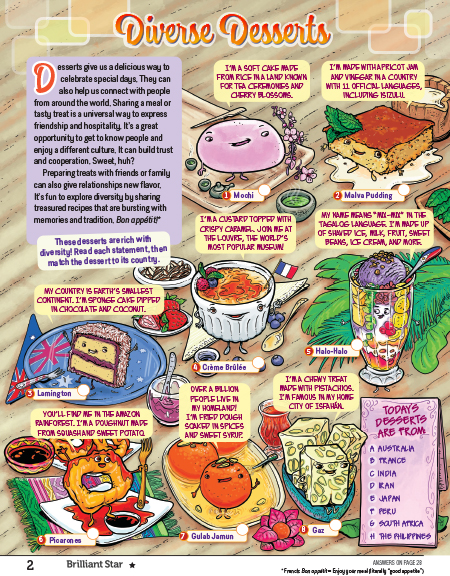
Match tasty treats to their homelands
> PURPOSE
This piece teaches readers about the unifying benefits of sharing and preparing tasty treats with people from other cultures. Readers also learn about delicious desserts from around the world.
> QUESTIONS FOR DISCUSSION
Pre-Kindergarten | Early Elementary
- What is your favorite food or your favorite dessert?
- Have you ever tried a food from another country? What was it? What did you think?
- What is your favorite food from another country?
- Have you tried any of the treats on this page? What were they like?
- How do you feel when you share a favorite treat with a friend?
Late Elementary | Junior Youth
- Why is food an important part of someone’s culture?
- Can you remember a time when you bonded with someone over a meal?
- Have you bonded with someone from another culture through food?
- Describe something cool you learned from someone of a different culture, religion, or background than yours.
- What are different ways we can help build unity in our communities?
> ACTIVITIES TO ENHANCE LEARNING
Pre-Kindergarten | Early Elementary
> Bring foods from around the world for kids to try. Ask them to guess which country each food is from. Have each kid share what they like about the food.
> Make a simple recipe with students and talk about how preparing and enjoying food together builds unity. Make sure everyone has a job to do. (NOTE: Check with parents for allergies/dietary restrictions.) Some sample recipes:
Guacamole:
https://brilliantstarmagazine.org/uploads/play/Luminous_Library_2010/Riley_SpiceLife_MJ10p21.pdf
Almond butter and apple wraps https://brilliantstarmagazine.org/uploads/play/Luminous_Library_2016/Riley_Eat_Locally_MJ16_p20.pdf
No-bake energy bites
https://brilliantstarmagazine.org/uploads/play/Treasure_Box_MJ2018_Celebrate_Our_Human_Family.pdf
Fruit pizza
https://brilliantstarmagazine.org/uploads/play/Luminous_Library_TAB/MJJ20_Community_Connections_FIN.pdf
Late Elementary | Junior Youth
> Bring foods from around the world for students to try. Ask them to guess which country each food is from. Divide students into groups and assign each group a country to research and share what they learn.
> Divide students into two groups and assign each a simple recipe to make (from another culture, if possible). Talk about where the ingredients originated and how they were shared around the world. Share the food together and ask students what they liked about the process and what they learned.
NOTE: Check with parents for allergies/dietary restrictions.
Cooking with Kids
https://www.pbs.org/food/theme/cooking-with-kids/page
Origin of Crops:
https://blog.ciat.cgiar.org/origin-of-crops/
BACK TO TOP
PAGE 3: QUIZ: ARE YOU A CHANGE MAKER?
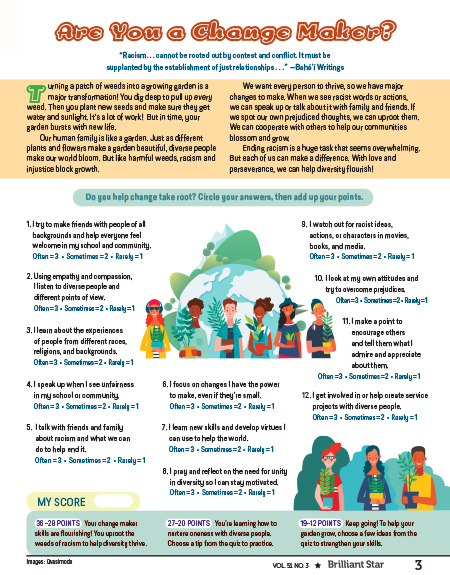
You can help uproot racism and prejudice
> PURPOSE
This page encourages kids to be proactive in making changes within themselves, in their families, and their communities. The quiz promotes self-reflection and offers concrete examples of actions kids can take to strengthen their change-making skills.
Quote: “Racism ... cannot be rooted out by contest and conflict. It must be supplanted by the establishment of just relationships ...”
—Bahá’í Writings
> QUESTIONS FOR DISCUSSION
Pre-K/Kindergarten | Early Elementary
- What are some thoughts and actions that help everyone feel loved and valued?
- What are some thoughts or actions that make people feel unwelcome?
- If you could do one thing to make the world a better place for everyone, what would it be?
- Can you share a time you helped make a change in your home?
- How do you like to help your family or community?
Late Elementary | Junior Youth
- What do you do when you notice a harmful thought or action creeping in? How do you stop it? What do you replace it with?
- Can you think of a time you saw positive words or actions change a situation and make it better? What impact did it have on everyone involved? What impact did it have on people watching?
- What is something in your community or school you would like to see change? What are some positive actions you can take to help?
- What are some spiritual qualities, virtues, or habits that help you make a change, either in yourself or in your community? What helps you strengthen those qualities?
> ACTIVITIES TO ENHANCE LEARNING
Pre-K/Kindergarten | Early Elementary
> Sit in a circle and read the quiz questions aloud. Students raise their hand if they’ve practiced that skill before. Invite one or two students to share examples. Try to make sure every kid has an opportunity to share a story.
> Invite kids to visualize themselves as a change maker. Ask them to choose two items from the quiz—one that they’ve already done, and one that they want to do. Then ask them to draw a picture of each to share with the class.
Late Elementary | Junior Youth
> Give kids time to take the quiz on their own, then reflect on the results. Were they surprised? Is there an action from the quiz they've taken? What’s one they’d like to try? Invite kids to share reflections. On a large sheet of paper, ask each student to write one action they’d like to take. Then hang the paper up so the class can see how a small step from each person can add up to a lot of change.
> Ask kids to choose two items from the quiz—one they’ve done, and one they want to do. Ask them to choose one of the two actions and draw a picture or write a story or a poem about it. Invite kids to share their work.
BACK TO TOP
PAGE 4: LIFE OF THE BÁB: SHRINE OF THE BÁB
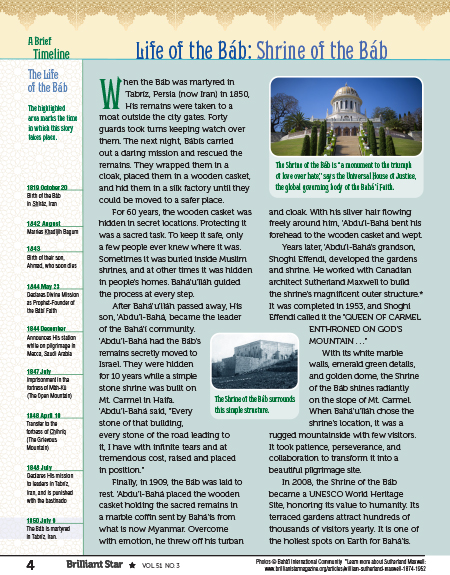
A majestic location honors His mission
> PURPOSE
To celebrate the 100th Anniversary of the Birth of the Báb in 2019, we’ve published a series of stories from His life. This final installment shares the story of the development of the Shrine of the Báb and how His sacred remains came to rest in Haifa, Israel.
> QUESTIONS FOR DISCUSSION
Pre-K/Kindergarten | Early Elementary
- Have you ever visited the Shrine of the Báb? What was it like? If you haven’t visited it, what do you think it would be like? (Talk about where it’s located, what the trip would be like, etc.)
- ‘Abdu’l-Bahá worked for years and years to build the Shrine of the Báb. What qualities did he show?
- What’s the biggest project you’ve ever worked on? How long did it take you to finish it? What helped you accomplish it? How did you feel when it was finally finished?
- If you planted a garden for the Báb, what flowers would you grow in it?
Late Elementary | Junior Youth
- ‘Abdu’l-Bahá worked for years and years to build the Shrine of the Báb. What qualities did he show?
- What is a project you worked on for a long time? What helped you accomplish it? How did you feel?
- Keeping the Báb’s remains safe and building the Shrine of the Báb was an enormous task that required the help of people from all over the world. What are some big tasks we face today? What can help us work together to accomplish them?
- People from all over the world helped design and build the Shrine of the Báb. What helps diverse people work together? What qualities help you work in groups?
- If you created a memorial for someone you love who passed away, what would you make? What qualities did that person have that you would want to put into their memorial?
> ACTIVITIES TO ENHANCE LEARNING
Pre-K/Kindergarten | Early Elementary
> Gate Craft
Help kids make gates with craft sticks to honor the Báb (which means “The Gate” in Arabic). They can use markers, stickers, and other supplies to decorate their gates.
https://brilliantstarmagazine.org/parents-teachers/family-community-life/community-celebrations-and-events/harmonious-holy-days-the-births-of-the-bab-and-bahaullah
Or, follow these instructions to make a gate and garden with paper, markers, and stamps. For younger kids, cut out the gate shape ahead of time.
https://brilliantstarmagazine.org/uploads/play/Luminous_Library_TAB/SO14_Honoring_the_Bab_-_Gate_FIN.pdf
> Prayer Card
Print a quote or prayer from the Báb on a piece of cardstock for each student. Ask them to use crayons, markers, sequins, etc., to create a border around the quote. Use the cards at a devotional gathering or give them to parents, friends, or neighbors. Brief prayers from the Báb to consider:
- Is there any Remover of difficulties save God? Say: Praised be God! He is God! All are His servants, and all abide by His bidding!
- Say: God sufficeth all things above all things, and nothing in the heavens or in the earth but God sufficeth. Verily, He is in Himself the Knower, the Sustainer, the Omnipotent.
- I adjure Thee by Thy might, O my God! Let no harm beset me in times of tests, and in moments of heedlessness guide my steps aright through Thine inspiration.
Source for additional prayers:
https://www.bahai.org/library/authoritative-texts/prayers/bahai-prayers/
> Music
Teach students to sing a song based on a prayer of the Báb. Videos and sheet music are available online:
https://www.bahaisongproject.com/say-god-sufficeth
https://www.bahaisongproject.com/is-there-any-remover-of-difficulties
Late Elementary | Junior Youth
> How to Draw Twin Roses Video
Share this video with the class and ask them to draw the Shrine of the Báb and twin roses, celebrating the lives and teachings of the Báb and Bahá’u’lláh.
https://brilliantstarmagazine.org/videos/how-to-draw-twin-roses
> Design a Shrine
Shoghi Effendi worked with Canadian Bahá’í and architect William Sutherland Maxwell (his wife’s father) to design the Shrine of the Báb. Imagine designing a holy place. What qualities (such as reverence, devotion, love) would you want it to express? What colors and shapes would you include? Ask kids to draw a shrine or Bahá’í temple with those shapes and colors.
BACK TO TOP
PAGE 5: WALL OF WONDER
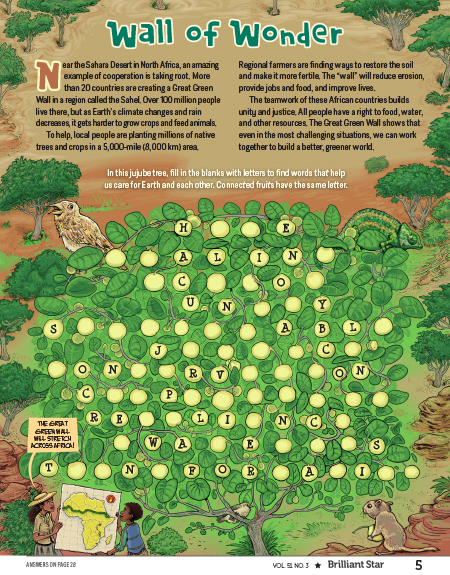
African nations are growing a greener future
> PURPOSE
This page illustrates people and countries cooperating on a huge project that will transform the land, their lives, and the future of Africa. The Great Green Wall is a wall that unites, not divides, and it gives hope to everyone in the world.
> QUESTIONS FOR DISCUSSION
Pre-K/Kindergarten | Early Elementary
- Where is Africa? [Display a map or globe.]
- Where is the Sahara Desert?
- How big is the Sahara Desert? (about the size of the U.S.)
- What is a desert?
- What does it mean to cooperate?
- What kind of wall is the Great Green Wall?
- Is this wall to keep people out? Or to keep the desert out?
Late Elementary | Junior Youth
- Find the location of the Great Green Wall on a map or globe. How many countries are cooperating to build this “wall”?
- How does planting trees stop the desert?
- Does learning about this project give you hope? For what? And Why?
- Have you ever planted anything? What was that like?
> ACTIVITIES TO ENHANCE LEARNING
Pre-K/Kindergarten | Early Elementary
> Show this very short video [1:30] about the Great Green Wall (from 2015), then discuss it.
https://www.youtube.com/watch?v=kmgrwW5fQ5E&ab_channel=GreatGreenWall
> Maya’s Mysteries: Make Grass Head Guys
https://brilliantstarmagazine.org/articles/mayas-mysteries-tiny-seeds
> Color a map of Africa
Map showing route of Great Green Wall:
https://ars.els-cdn.com/content/image/1-s2.0-S0048969720335221-ga1_lrg.jpg
Printable maps of Africa
https://coloringhome.com/coloring-page/148574?album=the-continent-of-africa-coloring-page
https://printable-maphq.com/wp-content/uploads/2019/07/category-map-167-sitedesignco-printable-map-of-africa-with-countries-labeled.png
Late Elementary | Junior Youth
> With students, watch this five-minute video about the Great Green Wall (from 2016). Discuss what you learn.
https://www.youtube.com/watch?v=pc3BTMVPIwc&ab_channel=GreatGreenWall
> Nur’s Nook: Make a HOUSE Planter
https://brilliantstarmagazine.org/uploads/play/Luminous_Library_2018/MA18_Nur_Planter_RS.pdf
> Maya’s Mysteries: Make Grass Head Guys
https://brilliantstarmagazine.org/articles/mayas-mysteries-tiny-seeds
> Play a cooperative game and talk about cooperation.
Games for Change
https://brilliantstarmagazine.org/uploads/play/Luminous_Library_2015/Games_for_Change_SOND15_JF16_p25.pdf
> Color a map of Africa. Indicate the location of the Green Wall:
ttps://ars.els-cdn.com/content/image/1-s2.0-S0048969720335221-ga1_lrg.jpg
Printable map with countries labeled:
https://printable-maphq.com/wp-content/uploads/2019/07/category-map-167-sitedesignco-printable-map-of-africa-with-countries-labeled.png
Blank map for writing in names of countries:
http://www.lschs.org/uploaded/faculty/donohoe/africa_blank.jpg
> Invite kids to color and discuss this Seeds of Hope poster:
https://brilliantstarmagazine.org/uploads/play/Luminous_Library_2017/JF17_Seeds_of_Hope.pdf
> Make seed paper and discuss the power of seeds to grow into amazing things.
https://climatekids.nasa.gov/seed-paper/
https://www.howlifeunfolds.com/sites/default/files/2019-11/SeedPaperDownloadable.pdf
> Snacks
Make seedling cupcakes
https://brilliantstarmagazine.org/uploads/play/Luminous_Library_TAB/MA20_Spirit_of_Spring.pdf
NOTE: Check with parents for allergies/dietary restrictions.
> Resources
Green Wall Info
https://www.greatgreenwall.org/about-great-green-wall
https://www.bbc.com/future/article/20190902-the-wall-holding-back-a-desert
https://www.nytimes.com/2007/02/11/world/africa/11niger.html
BACK TO TOP
PAGES 6-7: BAHÁ’U’LLÁH’S LIFE: THE RIDVÁN GARDEN
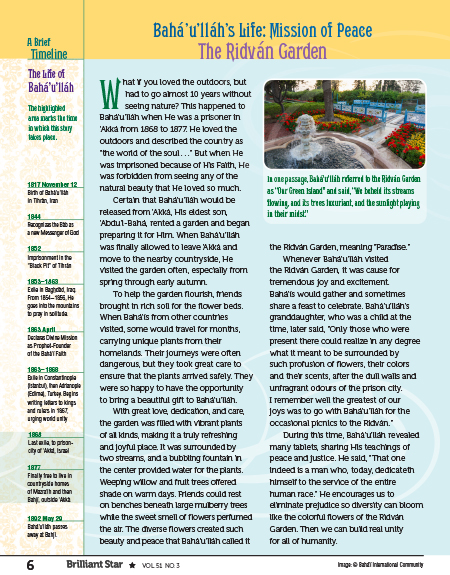
He loved visiting the Ridván garden near ‘Akká
> PURPOSE
This page shares the story of the development of the Garden of Ridván, which Bahá’u’lláh often visited after He was released from ‘Akká. It illustrates the love, care, and collaboration it took to bring diverse plants together to transform it into a garden paradise.
Quote: “O Friend! In the Garden of thy heart plant naught but the rose of love.” —Bahá’u’lláh
> QUESTIONS FOR DISCUSSION
Pre-K/Kindergarten | Early Elementary
- The Garden of Ridván was filled with peace and joy. What are some places that help you feel peaceful and joyful?
- Imagine if all flowers looked exactly the same. What would the world be like without different colors, shapes, or scents? What might happen to the insects, animals, and soil?
- How does having diverse plants help a garden? How does diversity help humanity?
- If you could bring a flower to Bahá’u’lláh, what kind would you want to bring?
Late Elementary | Junior Youth
- What qualities did it take to make the Garden of Ridván a joyful place?
- Just like friends brought plants from long distances to the Garden of Ridván, it takes great care to cultivate diversity in our communities. What qualities help us make sure people of diverse races and backgrounds are valued?
- How does having diverse plants help a garden? How does diversity help humanity?
- What new things have you learned from friends of different cultures?
- How does it impact your life when you have friends from different races, cultures, and backgrounds?
> ACTIVITIES TO ENHANCE LEARNING
Pre-K/Kindergarten | Early Elementary
> Paint Flower Pots
Give each kid a clay flower pot, and let them decorate it with permanent markers, stickers, etc. Add soil and either a seed or a flower that's ready to be repotted. Encourage the kids to care for their plants in class, then take them home to share with family.
> Nature Hunt (from page 7)
To simplify the activity, teachers can either create nature find sheets for each kid ahead of time, or the class can work together to make a single sheet. They can search for the items together on the hike, and celebrate as a class when they find them.
> Nature Frames (from page 7)
To adjust for younger grades, invite the kids to draw their shapes during one class, then have parents and teachers cut the shapes before the nature hike at your next class session.
> ABC’s of Nature (from page 7)
For young players, keep the categories simple and broad. If they’re young enough and still learning to read, don’t worry about words starting with specific letters. Just let the kids have fun naming objects or words that fit into different categories.
> Community Garden (from page 7)
This activity is accessibile for all ages, and diverse styles make the mural more interesting. In addition to using markers, younger kids might also enjoy adding stickers or sequins to their flowers.
Late Elementary | Junior Youth
> Nur’s Nook House Planter
The story shared how Bahá’ís from surrounding countries carried plants long distances to give to Bahá’u’lláh. Invite kids to make this homemade planter as a gift for someone they love.
https://brilliantstarmagazine.org/articles/nurs-nook-give-a-homemade-gift-make-a-house-planter
> Nature Hunt (from page 7)
Older students can turn this into a fun intergenerational activity. They can create the bingo cards, then invite younger kids to join them on a nature hike. They can work as partners or teams to find the items and celebrate.
> Nature Frames (from page 7)
Older students can save their favorite photos to share with the class, explaining what it is they like about the photo. If the technology is available, they can print photos to turn it into a photography show or create a slide show to share with the school.
> ABC’s of Nature (from page 7)
Older players might enjoy adding the challenge of memory. Each player repeats the items listed before, then adds their own item using the next letter of the alphabet. When they reach the end of the alphabet, see if anyone wants to try reciting the entire list.
> Community Garden (from page 7)
This activity is accessible for all ages, and diverse styles make the mural more interesting. Older participants can turn this into a mindfulness practice. By slowing their minds and thoughts, they can practice being present in the moment and tapping into creativity.
BACK TO TOP
PAGES 8-9: NUR’S NOOK—LIGHT OF TRUTH: MAKE A LIGHTHOUSE
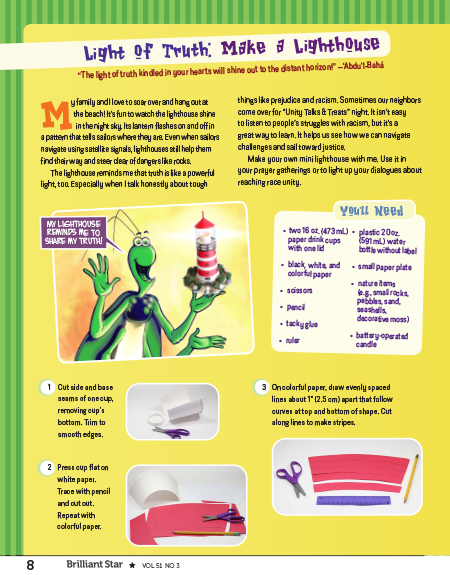
Make a mini lighthouse and let truth shine!
> PURPOSE
Readers learn how truthfulness is like a light (or lighthouse) that can help humanity navigate obstacles on our way toward racial justice. Kids are encouraged to engage in honest discourse about prejudice and racism with their family and friends to help them gain new understanding. They’re invited to make the step-by-step craft to create their own lighthouse decoration for race dialogues or prayer gatherings.
Quote: “The light of truth kindled in your hearts will shine out to the distant horizon!” —‘Abdu’l-Bahá
> QUESTIONS FOR DISCUSSION
Pre-K/Kindergarten | Early Elementary
- How do lighthouses help sailors?
- What are some challenges created from telling (or hearing) lies?
- Can we achieve unity when people lie? Why? (e.g., No, because when people lie, it’s harder to see, discover, or agree about the truth.)
- What would the world be like if we achieved race unity?
- What are some ways you can work toward race unity in your community?
Late Elementary | Junior Youth
- What are some ways telling (or hearing) the truth is like a light (or lighthouse)? (e.g., The truth can help us see clearly what’s happening. It’s easier to see obstacles we need to overcome with the light of truth.)
- What are some things you lose (or gain) when you tell (or hear) lies?
- Why do you think it is important to talk about racism and prejudice, even if it’s challenging? What virtues can help?
- How can knowing the truth help people achieve racial justice and unity?
- How can you be respectful when people share their experiences with racism and prejudice?
- What are some ways you can work toward racial justice and harmony?
> ACTIVITIES TO ENHANCE LEARNING
Pre-K/Kindergarten | Early Elementary
> Adapt lighthouse craft for younger kids
For Steps 3 and 4, make stripes around a white paper cup with red tape. Or glue red paper stripes around cup ahead of time for kids.
For Step 9, draw windows and doors with black marker. Add battery-operated candle on top and omit top lantern.
OR For Step 5, use a small plastic cup for lantern instead of cutting a plastic water bottle. (Optional: With help from an adult, cut lantern to desired size.)
Examples of simpler versions:
https://www.flickr.com/photos/46727412@N03/5432440046/
https://littleheartsbiglove.co.uk/crafting-with-kids-a-simple-lighthouse-craft/
> Prayer Circle for Race Unity
Dim the lights for prayer time and use lighthouses for decorations. Invite everyone to share prayers and/or an action they can take toward race unity.
> Truthfulness Songs: Listen, learn, or sing along with these two songs about truthfulness.
“Truthfulness” from Lesson 12, Ruhi Book 1 (lyrics on screen):
https://www.youtube.com/watch?v=kg81or1LPIk
“Truthfulness,” by Red Grammer
https://www.youtube.com/watch?v=H2MYUrPTHDc
Lyrics and recording for Red Grammer song:
https://redgrammer.com/index.php/truthfulness-song.html
> Storytime and Dialogue
Read this story to your class. Have an honest dialogue inspired by ‘Abdu’l-Bahá.
https://brilliantstarmagazine.org/uploads/play/Luminous_Library_2015/Abdul_Baha_Kindness_MJJA15.pdf
Ask the group questions such as:
- Why do you think kids called ‘Abdu’l-Bahá names and tossed sticks at him?
- How did Carrie Kinney help when the kids were being unfair to ‘Abdu’l-Bahá?
- How do you think it feels to be treated unfairly just because you’re different?
- How did ‘Abdu’l-Bahá treat the only Black boy in the group of white boys?
- What are some ways people experience racism or prejudice today?
- What can you do to work toward race unity and fairness in your community?
Late Elementary | Junior Youth
> Devotions and Race Dialogue
Dim the lights for prayers and use lighthouses for decorations. Invite everyone to share prayers and/or an action they can take toward racial justice. [See options below for ideas for sparking dialogues.]
> Quiz: How Open-Minded Are You?
https://brilliantstarmagazine.org/articles/quiz-how-open-minded-are-you
Read the article together, then ask kids to answer the questions about overcoming prejudices. Have an honest dialogue about one or more of the questions. You could ask if anyone has an experience they’d like to share that’s related to one of these questions. For example:
- How have you enjoyed learning about diverse people, countries, and cultures?
- How have you or someone you know spoken up when you heard an insult or joke about people of a certain race?
- When have you traveled, seen new places, and met new people who are different from you?
> Quests for Antiracism (for junior youth and up)
Use the free digital app at www.CharmsGame.com to play Charms: A Game of Insight. Use sample questions from Quests for Antiracism (or come up with your own questions) to help spark dialogues and ideas for positive actions.
How to play and sample questions
https://studio9games.s3-us-west-1.amazonaws.com/Charms_AntiRacism_Sample_Prepublication.pdf
> Two Truths and a Wish
Invite each person to share three things about themselves—two are true and one is a wish. The others try to guess which “facts” are true, and which is the wish.
After playing, have a discussion based on these questions like these:
- Was it easy (or hard) to figure out which statements were true?
- How can lies lead to misunderstandings such as prejudices or stereotypes about people or cultures?
- What helps you discover the truth?
Description and tips for game: https://www.lowell.k12.ma.us/site/handlers/filedownload.ashx?moduleinstanceid=7269&dataid=9811&FileName=Two%20Truths%20and%20a%20Wish%20Game.pdf
> Quiz about the human species
Read the article together, then have kids take the quiz. Discuss why it’s important to know the truth about the history of race and race relations.
https://brilliantstarmagazine.org/uploads/play/Luminous_Library_2017/MA17p20_Maya_Race_Quiz.pdf
Quiz Answers: 1) True, 2) True, 3) True, 4) True, 5) True, 6) False: “Race” appeared in English in the 1500s. 7) True, 8) True, 9) True, 10) True, 11) False: Africa has the greatest human variation. 12) False: Education and empathy can help people overcome racism.
BACK TO TOP
PAGE 10: FEAST OF FRIENDSHIP
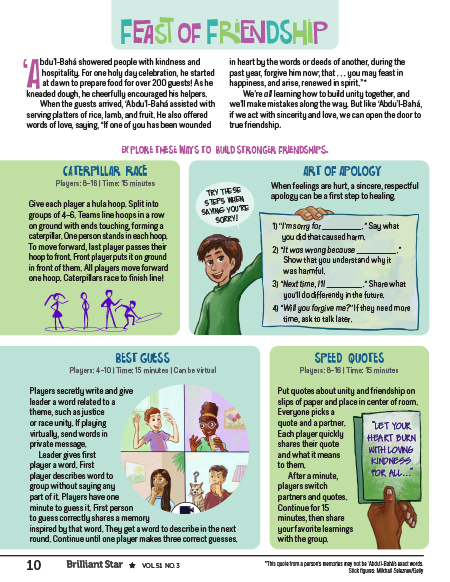
Activities to build unity and understanding
> PURPOSE
This page explores the concept of loving friendship and hospitality by sharing a story about ‘Abdu’l-Bahá. It offers readers ideas for strengthening friendships.
Quote: “Associate in perfect love and accord and consider humankind as one family ...”—‘Abdu’l-Bahá
> QUESTIONS FOR DISCUSSION
Pre-K/Kindergarten | Early Elementary
- Have you ever helped host a party or celebration? What did you do to help guests feel welcome?
- What makes you feel welcome when you visit a friend’s house?
- Think of a holiday or holy day celebration you enjoyed. What made it so special?
- What’s your favorite way to make your friends feel at home when they visit?
- What games do you like to play with friends? What virtues do you use while playing? (e.g., cooperation, fairness, honesty, etc.)
Late Elementary | Junior Youth
- Think of a holiday or holy day celebration that you enjoyed. What made it special? What spiritual qualities were demonstrated?
- What helps you feel welcome when you visit someone’s home?
- What actions and qualities help strengthen friendships?
- What activities do you do with your friends to get to know them better?
- Think of a time you played games with your friends. What did you learn about them? Did you discover stories or qualities that you admire or that surprised you?
> ACTIVITIES TO ENHANCE LEARNING
Pre-K/Kindergarten | Early Elementary
> Art of Apology
For younger kids, review the apology steps from the article, then practice together as a group. Describe a situation where one friend might apologize to another, then guide the class as they share their suggestions for apologizing. Some scenarios you could review:
- You tried to pass a soccer ball to your friend, but it hit them in the arm instead. It was an accident, but they still ended up hurt. How do you apologize?
- You were chasing your brother through the house, and didn’t look where you were going. You knocked a glass off the table and it broke. How do you apologize?
> Caterpillar Race
Turn this into a cooperative game by asking teams to race themselves. Try the caterpillar race for the first round, timing each group. Write down each group’s time. Ask them to reflect on what went well and how they might make it go faster.
Try out their ideas in round two, and time them again. Ask teams to share their tips and suggestions between groups before racing the third time.
> Best Guess
Simplify this game by choosing a concrete theme, such as “animals” or “fruits and veggies,” and coming up with related words ahead of time. If needed, give kids prompts to help them think of how to describe their word, such as color, shape, size, etc. If the children are very young, the leader can describe the words while the class works together to guess.
> Speed Quotes
Give younger kids a quote to draw or decorate. Instead of sharing their quote with partners, invite students to show their decorated quote to the class and share what it means to them.
Late Elementary | Junior Youth
> Art of Apology
Divide group into pairs. Ask them to create an imaginary scenario in which one friend apologizes to another. Encourage them to be specific. Where are they? What are they doing? What goes wrong? How does each feel?
Ask pairs to role play, using the “Art of Apology” tips. When all groups have practiced their apologies, invite them to share their role play scenario with the large group.
> Caterpillar Race
For older groups, try adding more rules to increase the challenge. Do a round with everyone standing on one foot. Or create an obstacle course for each team to navigate as they inch their way to the finish line.
> Best Guess
After playing a round with the original rules, try a variation. Choose a new theme and invite players to submit new related words. Then ask them to draw their word on their turn or silently act it out. They could also play “20 Questions,” where the group asks 20 “yes” or “no” questions to try to discover the secret word.
> Speed Quotes
Add another step to the game for older groups. After 15 minutes are up, gather in your large group. Ask one person to share their name and something they learned in the game. Then ask each person in the group to share something they learned about their partner in their quick exchanges.
BACK TO TOP
Updated on 5.13.21