
Parents and Teachers
Teaching Tools & Ruhi Classes
Teachers’ Guides & Resources
Teachers’ Guide: “Join Together,” Part 2

This guide is a tool to assist teachers of children’s classes and junior youth animators in using Brilliant Star’s “Join Together” issue in the classroom. While Brilliant Star is developed for kids aged 7-12, many younger and older kids enjoy learning from it. Activities can be adapted and expanded to engage groups ranging from ages 4-14. You’re invited to explore this guide and to share your own ideas in our Facebook group, Brilliant Star Idea Exchange.
These are some key themes in this issue; the discussion questions for each page can help to encourage dialogue:
- Acknowledging the nobility of the soul and the commonalities among all members of the human family;
- Understanding the meaning and impact of prejudice and racism, and using practical tools to overcome these negative forces;
- The importance of putting prayer and study of holy writings into concrete action against prejudice and racism;
- Building unity in our families, neighborhoods, and communities by getting out of our comfort zone and reaching out to others with kindness and friendship;
- Emphasizing a sense of hope that creating a unified world is possible and inevitable;
- Developing virtues of patience, perseverance, service, and initiative.
You can search, download, or print the full issue here.
We recommend Google Chrome for viewing and downloading PDFs.
For each page, you’ll find discussion questions and activities to enhance learning.
11 - We Are One
12 - Maya’s Mysteries: Nature’s Virtues
13 - Connected Creatures
14-15 - Lightning and Luna, Episode 88: Phantom Island
16-18 - Radiant Stars
19 - A Remarkable Marriage
20 - Reach Out with Respect
You Can Find Part 1 Here (pages 2-10)
You Can Find Part 3 Here (pages 21-29)
Age Groups:
- Pre-K/Kindergarten (4-5)
- Early Elementary (6-7)
- Late Elementary (8-10)
- Junior Youth (11-14)
PAGE 11: WE ARE ONE
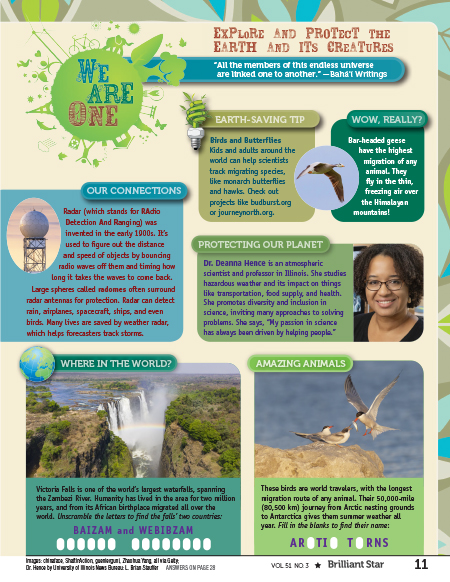
Explore and care for the place we all call home
> PURPOSE
We Are One inspires us to explore and protect the Earth and its creatures by learning more about the environment and our connections with it and each other.
Quote: “All the members of this endless universe are linked one to another.” —Bahá’í Writings
> QUESTIONS FOR DISCUSSION
Pre-K/Kindergarten | Early Elementary
- Do you ever go out in nature? Where?
- How do you feel when you’re out in nature?
- Why do we need to protect nature?
- How do you help the environment at school or at home?
Late Elementary | Junior Youth
- What is a question about the natural world you’d like to know the answer to?
- What is migration?
- Do people migrate, as well as animals? Why?
- The Bahá’í writings use nature and natural things as metaphors or examples for us. Can you think of some prayers or writings that mention nature?
> ACTIVITIES TO ENHANCE LEARNING
Pre-K/Kindergarten | Early Elementary
> Exploring a World of Wonder - Activities
Go on an Alphabet Hike or Rainbow Expedition as in “World of Wonder” below. For younger students, skip the writing part.
https://brilliantstarmagazine.org/uploads/play/Luminous_Library_2011/Exploring_a_World_of_Wonder_JA11p4.pdf
> Quiz: Are You Curious?
Use the quiz questions to help the kids brainstorm ways to exercise their curiosity. https://brilliantstarmagazine.org/uploads/play/Luminous_Library_2012/JA12_Quiz_Are_You_Curious.pdf
> Curiosity Poster
Ask students to create a curiosity poster. Invite them to write and draw about three subjects that stimulate their curiosity. Students can decorate their poster with tools, locations, ideas, heroes, and virtues related to each subject. Ask volunteers to share their posters.
> Song: “Hooray for the World,” by Red Grammer
https://www.youtube.com/watch?v=d-Frw3HXeSo
Lyrics:
https://redgrammer.com/index.php/lyrics?id=117
Late Elementary | Junior Youth
> Take a walk and make a nature journal, using this page or a custom-made page for your location. On this walk, you can recall how the Bahá’í writings use nature as metaphors or lessons about spiritual truths. See if you can discover any of these on your walk. For example, if you see bees or ants, you can observe how they’re working together with cooperation. Or if there are multiple colors of birds or bugs, you can point out their unity in diversity.
_____________’s Nature Journal:
https://brilliantstarmagazine.org/uploads/play/Luminous_Library_2013/MA13_Nature_Journal.pdf
> Weather Radar
Go to https://www.accuweather.com/en/us/national/weather-radar
Zoom in on your area. Use the key of colored dots below the map to see your weather. Move around the map to see where it’s raining or snowing.
How does knowing the weather in advance help us?
> Science Style Quiz
Have the students take this quiz to find their science style. Ask them to brainstorm with each other about what kinds of science they would like to study and why.
https://brilliantstarmagazine.org/uploads/play/Luminous_Library_2011/Quiz_What_Shade_Green_JA11p17.pdf
> Curiosity Poster
Ask students to create a curiosity poster by writing and drawing about three subjects that stimulate their curiosity. For each subject, ask them to research online and find three fascinating facts to add to their poster. If Internet research isn’t practical, students can decorate their poster with tools, locations, ideas, heroes, and virtues related to each subject. Ask volunteers to share their posters.
> Song: The Sun Will Shine Again
https://brilliantstarmagazine.org/videos/sun-will-shine-again
https://brilliantstarmagazine.org/uploads/characters/pdf-character/Music_SunAgain_MA14p20_com.pdf
> Snacks
No-Bake Bird Nest treat
https://andianne.com/no-bake-birds-nest-cookies/
NOTE: Check with parents for allergies/dietary restrictions.
> Resources
Additional STEAM Ideas: Maya’s Art of Science
https://brilliantstarmagazine.org/uploads/play/Luminous_Library_2017/ND17p24_Maya_STEAM.pdf
Fun nature activities
https://climatekids.nasa.gov/pdfs/
BACK TO TOP
PAGE 12: MAYA’S MYSTERIES

What virtues can you find in nature?
> PURPOSE
This page introduces the concept that observing nature and reflecting on it can teach us about virtues. It invites kids to go outdoors and find items that reflect virtues, then write about them in a bingo grid.
Quote: “Every created thing is a sign of the revelation of God.” — Bahá’u’lláh
> QUESTIONS FOR DISCUSSION
Pre-K/Kindergarten | Early Elementary
- ‘Abdu’l-Bahá said people are like different-colored flowers in a garden. What do you think that means?
- What is your favorite place to go in nature? Why do you like it?
- How do you feel when you’re out in nature or in a beautiful garden? Describe a time you felt the same way when you were with a friend or family member.
- What can you do to help your friends and family feel happy and loved?
- What are some things in nature that make you curious, so you want to learn more about them?
- What are some things in nature that make you feel joyful and happy?
Late Elementary | Junior Youth
- ‘Abdu’l-Bahá said our human family is like different flowers in a garden. What do you think that means?
- What are some things about other cultures or countries that you find really interesting or cool?
- What is a natural wonder or place you’d love to see, and why does it interest you?
- There are lots of created things we may not see on a nature walk in our area (possible examples: stars, ocean, mountain, planet, waterfall, giant redwood tree, giraffe, whale). What are some virtues that those things bring to mind?
- What are some mysteries about Earth or the universe that you’d like to know more about?
- Choose a virtue from the bingo game. What can you do to express that virtue? (Examples: curious, friendly, joy, peace, listening, love, cooperate)
- What is your favorite place to go in nature? Why do you like it? How does it make you feel?
> ACTIVITIES TO ENHANCE LEARNING
Pre-K/Kindergarten | Early Elementary
> Discuss the meaning of virtues included in the bingo game. Invite students to share an example of a time they felt that way or used that virtue. Some definitions:
- Awe – Wonder, amazement
- Bold – Daring, courageous, confident
- Cooperate – Working together with someone, sharing
- Creative – Using imagination, doing something new
- Curious – Wondering about things, questioning
- Determined – Focusing your energy on something, sticking with it until it’s done
- Enthusiasm – Being excited and eager
- Flexible – Being open to change, thinking about other people’s feelings and ideas
- Friendly – Being interested in people and a good friend
- Gentle – Touching softly and carefully
- Growth – Getting bigger and taller, developing, learning
- Hope – Expecting good things to happen
- Humor – Enjoying a laugh when something is funny
- Joy – Being happy and content
- Listening – Paying attention with respect when others speak
- Love – Showing kindness and care, being concerned for others
- Modesty – Being humble, having self-respect
- Organized – Being neat, keeping things in order
- Peace – Being calm inside
- Reverence – Having wonder and faith, being aware of the sacred
- Serenity – Feeling calm, peaceful, steady
- Strength – Being sure of your power to work and try things
- Unity – Working together peacefully, valuing others
> Resources
The Virtues Project
https://virtuesproject.com/virtuesdef.html#
Merriam-Webster online dictionary
https://www.merriam-webster.com/
> Ask students to draw a picture of something that amazes them from anywhere on Earth or in the universe (possible examples: stars, ocean, mountain, planet, waterfall, giant redwood tree, giraffe, whale). Then ask, "What virtues would we find there?" Students can share their drawings and explain why they chose those virtues.
Late Elementary | Junior Youth
> Discuss the meaning of the virtues included in the bingo game. Invite students to share an example of a time they felt that way or used that virtue. Some definitions:
- Awe – Wonder, amazement
- Bold – Daring, courageous, confident
- Cooperate – Working together with someone, sharing
- Creative – Using imagination, doing something new
- Curious – Wondering about things, questioning
- Determined – Focusing your energy on something, sticking with it until it’s done
- Enthusiasm – Being excited and eager
- Flexible – Being open to change, thinking about other people’s feelings and ideas
- Friendly – Being interested in people and a good friend
- Gentle – Touching softly and carefully
- Growth – Getting bigger and taller, developing, learning
- Hope – Expecting good things to happen
- Humor – Enjoying a laugh when something is funny
- Joy – Being happy and content
- Listening – Paying attention with respect when others speak
- Love – Showing kindness and care, being concerned for others
- Modesty – Being humble, having self-respect
- Organized – Being neat, keeping things in order
- Peace – Being calm inside
- Reverence – Having wonder and faith, being aware of the sacred
- Serenity – Feeling calm, peaceful, steady
- Strength – Being sure of your power to work and try things
- Unity – Working together peacefully, valuing others
> Resources
The Virtues Project
https://virtuesproject.com/virtuesdef.html#
Merriam-Webster online dictionary
https://www.merriam-webster.com/
> Choose a virtue from the bingo game to explore through art. Ask students to draw a picture, create a collage, write a poem or song, or create a sculpture. They can share their work with the class and talk about why they chose that virtue and how they expressed it through art.
BACK TO TOP
PAGE 13: CONNECTED CREATURES
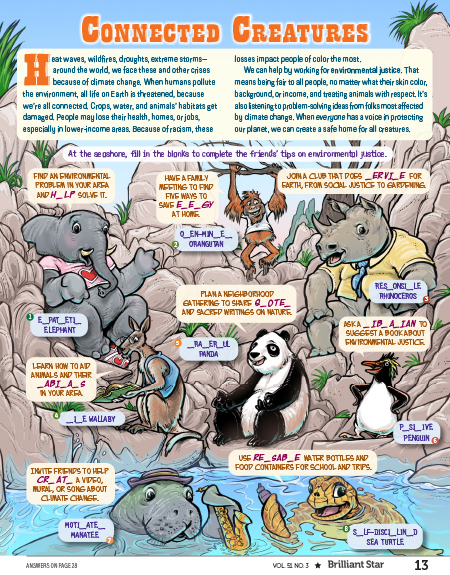
How does justice relate to climate change?
> PURPOSE
This page prompts readers to think about the effects of climate change on people and animals and how those effects disproportionately impact people of color. It also introduces them to the concept of environmental justice. The fill-in-the-blanks activity highlights virtues needed for consultation and the pursuit of social justice. It also offers actionable tips for kids who want to work against climate change.
> QUESTIONS FOR DISCUSSION
Pre-K/Kindergarten | Early Elementary
- What is climate? What is climate change? Resource: https://climatekids.nasa.gov/climate-change-meaning/
- Has your family ever experienced a crisis caused by climate change (heat wave, wildfire, drought, or extreme storm)? How did you deal with it, and how did it affect your life?
- Each animal gives a tip for helping to create environmental justice. Do you and your family do any of these things? Which tip would you like to try?
- Each animal on this page has a virtue that is needed for consulting and problem-solving. Talk about the meaning of each virtue. Ask kids which virtue they would most like to develop and why.
Late Elementary | Junior Youth
- Has your family ever experienced a crisis caused by climate change (heat wave, wildfire, drought, or extreme storm)? How did you deal with it, and how did it affect your life?
- If none of the kids have experienced one of these crises, ask them to discuss examples they may know about, like Hurricane Katrina or Sandy, the California wildfires, etc. Ask why they think people of color tend to be most strongly affected by the losses from these incidents.
- Each animal gives a tip for helping to create environmental justice. Do you and your family do any of these things? Which tip(s) would you like to try?
- What other ways can you think of to help promote environmental justice?
- Are there examples of environmental injustice in your area? Discuss what they are (e.g., toxic waste sites, lead pipes, houses or apartments with lead paint, vermin) and who is affected by them. What could you do to help achieve environmental justice?
> ACTIVITIES TO ENHANCE LEARNING
Pre-K/Kindergarten | Early Elementary
> Ask kids to draw themselves helping to preserve animal habitats (e.g., building a bird feeder, picking up trash from a park or a beach, etc.)
> As a class, write a poem or story about protecting the environment.
> Working in pairs or small groups (if meeting in person) or with a parent (if meeting online), invite kids to make simple bird feeders from empty milk cartons. Talk about the birds and other wildlife in your area. Bird feeder instructions:
https://brilliantstarmagazine.org/uploads/play/Luminous_Library_2013/MA13_Nur_Feathered_Friends.pdf
Late Elementary | Junior Youth
> If the group discussed examples of environmental injustice in their area and how they might be able to help, ask them to make a plan for actions they will take.
> Ask each student to create a poster highlighting ways to protect the environment or combat climate change. Suggest that they ask to display it at their school, community center, or Bahá’í center.
> As a class, in small groups, or individually ask students to write a poem, song, or story about protecting the environment.
> Divide class into groups of 3-4 students and ask each one to write and perform a skit about protecting the environment or working for environmental justice.
BACK TO TOP
PAGES 14-15: LIGHTNING AND LUNA, EPISODE 88: PHANTOM ISLAND
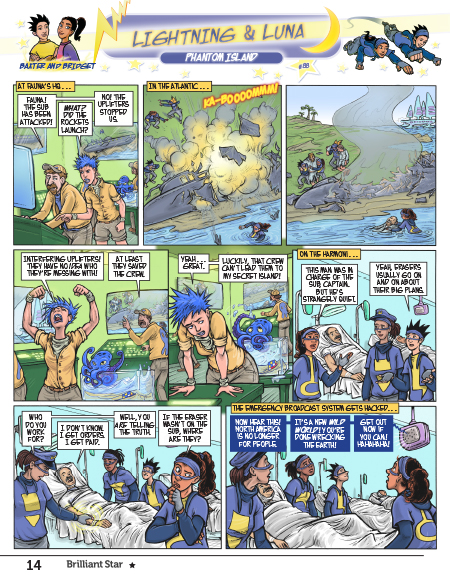
Can the Uplifters find the secret HQ in time?
> PURPOSE
Brother and sister Lightning and Luna are part of a league of young superheroes called Uplifters who use their virtues and powers to save the world. When Lightning and Luna aren’t on a mission, they keep their superhero identity a secret and try to cope with middle school.
> QUESTIONS FOR DISCUSSION
Pre-K/Kindergarten | Early Elementary
- What is a hero?
- What is a superhero?
- Can anyone be a hero?
- What are some things you do that are heroic?
Late Elementary | Junior Youth
- Do you know anyone who is a hero?
- What makes those people heroic?
- What are some stories, movies, or TV shows that inspire you to be strong or heroic?
- What are some superhero qualities or virtues that help you with challenges? (e.g., courage, confidence, love, strength, trustworthiness)
- What are some heroic qualities or virtues that you try to use?
- How does it feel when you’re using your powers or virtues to do something good or helpful?
- Do you have to be perfect to do good in the world?
- Do you think the Erasers think of themselves as bad guys? Why or why not?
> ACTIVITIES TO ENHANCE LEARNING
Pre-K/Kindergarten | Early Elementary
> Sing the song “There’s a Hero in You,” by Ellis Paul. Ask kids to describe simple ways they can be heroic in their everyday lives.
Music and lyrics: https://brilliantstarmagazine.org/uploads/characters/pdf-character/Music_HeroYou_SO13p20_com.pdf
Video:
https://brilliantstarmagazine.org/videos/the-hero-in-you
> Sing “Everyday Hero,” by Rachel Coleman
https://www.youtube.com/watch?v=c-5B_s-rzas&ab_channel=RachelColeman-Topic
> Using the “_______’s Super Journal” activity, read the introduction, then read one of the questions aloud. Invite students to share their answers. After a few students have answered, read another question. Afterward, encourage students to draw themselves as an Uplifter or another type of hero.
_______’s Super Journal
https://brilliantstarmagazine.org/uploads/play/Luminous_Library_2019/V51N2p13_Super_Journal.pdf
Late Elementary | Junior Youth
> Quiz: Are You a Team Player?
Lightning and Luna are Baxter and Bridget Blaze in real life. They’re a sister and brother team, and they take on superhero missions together. Ask students what they think it would be like to be part of a superhero team.
Read the introduction to this quiz. Then ask students to pair up and ask each other the questions. Everyone keeps track of their own answers. Invite volunteers to discuss their results and what they learned.
https://brilliantstarmagazine.org/uploads/play/Luminous_Library_2013/Quiz_Team_Player_edited_SO13p9.pdf
> Sing the song “There’s a Hero in You,” by Ellis Paul. Ask each student to describe simple ways they can be heroic in their everyday lives.
Music and lyrics:
https://brilliantstarmagazine.org/uploads/characters/pdf-character/Music_HeroYou_SO13p20_com.pdf
Video:
https://brilliantstarmagazine.org/videos/the-hero-in-you
> Make this “Book of Adventure” with students, except that instead of a Book of Adventures, they’ll create a Hero’s Journal.
https://brilliantstarmagazine.org/uploads/play/Luminous_Library_2016/Nur_Book_of_Adventures_JA16.pdf
Give each student a copy of the “________’s Super Journal” activity to start their Hero’s Journal. They can cut out each box and put it on a separate page of their journal. Then they can add more ideas, drawings, and virtues related to being a hero in everyday life.
_______’s Super Journal
https://brilliantstarmagazine.org/uploads/play/Luminous_Library_2019/V51N2p13_Super_Journal.pdf
Junior Youth
> Build an obstacle course for younger kids
Ask junior youth to invent and prepare an obstacle course for younger kids. The goal of the course is for all kids to finish, so there may be obstacles that take cooperation. Send players through the course in pairs or groups to allow them to help each other with their “hero skills.” Parts of the obstacle course could be puzzles/challenges, like saying something positive about your partner. Decorate the area with heroic signs. Jump ropes, pool noodles, hula hoops, cones, small blocks or step stools, chairs, small buckets of balls, and colored tape are great supplies to have on hand.
Obstacle course examples:
https://www.beafunmum.com/2017/01/backyard-obstacle-course-ideas/
https://inspired-motherhood.com/obstacle-course-for-kids/
> Snacks
Prepare dishes of healthy snacks and label each one with a sign about a superpower that food enhances (such as invisibility, super strength, or flying power). Example:
https://theclassroomcreative.com/wp-content/uploads/2012/07/foodbowls.jpg
NOTE: Check with parents for allergies/dietary restrictions.
BACK TO TOP
PAGES 16-18: RADIANT STARS
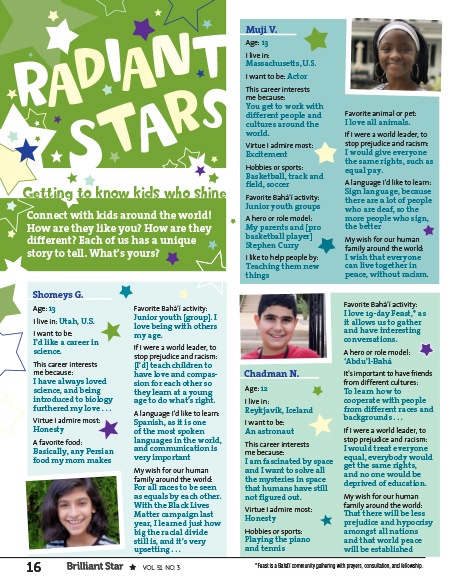
Get to know kids who shine, like you
> PURPOSE
The “Radiant Stars” feature facilitates a feeling of community among Brilliant Star’s readers (from around the U.S. and the world). In their responses to our reader surveys, kids who are the only Bahá’í in their school or one of just a few Bahá’ís in their area say that “Radiant Stars” reminds them they’re not alone, and there are kids like them around the globe.
Quote: “God has crowned you with honor and in your hearts has He set a radiant star; verily the light thereof shall brighten the whole world!” — ‘Abdu’l-Bahá
> QUESTIONS FOR DISCUSSION
Pre-K/Kindergarten | Early Elementary
- What are some virtues you admire (such as kindness or patience)?
- What are your favorite things to do with your Bahá’í community or other faith group?
- Why is it important to have friends from different races, cultures, and backgrounds?
- If you were a world leader, what would you do to end prejudice and racism?
- What is your wish for our human family around the world?
Late Elementary | Junior Youth
- Why is it important to have friends from different races, cultures, and backgrounds?
- If you were a world leader, what would you do to end prejudice and racism?
- What’s something cool you’ve learned from someone of a different culture?
- What is a culture or country you’d like to visit or learn more about, and why?
- If you were going to learn a new language, what would it be, and why?
- What is your wish for our human family around the world?
> ACTIVITIES TO ENHANCE LEARNING
Pre-K/Kindergarten | Early Elementary
> Ask kids to draw a picture that shows their answer to a question from the Discussion Questions list.
> Provide scissors, glue, markers, a piece of construction paper or poster board, and a variety of magazines. Invite kids to make a collage that illustrates unity in diversity.
> Read a story in which characters explore their cultural background or share it with another person. Invite students to talk about the different races and cultures of the characters and what they all have in common.
Late Elementary | Junior Youth
> Divide the group into pairs and ask each person to interview their partner, asking them the discussion questions above and these standard “Radiant Star” questions:
- Name:
- Age:
- I live in (state, country):
- I want to be (future career):
- This career interests me because:
- The virtue I admire most in people:
- Hobbies or sports:
- Favorite Bahá’í activities:
- Favorite animal or pet:
- Places I’d love to visit:
- I like to help people by:
- A favorite book or song:
- A favorite food:
- A hero or role model:
After the interviews, ask each person to introduce their partner to the class and share some of their answers.
> Invite each student to create a poster that illustrates their answer(s) to any of the discussion questions above. (If the class is virtual, the “poster” could be on 8 ½" x 11" paper.) Depending on the materials available to students, posters can include words, drawings, symbols, designs, photos, images cut from magazines, etc. Ask each student to share their poster with the class and talk about its various elements and what they represent. Then hang the posters in the classroom.
> Invite students to write a poem, song, or rap about appreciating diverse cultures, ending prejudice and racism, or their wish(es) for our global human family.
BACK TO TOP
PAGE 19: A REMARKABLE MARRIAGE
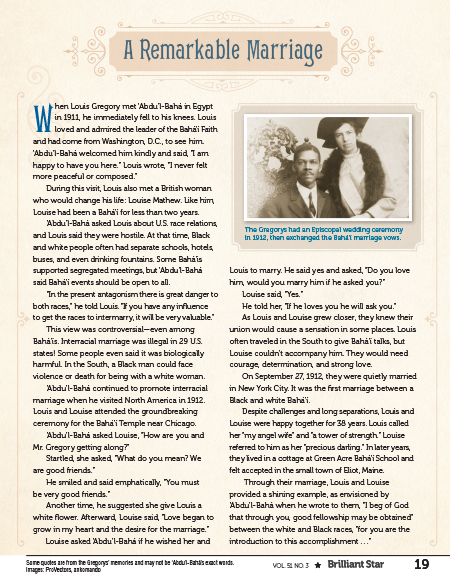
The first union of a Black and white Bahá’í
> PURPOSE
This page describes how ‘Abdu’l-Bahá promoted the controversial topic of interracial marriage in 1912, when it was illegal in 29 U.S. states. It tells the story of how he encouraged Louis and Louise Gregory to become the first Black and white Bahá’ís to marry.
Quote: “In the present antagonism there is great danger to both races... If you have any influence to get the races to intermarry, it will be very valuable.”
> QUESTIONS FOR DISCUSSION
Pre-K/Kindergarten | Early Elementary
- Did you know that it used to be against the law in some places for people of different races to get married?
- ‘Abdu’l-Bahá encouraged Louis and Louise Gregory to marry, even though it was unusual for white and Black people to get married at that time. What are some virtues that may have helped Louis and Louise?
- ‘Abdu’l-Bahá told Louis that interracial marriage would help build race unity. How do you think it might help people of different races get along?
- Are there different cultures or races in your family? How does that impact your family? (For example, do these cultures influence language, foods, travel, celebrations, etc.?)
Late Elementary | Junior Youth
- What are some ways that interracial marriage brings about unity and harmony between cultures in a family?
- What are some challenges that people might face in an interracial marriage? What would help them to handle those challenges?
- The Gregorys stood up to prejudice with courage and determination. Have you ever spoken out against racial prejudice? What did you say? (Or if you haven’t, discuss a situation you’ve seen in the media; what would you say if you were involved?)
- ‘Abdu’l-Bahá encouraged interracial marriage, and the Gregorys’ marriage provided an example of his guidance. What impact do you think that had on other Bahá’ís?
> ACTIVITIES TO ENHANCE LEARNING
Pre-K/Kindergarten | Early Elementary
> Discuss how race is a social idea, not a biological fact. Scientists say we’re all part of one human family.
Possible resources:
Maya’s Mysteries: Does Race Exist?
https://brilliantstarmagazine.org/uploads/play/Luminous_Library_2017/MA17p20_Maya_Race_Quiz.pdf
Hoshi’s Adventures: The Human Race
https://brilliantstarmagazine.org/uploads/play/Luminous_Library_2013/Hoshi_Adventures_MJ13_p27.pdf
> Talk about how melanin gives people different skin colors. Our skin colors are determined by how close our ancestors lived to the Equator. Do one of these activities to learn more about color and melanin.
Maya’s Mysteries: Colors of Humanity
https://brilliantstarmagazine.org/uploads/play/Luminous_Library_2013/Maya_Rainbow_Bubbles_MJ13_p6.pdf
Sheep Smarts: Picture Find
https://brilliantstarmagazine.org/uploads/play/Luminous_Library_2017/Sheep_Smarts_MA17_p7.pdf
Late Elementary | Junior Youth
> Ask students to learn about the story of the “Loving v. Virginia” Supreme Court case that made laws against interracial marriage illegal in 1967. Does anything surprise them in the story? What were some of the spiritual principles involved? What virtues did people show or need to show?
Possible resources:
https://www.history.com/topics/civil-rights-movement/loving-v-virginia
https://www.pbs.org/newshour/nation/landmark-loving-interracial-marriage-case-began-town
> Invite students to learn more about the story of Louis and Louise Gregory. What services did they offer the Bahá’í Faith? What virtues did they show in their lives? Create a poster listing 10 facts about them and an inspiring quote by one of them.
Possible resources:
Shining Lamp: Louis Gregory
https://brilliantstarmagazine.org/articles/louis-gregory-1874-1951
A Memorable Meal with ‘Abdu’l-Bahá
https://brilliantstarmagazine.org/uploads/play/Luminous_Library_2017/Memorable_Meal_MA17_p26.pdf
Bahá’í Encyclopedia: Gregory, Louis George
https://www.bahai-encyclopedia-project.org/index.php?view=article&catid=56%3Aa-selection-of-articles&id=63%3Agregory-louis-george&option=com_content&Itemid=74
Bahá’í Blog: A Seed in Your Heart—A New Book about Louise Mathew Gregory
https://www.bahaiblog.net/2019/04/seed-in-your-heart-book-louise-gregory/
> Explore the concept of privilege with students. What does it mean? Do they recognize any privileges that they have? Are there ways they can use that privilege to promote racial justice and fairness? Play some of these games that highlight privilege, then talk about how it feels to be in either group.
Privilege: An Unfair Game
https://brilliantstarmagazine.org/uploads/play/Luminous_Library_2017/Privilege_An_Unfair_Game_MA17_p25.pdf
Fair Play
https://brilliantstarmagazine.org/uploads/play/Luminous_Library_2019/Fair_Play_v50n6_RS.pdf
> Ask students to interview a friend or relative from an interracial family. Have they experienced prejudice or racism because of their family’s diversity? What are some things they love about their family’s cultures?
Possible resource:
Talking About . . . The Reality of Racism
https://brilliantstarmagazine.org/uploads/play/interview.pdf
> Encourage students to reflect on their family’s culture. What are some things they like best about it? Does race or culture have an impact on family events and discussions? Ask them to complete this art activity and share it with the class.
________’s Cultural Canvas
https://brilliantstarmagazine.org/uploads/play/Luminous_Library_2014/Cultural_Canvas_Journal_MJ14p25.pdf
BACK TO TOP
PAGE 20: REACH OUT WITH RESPECT
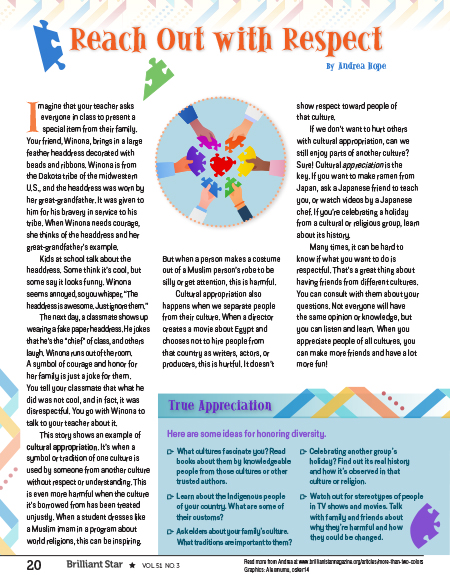
How can we truly honor diversity?
> PURPOSE
This page helps readers begin to explore the difference between cultural appropriation and cultural appreciation.
Quote: “The time has arrived for freedom of belief . . . for mutual respect between diverse peoples and nations, indeed, for the unity of the entire human race.”
— Bahá’í Writings
> QUESTIONS FOR DISCUSSION
Pre-K/Kindergarten | Early Elementary
- What is culture?
- What are some things you enjoy about your culture? (e.g., foods, celebrations, stories, music, etc.)
- When is it respectful to wear a costume of someone from another culture?
- Do you think it’s respectful for a sports team to be named the Indians, Chiefs, or something like that? Why or why not?
Late Elementary | Junior Youth
- What is culture?
- What is the dominant culture in our country?
- Are you a member of the dominant culture in your area? What about the dominant religion?
- Do you think it’s respectful for a sports team to be named the Indians, Chiefs, or something like that? Why or why not?
- What is your school mascot? Do you think that is a respectful mascot?
> ACTIVITIES TO ENHANCE LEARNING
Pre-K/Kindergarten | Early Elementary
> Read the story “A New Culture”
https://brilliantstarmagazine.org/uploads/play/pdf-play/Story_NewCulture_JF05p20p21.pdf
Questions to discuss:
- Was Ally Persian?
- Why did she identify with the Persian culture?
- Is Bahá’í a culture?
> Cultural Sharing
Using the questions in the page below, ask students to share their culture with classmates. Talk about how in some families, multiple cultures are united.
_______’s Cultural Canvas
https://brilliantstarmagazine.org/uploads/play/Luminous_Library_2014/Cultural_Canvas_Journal_MJ14p25.pdf
Late Elementary | Junior Youth
> Cultural Sharing
Have students complete the activity below. Then share them with the class. Ask what they notice about culture from doing this exercise.
_______’s Cultural Canvas
https://brilliantstarmagazine.org/uploads/play/Luminous_Library_2014/Cultural_Canvas_Journal_MJ14p25.pdf
> Snack
Read the article: “Riley’s Rainforest: The Spice of Life” and make the snack together. Or read the article and share snacks from the cultures of the teacher or students.
https://brilliantstarmagazine.org/uploads/play/Luminous_Library_2010/Riley_SpiceLife_MJ10p21.pdf
Resources:
Culture
Culture refers to anything associated with a group of people based on their ethnicity, religion, geography, or social environment. This might include beliefs, traditions, language, objects, ideas, behaviors, customs, values, or institutions. Most often, culture is thought of as belonging to particular ethnic groups.
Appropriation
Appropriation refers to taking something that doesn't belong to you, and most often refers to an exchange that happens when a dominant group takes or borrows something from a minority group that has historically been exploited or oppressed.
In this sense, appropriation involves a lack of understanding of or appreciation for the historical context that influences the act of what is being taken (for example, taking a sacred object from a culture and producing it as part of a Halloween costume).
Cultural Denigration
Cultural denigration refers to when someone adopts an element of a culture with the sole purpose of humiliating or putting down people of that culture.
The most obvious example of this is blackface, which originated as a way to put down people of color as having certain undesirable personality traits.
Cultural Appreciation & Respect
Cultural appreciation is the respectful borrowing of elements from another culture with an interest in sharing ideas and diversifying oneself.
Examples would include learning martial arts from an instructor with an understanding of the practice from a cultural perspective or eating Indian food at an authentic Indian restaurant.
https://www.verywellmind.com/what-is-cultural-appropriation-5070458
Food and Cultural Appropriation
https://www.bbc.com/news/world-us-canada-47892747
Riley’s Rainforest: Your Cool Culture
https://brilliantstarmagazine.org/uploads/play/Luminous_Library_2013/Riley_Culture_MJ13_p4.pdf
BACK TO TOP
Updated on 5.10.21