
Parents and Teachers
Teaching Tools & Ruhi Classes
Teachers’ Guides & Resources
Teachers’ Guide: “Hearts in Harmony,” Part 1

This guide is a tool to assist teachers of children’s classes and junior youth animators in using Brilliant Star’s “race unity” issue in the classroom. While Brilliant Star is developed for kids aged 7-12, many younger and older kids enjoy learning from it. Activities can be adapted and expanded to engage groups ranging from ages 4-14. You’re invited to explore this guide and to share your own ideas in our Facebook group, Brilliant Star Idea Exchange.
These are the key themes in this issue; the discussion questions for each page can help to encourage dialogue:
-
Acknowledging the nobility of the soul and the commonalities among all members of the human family;
-
Understanding the meaning and impact of prejudice and racism, and using practical tools to overcome these negative forces;
-
The importance of putting prayer and study of holy writings into concrete action against prejudice and racism;
-
Building unity in our families, neighborhoods, and communities by getting out of our comfort zone and reaching out to others with kindness and friendship;
-
Emphasizing a sense of hope that creating a unified world is possible and inevitable;
-
Developing virtues of patience, perseverance, service, and initiative.
You can search, download, or print the full issue here.
We recommend Google Chrome for viewing and downloading PDFs.
In the thee parts of this guide, you’ll find discussion questions and activities to enhance learning for each page in the magazine.
“Hearts in Harmony” Pages, Part 1
4 - Life of the Báb: The Promised One
6-7 - Bahá’u’lláh’s Life: The Fire Tablet
8-9 - Nur’s Nook: Make a Balanced Bird Sculpture
10 - Quiz: Do You Take Action Against Racism and Prejudice?
You Can Find Part 2 Here (pages 11-20)
You Can Find Part 3 Here (pages 21-29)
PAGE 2: FAIR PLAY
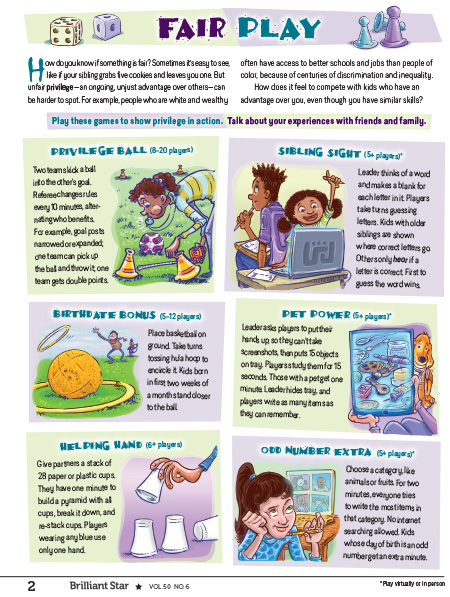
Play games to explore privilege.
> PURPOSE
The purpose of this page is to teach kids about privilege (an unfair, ongoing advantage over others) through games that engage their minds and bodies. This piece provides both active games that groups would play outdoors, as well as thinking games that can be played in person or virtually. Each game is structured so that some players have an unfair advantage over others.
> QUESTIONS FOR DISCUSSION
Pre-K/Kindergarten | Early Elementary
- If you had an unfair privilege during the game, how did you feel about it? Did you think about how the kids who didn’t have privilege might feel?
- If you didn’t have privilege during the game, how did you feel about that?
- Do you think a game should be fair for everyone who’s playing? What can you do if you see that a game isn’t fair?
- Can you think of a real-life situation where some people have an unfair privilege and other people don’t? Who has the privilege and who doesn’t?
Late Elementary | Junior Youth/Youth
- If you had privilege during the game, how did you feel about it? Did you think about how the kids who didn’t have privilege might feel?
- If you didn’t have privilege during the game, how did you feel about that?
- What’s an example of a real-life situation where one group has privilege and another doesn’t? Name who has the privilege and who doesn’t. How do you think having or not having privilege affects each group?
- These games make it very clear who has privilege and who doesn’t. Have you ever been in a situation where you could see that one group had an unfair advantage over the other, but nobody talked about it? Did you speak up?
- What do you think kids can do to help make the world more just?
- There are different types of privilege. What type(s) do you have? What is one way you could use your privilege to stand up for someone without that privilege?
> ACTIVITIES TO ENHANCE LEARNING
Pre-K/Kindergarten | Early Elementary
> If your group began by playing one of the outdoor games, try playing one of the indoor/virtual games to reinforce the concept of privilege.
> Read “A Memorable Meal with ‘Abdu’l-Bahá” and discuss how ‘Abdu’l-Bahá used his privilege to help someone else in the story who did not have privilege.
brilliantstarmagazine.org/uploads/play/Luminous_Library_2017/Memorable_Meal_MA17_p26.pdf
> If class is in person, play additional games about exploring privilege. brilliantstarmagazine.org/uploads/play/Luminous_Library_2017/Privilege_An_Unfair_Game_MA17_p25.pdf
Late Elementary | Junior Youth
> If your group began by playing one of the outdoor games, try playing one of the indoor/virtual games to reinforce the concept of privilege.
> As a group, watch the video, “Cracking the Codes: Joy DeGruy ‘A Trip to the Grocery Store’” (https://www.youtube.com/watch?v=Wf9QBnPK6Yg).
Ask students to discuss 1) their thoughts/feelings about the video, 2) what they would have done if they’d been in Joy’s place, and 3) what they could have done if they had been behind Joy in the checkout line.
PAGE 3: STORIES OF UNITY
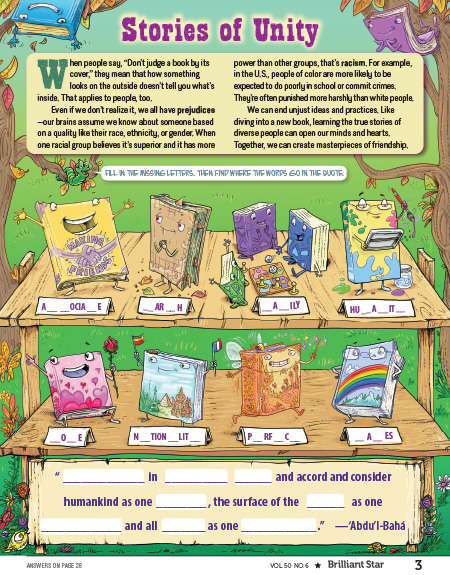
Fill in the blanks to complete a quote about unity.
> PURPOSE
This piece uses the adage “Don’t judge a book by its cover” to introduce prejudice and racism. The terms “prejudice” and “racism” are defined and examples are offered. Personified books have covers that illustrate specific words, and students fill in the missing letters in the words. Students then figure out where the words belong in a Bahá’í quote.
Quote: “Associate in perfect love and accord and consider humankind as one family, the surface of the earth as one nationality and all races as one humanity.”—‘Abdu'l-Bahá
> QUESTIONS FOR DISCUSSION
Pre-K/Kindergarten | Early Elementary
- Have you ever decided you wanted to look at or read a book because you like the cover?
- Have you ever decided not to look at a book because you didn’t like the cover?
- Does how something looks on the outside always tell you what it’s like inside?
- What about people? Can we know about them just by seeing how they look?
- What are some ways you can be kind to people who are different from you?
Late Elementary | Junior Youth
- Have you ever gotten to know someone who surprised you or was different than you’d expected them to be?
- Can you think of a prejudice you used to have that you learned was inaccurate?
- Have you or someone you know faced prejudice or racism? What happened and how did you or they handle it?
- What are some examples of systemic or institutional racism?
- What can you do if you see someone being treated unfairly?
- What can kids and youth do to help stop prejudice and racism?
- What are some ways we can “Associate in perfect love and accord” and treat all people as one family?
> ACTIVITIES TO ENHANCE LEARNING
Pre-K/Kindergarten
> Choose 8-12 books — some that you expect kids to enjoy and others that they’re not likely to find appealing. Use gift wrap, newspaper, construction paper, and similar materials to wrap the book covers and decorate them. Make some look appealing and others unappealing (wrap some of the appealing books in less appealing covers, and vice versa).
Ask the class to sit in a circle with the books scattered in the middle. Ask students to point out some they’d like to read and others they wouldn’t want to read. Then invite students to examine the books. Were they surprised by the contents of some books?
Discuss how the books are like people—we can’t know all about them by their outer looks. When you meet someone new, what can you do help them feel welcome?
> Read or listen to the story “Eat, My Fine Coat!” How do you think the Hoca (pronounced Hoe-djah) felt the first time he went to the banquet? What about the second time? What could the host have done differently to be more welcoming?https://www.tolerance.org/classroom-resources/texts/eat-my-fine-coat
> Read or summarize the story of Fred Mortensen’s visit to ‘Abdu’l-Bahá at Green Acre Bahá’í School. How did ‘Abdu’l-Bahá treat Fred? How do you think that made Fred feel?
Shining Lamp: Fred Mortensen
https://brilliantstarmagazine.org/uploads/play/Luminous_Library_2012/JA12_Shining_Lamp_Fred_Mortensen.pdf
Early Elementary
> Post the quote on a large piece of banner paper, with blanks for the missing words. Print each of the eight missing words on a piece of card stock. Read each one with the class and talk about its meaning. Then read the quote on the banner and talk about any unfamiliar words, such as accord (agreement or harmony) or consider (think about).
Work with the class to figure out where each word belongs in the quote. Consider small phrases in the quote to help them to deduce the correct order of the words. For example, one phrase is “surface of the _____”; which word makes sense in that blank? When the class decides where a word belongs, attach that piece of card stock to the banner with tape. When the activity is complete, ask a couple of kids to take turns reading it.
> Read or summarize the story of Fred Mortensen’s visit to ‘Abdu’l-Bahá at Green Acre Bahá’í School. How did ‘Abdu’l-Bahá treat Fred? How do you think that made Fred feel?
Shining Lamp: Fred Mortensen
https://brilliantstarmagazine.org/uploads/play/Luminous_Library_2012/JA12_Shining_Lamp_Fred_Mortensen.pdf
Late Elementary | Junior Youth
> Watch the video “Systemic Racism Explained” with the class, then discuss it. Did students learn new things they weren’t aware of? Can students think of other examples of systemic racism not mentioned in the video?https://www.youtube.com/watch?v=YrHIQIO_bdQ
> Read the story of Fred Mortensen’s visit to ‘Abdu’l-Bahá at Green Acre Bahá’í School. How did ‘Abdu’l-Bahá treat Fred? How do you think that made Fred feel?
Shining Lamp: Fred Mortensen
https://brilliantstarmagazine.org/uploads/play/Luminous_Library_2012/JA12_Shining_Lamp_Fred_Mortensen.pdf
> Ask students to work together in groups to create a skit about the importance of not judging someone based on their outer appearance.
PAGE 4: LIFE OF THE BÁB: THE PROMISED ONE
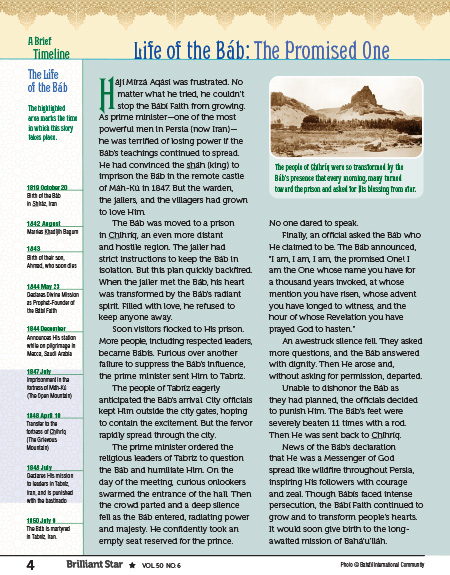
Learn how the Báb transformed a community from His prison.
> PURPOSE
To celebrate the 200th Anniversary of the Birth of the Báb in 2019, each issue shares a story from His life. This installment tells the story of the Báb’s imprisonment in Chihríq, and His proclamation in Tabríz. It illustrates the powerful impact of the Báb’s noble character and spirit as He faced hardships and transformed hearts.
> QUESTIONS FOR DISCUSSION
Pre-K/Kindergarten | Early Elementary
- Why did the prime minister want to stop the Báb?
- Why did people in Chihríq want to visit the Báb?
- In Tabríz, officials hoped to humiliate the Báb at the trial. What qualities did the Báb show instead?
- Why did officials beat the Báb’s feet 11 times?
Late Elementary
- Why didn’t the prime minister’s plans to stop the Báb work?
- How would you feel, walking into a public trial filled with crowds and top government officials? What qualities did the Báb show?
- Government officials hoped to belittle the Báb’s dignity by beating his feet 11 times. Whose dignity was harmed by that act?
- Officials hoped a public trial would stop the growing excitement surrounding the new Bábí Faith. What impact did it really have?
Junior Youth
- What qualities motivated the prime minister? What qualities did the Báb show in sharing His Message?
- If you were a citizen of Chihríq when the Báb was imprisoned there, what would you ask Him if you had the chance to visit Him?
- Imagine you were a citizen of Tabríz. How would you feel, watching the Báb walk into the trial?
- Why did the Báb’s proclamation have such a powerful impact on the Bábí community?
> ACTIVITIES TO ENHANCE LEARNING
Pre-K/Kindergarten
> Find Iran on a globe. Then find the country where your class or group is meeting. Find other locations on the globe that are special to the kids in your class, such as Haifa, Israel, the location of Bahá’í Houses of Worship, or if they have family in other countries.
> Copy a picture from the story of the life of the Báb in Ruhi Book 4: The Twin Manifestations. Give each kid a copy to color.
Early Elementary
> Find Iran on a globe. Then find the country where your class or group is meeting. Find other locations on the globe that are special to the kids in your class, such as Haifa, Israel, the location of Bahá’í Houses of Worship, or if they have family in other countries.
> Draw the Castle of Chihríq, where the Báb was imprisoned.
Late Elementary
> On a map of Iran and Iraq, find the different locations the Báb either visited or was imprisoned in His life.
> Create a drawing or painting inspired by the Báb’s impact on Chihríq.
Junior Youth
> Review resources, such as Brilliant Star’s “Life of the Báb” series and Ruhi Book 4: The Twin Manifestations to create a list of the Báb’s imprisonments and travels. Working in pairs or alone, use the list to create a map, documenting the locations of the Báb’s life.
> Imagine being a citizen of Tabríz at the time of the Báb’s trial. Write a story from the perspective of a citizen watching the growing excitement of the city, and witnessing the powerful trial.
> Imagine being a citizen of Chihríq during the Báb’s imprisonment there. Write a poem about His impact on the region.
> Create a drawing or painting inspired by the Báb’s impact on Chihríq.
PAGE 5: BE-LEAF IN UNITY
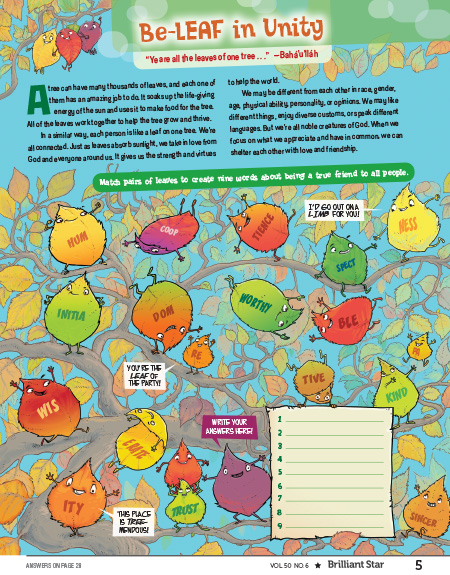
Combine word fragments to create words about friendship.
> PURPOSE
This activity presents the concept of unity in diversity. Like leaves on a tree, all people are connected, even though we may look different from each other. We’re all noble creatures of God. Students match pairs of leaves with word fragments on them to form nine words related to being a friend to all people.
Quote: “Ye are all the leaves of one tree ...” —Bahá’u’lláh
> QUESTIONS FOR DISCUSSION
Pre-K/Kindergarten | Early Elementary
- How do leaves help a tree survive?
- Bahá’u’lláh says people are like leaves on one tree. What does that mean?
- What are some things you can do to be a true friend to all people?
- What are some ways we feel God’s love in our lives?
Late Elementary | Junior Youth
- Why is it sometimes challenging to get along with people who are different from yourself?
- What does it mean that all people are “noble creatures of God”?
- What are some things you can do to be a true friend to all people, like leaves on one tree?
- How is God’s love like the sun? What are some ways we feel God’s love in our lives?
> ACTIVITIES TO ENHANCE LEARNING
Pre-K/Kindergarten | Early Elementary
> Cut out paper leaves in different shapes and colors. Write a word fragment on each half, with matching fragments in the same shape or color. Give a leaf to each student, and ask them to find the student who holds the remaining portion of their word (pre-readers can match leaves by shape or color). When pairs are found, gather the students to read the matched leaves and talk about what each word means and how we can express that quality with others.
> Create a tree trunk and branches out of brown paper and hang it on a wall. On the trunk, write the quote “Ye are all the leaves of one tree ...” —Bahá’u’lláh
Ask students to cut out a leaf shape, write their name on it, and draw or write something they like to do with friends. Gather the students and ask each one to share their leaf and what they drew, then tape the leaves to the tree. Later, take a class photo near the leaf-filled tree.
> To tie into the leaf theme, take the class on a nature walk and find leaves that have fallen from trees. (If meeting virtually, ask kids to walk at home with a family member and then show their leaves onscreen.)
Ask each student to put white paper over their leaves and rub over the paper with the side of a crayon to reveal the leaf texture. Then ask them to use the image to create a homemade card to give to a friend or family member.
Late Elementary | Junior Youth
> Cut out paper leaves, and write a word fragment on each. Give a leaf to each student, and ask them to find the student who holds the remaining portion of their word. When the two students find each other, they work together to create a skit about their word and what it means. After the skits are performed for the larger group, everyone completes the page in the magazine.
> Divide the group into pairs (if possible, pair students who aren’t well known to each other). Give each pair five minutes to talk together about things they like to do, things that make them happy, future goals, etc. Then ask each pair to report at least two things that they have in common with each other.
> The answers to this activity are: cooperate, humble, initiative, kindness, patience, respect, sincerity, trustworthy, wisdom. Put each of these words on a slip of paper and put the slips in a box. Ask each student to draw one word and then use charades to act it out. The first student to guess is the next person to act out a word.
PAGES 6-7: BAHÁ’U’LLÁH’S LIFE: THE FIRE TABLET
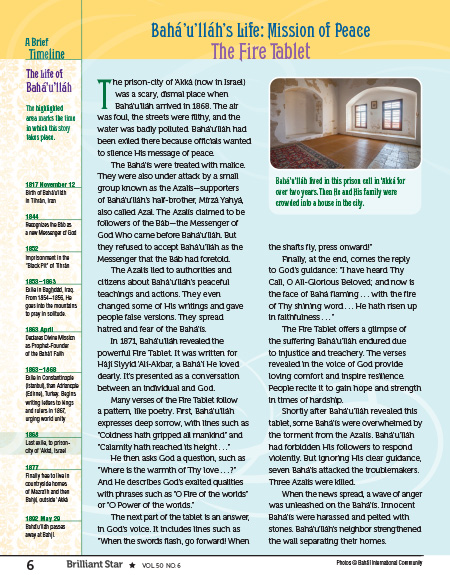
Learn about the Fire Tablet and search for words included in it.
> PURPOSE
This story introduces readers to the Fire Tablet—a powerful tablet revealed by Bahá’u’lláh. It explores the circumstances surrounding its revelation, offering a glimpse into Bahá’u’lláh’s resilience in the face of hardships. It also addresses the content of the Fire Tablet, looking at the language and structure so readers can begin to explore it on their own.
Quote: “Should all the servants read and ponder this, there shall be kindled in their veins a fire that shall set aflame the worlds.” —Bahá’u’lláh
> QUESTIONS FOR DISCUSSION
Pre-K/Kindergarten | Early Elementary
- What helps you when you’re having a hard time?
- Which prayers or songs help you when you’re feeling sad?
- What does resilience mean?
- Can you think of something in nature that’s resilient?
Late Elementary
- What are some examples of resilience in nature or in your life?
- What helps your family stay strong and united when you face tough times?
- Why was Bahá’u’lláh sad that Bahá’ís ignored His call for peace and used violence instead?
- Why did people in ‘Akká eventually stop attacking the Bahá’ís?
Junior Youth
- How does turning to God help you when you’re struggling?
- What examples of resilience have you seen in your community?
- What examples of resilience have you learned about from history?
- In the U.S., people of color have demonstrated tremendous resilience in the face of severe hardship and injustice. What can Bahá’ís do to keep working for peace and justice?
> ACTIVITIES TO ENHANCE LEARNING
Pre-K/Kindergarten
> To help kids further explore the concept of resilience, read “Hop Through Hardship” together. Cut out paper rabbits. On each one, write a quality that helps us be resilient. Hide the bunnies throughout the room and let kids search for them. When they find the rabbit, share the quality written on it.
brilliantstarmagazine.org/uploads/play/Luminous_Library_2018/v50n4p19_Hop_Through_Hardship_RS.pdf
> Use paper, tape, and dowel rods to create a small, simple scroll for each student. Write a verse from the Fire Tablet at the center of each paper. Invite kids to color around the outside of the verse to create a decorative border.
Early Elementary
> To help kids further explore the concept of resilience, read “Hop Through Hardship” together. Then let kids work in pairs to finish the activity together. Invite kids to draw a rabbit and cut it out, then hide it in the room. Once everyone has hidden their rabbits, they can find them themselves, or invite a younger class to join in the fun. brilliantstarmagazine.org/uploads/play/Luminous_Library_2018/v50n4p19_Hop_Through_Hardship_RS.pdf
> Give each student a piece of paper with a verse from the Fire Tablet typed in the center. Invite them to use crayons and markers to create a decorative border around the verse. When they’re finished, give them two dowel rods. They can tape a dowel rod to the top of the paper and one to the bottom, then roll the paper into a scroll.
Late Elementary
> With a partner or in a small group, choose a section of the Fire Tablet to study and memorize.
> Explore how prayer can help strengthen our resilience. Write a poem or draw a picture to explore how prayer can help strengthen our resilience.
Junior Youth
> With a partner or in a small group, study the Fire Tablet together.
> Choose a passage from the Fire Tablet that you found particularly moving or inspiring. Memorize it or put it to music and share with your class.
> Explore how prayer can help strengthen our resilience. Write a poem or draw a picture to explore how prayer can help strengthen our resilience.
PAGES 8-9: NUR’S NOOK: MAKE A BALANCED BIRD SCULPTURE
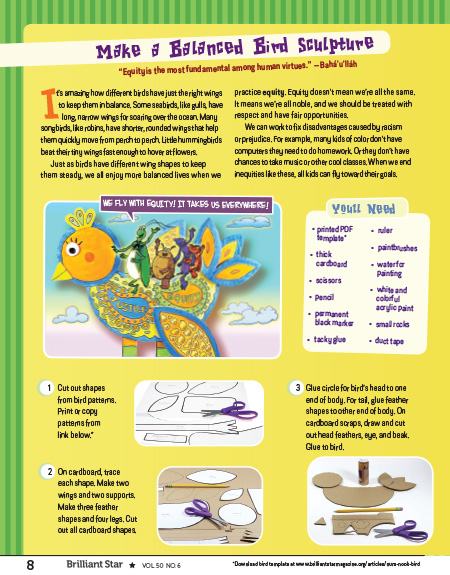
Create a colorful balanced bird to brighten your home or school.
> PURPOSE
This piece covers the concept of equity (all people should be treated with respect and have fair opportunities). Just as birds’ wings keep them balanced, our lives are balanced when we practice equity. Like how different birds have the wing size and shape they require, equity is not giving all people exactly the same thing. Instead, we consider what people need in order to thrive.
Quote: “Equity is the most fundamental among human virtues.” — Bahá’u’lláh
A template PDF for the bird shapes is available online.
> QUESTIONS FOR DISCUSSION
Pre-K/Kindergarten | Early Elementary
- What would happen if an eagle had tiny wings like a hummingbird?
- What would happen if a hummingbird had giant wings?
- So do all birds need the same size wings?
- What about people? Do all people need exactly the same things? (For example, Some people need glasses and some people don’t. Some kids need to avoid foods they’re allergic to, and other kids don’t have allergies.)
- What are some basic things all people need?
- What happens if only some people get what they need?
Late Elementary | Junior Youth
- What would happen if different kinds of birds all had the same wings?
- Why is it fair for each bird to have wings in just the right size and shape it needs?
- What are some basic things all people need?
- What are some things that some people might need and others don’t?
- Is it fair if only some people get what they need?
- What are some things we can do to help people who are disadvantaged and aren’t able to get their needs met due to prejudice and racism?
> ACTIVITIES TO ENHANCE LEARNING
Pre-K/Kindergarten | Early Elementary
> To adapt the Balanced Bird craft for young kids, use washable white glue. Teachers can cut the shapes (other than Support and Base) out of thick paper for each student’s bird ahead of time, using the template PDF. Also cut out shapes for the beak, eye, and head feathers. Demonstrate Steps 3-4B for assembling the bird, and ask students to follow along and glue their birds together. Have kids decorate their birds with colorful crayons, washable markers, or washable paint.
Post a list of virtues as prompts, or prewrite virtues on small, colorful paper cutouts. Encourage students to add virtues to their bird (by writing or gluing them on). With clear tape, secure ends of a piece of string or ribbon to tip of bird’s top wing for hanging.
> Plan time for students to share their Balanced Birds, giving each one an opportunity to talk about the designs and virtues they chose. Encourage kids to display their birds at home as a keepsake of the seasonal school experience.
> Read the story “The Dove’s Journey” and talk about how the birds in the story helped each other and worked in unity. https://brilliantstarmagazine.org/uploads/play/Luminous_Library_2011/Story_Doves_Journey_SO11p6.pdf
> Make “Bird’s Nest Cookies” with the class, or make them outside of class and serve them as a snack. Put ¾ cup butterscotch chips and ½ cup creamy peanut butter in the microwave for 20 seconds, then stir. Repeat until melted. Pour over two cups crunchy chow mein noodles and mix well. Place spoonfuls of noodles on baking sheet lined with wax paper. Top with egg-shaped candies, then refrigerate until firm. **Food Allergy Warning: This recipe contains peanuts; consider a substitute ingredient if allergies are a concern.**
Bird’s Nest Cookies:
https://brilliantstarmagazine.org/uploads/about/MA19_Spring_RS.pdf
Late Elementary | Junior Youth
> Plan time for students to share their balanced birds, giving each one an opportunity to talk about the colors, designs, and virtues they chose. This is a keepsake of the seasonal school experience.
> Make “Bird’s Nest Cookies”: Put ¾ cup butterscotch chips and ½ cup creamy peanut butter in the microwave for 20 seconds, then stir. Repeat until melted. Pour over two cups crunchy chow mein noodles and mix well. Place spoonfuls of noodles on baking sheet lined with wax paper. Top with egg-shaped candies, then refrigerate until firm. **Food Allergy Warning: This recipe contains peanuts; consider a substitute ingredient if allergies are a concern.**
Bird’s Nest Cookies:
https://brilliantstarmagazine.org/uploads/about/MA19_Spring_RS.pdf
> Read the story “A Memorable Meal with ‘Abdu’l-Bahá,” and ask each student to write down five things they can do to include more diverse people in their lives. Ask the class to share some items from their action plan with the larger group.
https://brilliantstarmagazine.org/uploads/play/Luminous_Library_2017/Memorable_Meal_MA17_p26.pdf
> It’s easier to practice equity when individuals and communities have open minds about diverse people, genders, and cultures. Then people are more likely to make sure everyone has fair opportunities to get their needs met.
Do this activity together as a class, or group students in pairs. Classmates or each pair can take turns asking each other the questions from this quiz and explain the reason for each of their answers. Then discuss everyone’s thoughts about the quiz in the larger group.
“How Open-Minded are You?”
https://brilliantstarmagazine.org/articles/quiz-how-open-minded-are-you
PAGE 10: QUIZ: DO YOU TAKE ACTION AGAINST RACISM?
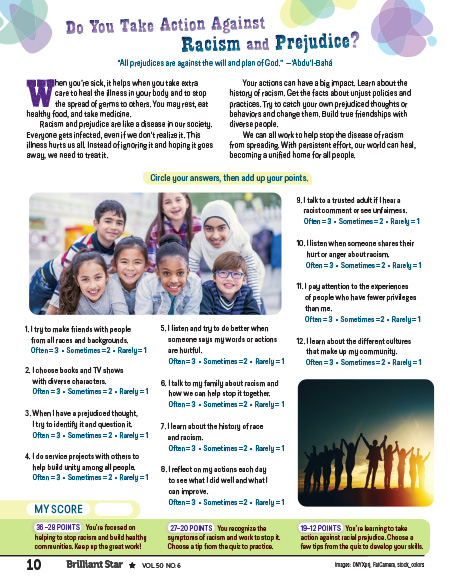
Quiz yourself on anti-racism skills.
> PURPOSE
This quiz helps kids reflect on the actions they’re taking to uproot racism. It provides examples of concrete steps they can take to free themselves and their communities from racial prejudice.
Quote: “All prejudices are against the will and plan of God.”—‘Abdu’l-Bahá
> QUESTIONS FOR DISCUSSION
Pre-K/Kindergarten | Early Elementary
- What helps you when you’re feeling sick?
- How do you make new friends?
- If you see a friend being hurt, what do you do to help?
- What do you do when someone is treated unfairly?
Late Elementary | Junior Youth
- In what ways is racism like an illness?
- Why is friendship with diverse people important?
- How have you experienced or witnessed racism?
- When did you first become aware of race?
- What is one action you could take immediately to help stop the spread of racial prejudice?
> ACTIVITIES TO ENHANCE LEARNING
Pre-K/Kindergarten
> Draw a picture of yourself with friends from around the world.
> Read children’s books on the history of race, and books that share diverse perspectives. Possible resources:
https://www.embracerace.org/resources/where-to-find-diverse-childrens-books
Early Elementary
> Choose an idea from the quiz and draw a picture of yourself taking a stand against racial prejudice.
> Play games from “Privilege: An Unfair Game” to explore the harm racism has our relationships and in our communities.
https://brilliantstarmagazine.org/uploads/play/Luminous_Library_2017/Privilege_An_Unfair_Game_MA17_p25.pdf
Late Elementary
> Play games from “Privilege: An Unfair Game” to explore the harm racism has our relationships and in our communities.
https://brilliantstarmagazine.org/uploads/play/Luminous_Library_2017/Privilege_An_Unfair_Game_MA17_p25.pdf
> Write a poem about working together with your community to create race unity.
Junior Youth
> Working in pairs, take photos of your community or seasonal school, using the theme of the quiz as inspiration. Share photos with the class. If possible, the class can print some of their favorite photos out to create a photo gallery for their friends, family, and neighbors.
> In groups of three or four, work together to create a short talk to share with your community to share ideas for eliminating racial prejudice together.
Updated on 6.20.20