
Parents and Teachers
Teaching Tools & Ruhi Classes
Teachers’ Guides & Resources
Teachers’ Guide: “Hearts in Harmony,” Part 2

This guide is a tool to assist teachers of children’s classes and junior youth animators in using Brilliant Star’s race unity content in the classroom. While Brilliant Star is developed for kids aged 7-12, many younger and older kids enjoy learning from it. Activities can be adapted and expanded to engage groups ranging from ages 4-14. You’re invited to explore this guide and to share your own ideas in our Facebook group, Brilliant Star Idea Exchange.
These are the key themes in this issue; the discussion questions for each page can help to encourage dialogue:
-
Acknowledging the nobility of the soul and the commonalities among all members of the human family;
-
Understanding the meaning and impact of prejudice and racism, and using practical tools to overcome these negative forces;
-
The importance of putting prayer and study of holy writings into concrete action against prejudice and racism;
-
Building unity in our families, neighborhoods, and communities by getting out of our comfort zone and reaching out to others with kindness and friendship;
-
Emphasizing a sense of hope that creating a unified world is possible and inevitable;
-
Developing virtues of patience, perseverance, service, and initiative.
You can search, download, or print the full issue here.
We recommend Google Chrome for viewing and downloading PDFs.
In the thee parts of this guide, you’ll find discussion questions and activities to enhance learning for each page in the magazine.
“Hearts in Harmony” Pages, Part 2
12 - Maya’s Mysteries: Courage to Connect
14-15 - Lightning and Luna, Episode 85: Wild World
20 - Talking About ... The Reality of Racism
You Can Find Part 1 Here (pages 2-10)
You Can Find Part 3 Here (pages 21-29)
PAGE 11: WE ARE ONE
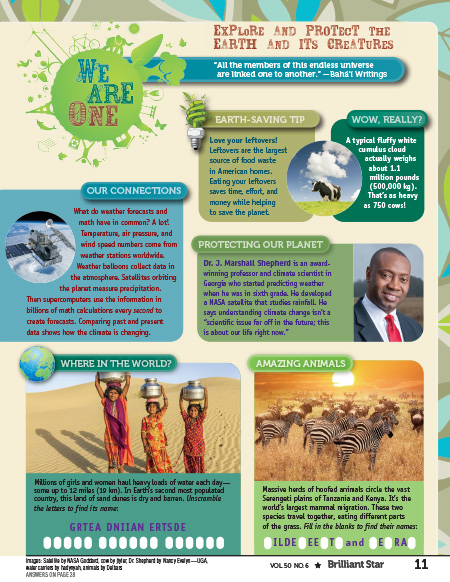
Explore and care for the place we all call home.
> PURPOSE
We Are One inspires us to explore and protect the Earth and its creatures by learning more about the environment and our connections with it and each other.
Quote: “All the members of this endless universe are linked one to another.” —Bahá’í Writings
> QUESTIONS FOR DISCUSSION
Pre-K/Kindergarten
- Where does your water come from?
- What do we need water for?
- Have you ever lived anywhere or been camping where you had to walk to get water?
- What do you think it would be like to walk for miles every day to get water for your family?
- Where is the Serengeti?
Early Elementary | Late Elementary | Junior Youth
- How do you help the environment at school or at home?
- What is a question about the natural world you’d like to know the answer to?
- Why do we want to predict the weather?
- What is migration? Do people migrate, as well as animals? Why?
Late Elementary | Junior Youth
- The Bahá’í writings use nature and natural things as metaphors or examples for us. Can you think of some prayers or writings that mention nature?
- Why do some people have to walk so far to get water?
- If you didn’t have running or bottled water, how far would you have to walk to get some?
- Why do you think the job of getting water falls on women and girls?
- If you spent your day getting water, what would you have to give up?
- In our lives, how can we make sure girls and women are treated fairly?
> ACTIVITIES TO ENHANCE LEARNING
Pre-K/Kindergarten | Early Elementary
> Go on an Alphabet Hike or Rainbow Expedition as in “World of Wonder” at the link below. For younger students, skip the writing part.
https://brilliantstarmagazine.org/uploads/play/Luminous_Library_2011/Exploring_a_World_of_Wonder_JA11p4.pdf
> Create a thunderstorm using body percussion. Divide students into four groups to create a moving storm of sound. Point to group one, and rub your hands together. Direct the other groups to join in, one at a time. Return to group one and snap your fingers. Have the other groups do the same. Continue with clapping your hands and stamping your feet. Then quiet the storm by going back through clapping, snapping, and hand-rubbing. Ask for new sounds to add, and start again.
> Song: “Hooray for the World,” by Red Grammer
https://www.youtube.com/watch?v=4oiuF8c1c5Y
> Make rain sticks with the class and use them to create music and cool sounds. Each student decorates a sturdy paper tube with paint or markers. Cut two paper circles that are larger than the tube's opening. Cover one end of the tube with the paper and secure with a rubber band. Put a handful of rice or beans inside the tube. Twist a pipe cleaner around a pencil and insert the spiral pipe cleaner inside the rain stick too. Cover the other end of the stick with paper and a rubber band. Then enjoy the music!
https://buggyandbuddy.com/how-to-make-a-rainstick-instrument/
> Make an ocean ecosystem dessert with gelatin, licorice twists, and gummy fish.
https://climatekids.nasa.gov/ocean-ecosystem/
Late Elementary | Junior Youth
> Take a walk and make a nature journal, using this page, or create your own page specifically for your location. On your walk, consider how the Bahá’í writings use nature as metaphors or lessons about spiritual truths. Can you discover any as you walk? For example, if you see bees or ants, you can observe how they’re working together. Or if there are multiple colors of birds or bugs, you can think about their unity in diversity.
https://brilliantstarmagazine.org/uploads/play/Luminous_Library_2013/MA13_Nature_Journal.pdf
> Song: “The Sun will Shine Again,” by Frances England
https://brilliantstarmagazine.org/videos/sun-will-shine-again
OR
https://brilliantstarmagazine.org/uploads/characters/pdf-character/Music_SunAgain_MA14p20_com.pdf
> Creat a solar oven with a cardboard box and use the power of the sun to make s’mores.
https://climatekids.nasa.gov/smores/
> Have a water carrying relay race. Line up students in two teams. For each time, put a full bucket of water at the starting line. Put an empty bucket in the distance. Indicate a “full” line on the bucket with a permanent marker. The first student fills a cup or bowl from their bucket, runs to their other bucket to pour it in, then runs back to start and hands the cup to the next person. The first time to fill their bucket wins.
Afterward, talk about whether this race was challenging. What if you had to carry that water for miles?
PAGE 12: MAYA’S MYSTERIES: COURAGE TO CONNECT
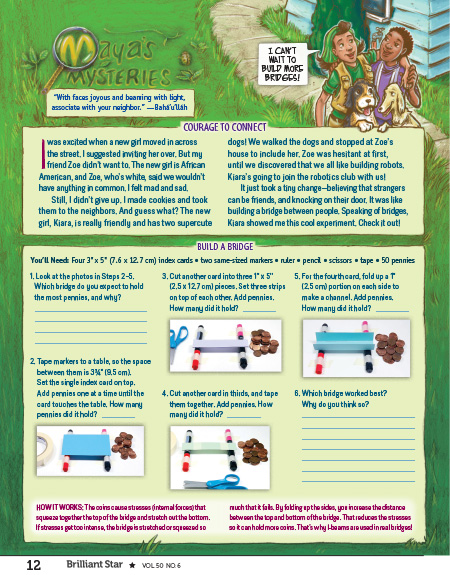
Which paper bridge is the strongest?
> PURPOSE
Maya tells a story of building a bridge to race unity by taking small steps toward friendliness. Then she presents a science experiment about creating a strong bridge from sturdy paper and other common materials.
Quote: “With faces joyous and beaming with light, associate with your neighbor.” — Bahá’u’lláh
> QUESTIONS FOR DISCUSSION
Pre-K/Kindergarten
- Why do we build bridges?
- Why do we have different-colored skin?
- Since God created us all equal, what are some ways we can be friendly to everyone?
- Have you or someone you know ever felt nervous about meeting someone new? What did you do to make friends?
Early Elementary | Late Elementary
- When was a time you made a friend from another culture? Where did you meet?
- How can we make friends with more diverse kids? Why is that important?
- What does it mean to be treated unfairly?
- If you could build any kind of bridge in the world, between anything or anyone, what would you build?
Late Elementary | Junior Youth
- How can we make more diverse friends? Why is that important?
- How can I check myself for unconscious prejudice?
- Do you ever notice kids being treated unfairly (either good or bad) by other kids? What can you do?
- If you could build a bridge between yourself and anyone, or anything, what would you build?
> ACTIVITIES TO ENHANCE LEARNING
Pre-K/Kindergarten
> Collect a bunch of LEGO minifigs and characters, or other small characters. Make pairs of different characters, like black minifig and white minifig, or person minifig and dragon. Line up the pairs about 6 inches apart. Take an index card and hold it between the first pair like a wall. Then say, wall or bridge? The kids most likely will answer bridge, and you can put down the card for a bridge and they can walk the characters to the middle to meet. Kids can tap the characters together when they meet, like a high five. Have the kids take over the game, letting all the characters meet and be happy.
Then start over, putting objects that represent food or money on one side or both sides of each pair. Play the game again. In the first example, show that when the bridge goes across, the goods are shared. Let the kids play. Explain that not wanting to share is a big reason that some people put up walls. Talk about sharing and building bridges in real life. If possible, end up with each pair linked by a bridge and all the goods shared. See if kids point out that everyone has enough when we share.
> Read a book about unity, peace, kindness, and diversity. Here are some suggestions from the American Library Association:
http://www.ala.org/alsc/sites/ala.org.alsc/files/content/compubs/booklists/Unity.%20Kindness.%20Peace%20%281%29.pdf
Early Elementary | Late Elementary | Junior Youth
> Do the Maya experiment together and discuss the results.
> Building a bridge is one way to get across a big river. Building a boat is another way. Have the students build these Nur’s Nook Origami FriendShips:
https://brilliantstarmagazine.org/articles/all-aboard-make-an-origami-friend-ship
OR
https://brilliantstarmagazine.org/uploads/play/Luminous_Library_2014/Nur_FriendSHIP_SOND14p20p21.pdf
> Invite students to quiz each other about having a warm welcome:
https://brilliantstarmagazine.org/uploads/play/Luminous_Library_2013/JF13_How_Warm.pdf
> Use the information on this page to make a giant mural or poster for the classroom. Students can practice greeting each other in many languages.
https://brilliantstarmagazine.org/uploads/play/Luminous_Library_2015/Global_Greetings_JFMA15.pdf
> Make this friendship book on the first day of class. Have the students interview others all week. On the last day, share what they enjoyed about the activity and learned from it.
https://brilliantstarmagazine.org/uploads/play/Luminous_Library_2011/Nur_Beyond_comfort_zone_MJ11p9.pdf
Late Elementary | Junior Youth
> Invite students to quiz each other on these facts about race:
https://brilliantstarmagazine.org/uploads/play/Luminous_Library_2017/MA17p20_Maya_Race_Quiz.pdf
> Do the activity at the link below. Ask students to discuss how they have used or might use the tips in real life. Invite students to work together (or on their own, if meeting virtually) to build a scene with LEGO bricks that shows friends doing something fun together, possibly including a bridge. Or ask students to draw the scene and share it.
https://brilliantstarmagazine.org/uploads/play/Luminous_Library_2014/LEGO_New_Friendships_SOND14p5.pdf
> Invite kids to complete this activity about the amazing human race, and discuss the results together: https://brilliantstarmagazine.org/uploads/play/Luminous_Library_2013/Hoshi_Adventures_MJ13_p27.pdf
PAGE 13: SIGNS OF ONENESS
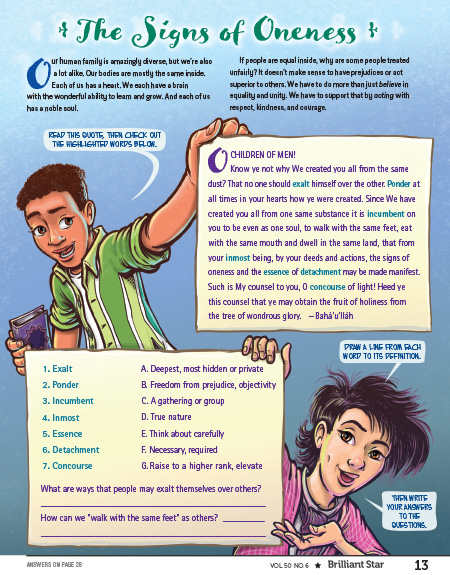
Dive into the meaning of a powerful Bahá’í quote.
> PURPOSE
The purpose of this page is to connect the hearts and souls with the word of God and to explain some of the difficult vocabulary. We also want to make sure that the message of the quote, that we shouldn’t exalt ourselves above others, is clear.
> QUESTIONS FOR DISCUSSION
Pre-K/Kindergarten | Early Elementary
For younger students, read and explain the first part of the quotation:
O CHILDREN OF MEN!
Know ye not why We created you all from the same dust? That no one should exalt himself over the other. Ponder at all times in your hearts how ye were created.
Mention that asking these questions is a way to “ponder in your hearts.”
- Who are the “Children of Men”?
- Where is your brain? Where’s your heart? Where’s your kindness? Where’s your love?
- Can we see our soul? Where is our soul?
- What would happen to our body if we didn’t eat?
- If we eat food to keep our body strong, what do we do to keep our soul strong?
- If God made all of us, and God loves all of us, can anyone claim to be better than someone else?
Late Elementary | Junior Youth
- Why does Bahá’u’lláh use such challenging words?
- Why is it important to say prayers? Or How do we build up spiritual strength?
- What are some things we can do to avoid exalting ourselves over others?
- What does it mean to “obtain the fruit of holiness from the tree of wondrous glory”?
> ACTIVITIES TO ENHANCE LEARNING
Pre-K/Kindergarten | Early Elementary
> Go outside and collect some paper cups of dirt (dust) from the same place. Ask which cup of dirt is better. Put the dirt back and, if allowed, and plant some flower seeds as an act of kindness toward others.
> Do a simpler vocabulary matching, such as Blessed is the Spot.
> Create prayer books with the words from either “Blessed is the Spot” or the quote in the “Signs of Oneness” activity.
https://brilliantstarmagazine.org/articles/a-prayer-to-share
OR
https://brilliantstarmagazine.org/uploads/play/Luminous_Library_2013/Nur_Prayer_to_Share_SO13p6_new.pdf
> As a way to “walk with the same feet,” play the Walk as One game: https://brilliantstarmagazine.org/uploads/play/Luminous_Library_2015/Games_for_Change_SOND15_JF16_p25.pdf
> Have a three-legged race. Divide kids into pairs, and gently tie two of their legs together, so they need to move in harmony.
Late Elementary | Junior Youth
> After doing the activity on the page, ask students to take turns making up new sentences with the same vocabulary words.
> Try this experiment – Maya’s Mysteries: The Colors of Humanity
Make Your Own Rainbow
https://brilliantstarmagazine.org/uploads/play/Luminous_Library_2010/Rainbow_MJ10p23__Maya.pdf
> Sometimes some groups of kids think they’re better than others. How do you deal with that?
https://brilliantstarmagazine.org/uploads/play/Luminous_Library_2011/Maya_Coping_Cliques_MJ11p8.pdf
> Do you believe in equality for all? Take this quiz as a class and discuss it.
https://brilliantstarmagazine.org/uploads/play/Luminous_Library_2016/Do_You_Believe_in_Equality_for_All_MJ16_p18.pdf
PAGES 14-15: LIGHTNING AND LUNA, EPISODE 85: WILD WORLD
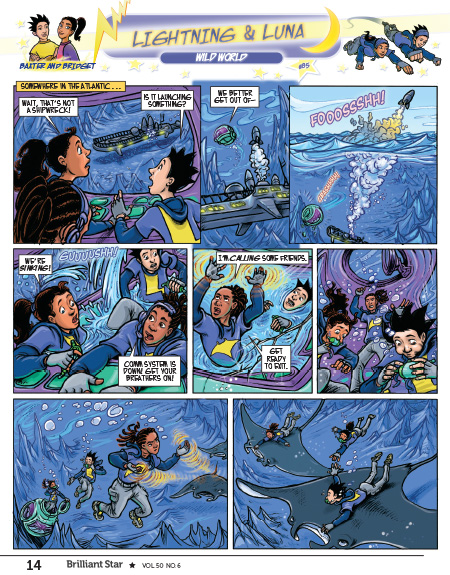
What virtues do you see in the kid superheroes, Lightning and Luna?
> PURPOSE
Brother and sister Lightning and Luna are part of a league of young superheroes called Uplifters who use their virtues and powers to save the world. When Lightning and Luna aren’t on a mission, they keep their superhero identity a secret and try to cope with middle school.
> QUESTIONS FOR DISCUSSION
Pre-K/Kindergarten
- What is a hero?
- What is a superhero?
- Can anyone be a hero?
- What are some things you do that are heroic?
- Have you ever seen a turtle? How big was it? How big is a leatherback sea turtle? [Adults can be 6-7.2 feet]
Early Elementary | Late Elementary | Junior Youth
- Do you know anyone who is a hero?
- How do stories help us be heroes in our own lives?
- Who are some people that you look up to as heroes?
- What are some superhero qualities or virtues that help you with everyday challenges?
- Almost everyone has anxiety sometimes, like Lightning does in this episode. What are some ways to deal with anxiety?
- Why do turtles have shells?
Late Elementary | Junior Youth
- What heroic qualities or virtues do you try to use?
- How do we know we’re using our powers for good (like the Uplifters do)?
- Do you have to be perfect to do good in the world?
- Do you think Erasers think they are bad guys?
- How can you be a friend to people with anxiety?
- Why do you think sea turtles migrate so far? Why are they endangered?
- How is being a scientist heroic?
> ACTIVITIES TO ENHANCE LEARNING
Pre-K/Kindergarten | Early Elementary | Late Elementary
> Sing the song “There’s a Hero in You” and ask each student to describe a time they did something heroic.
https://brilliantstarmagazine.org/uploads/characters/pdf-character/Music_HeroYou_SO13p20_com.pdf
Video:
https://brilliantstarmagazine.org/videos/the-hero-in-you
> Do this page from Brilliant Star to tie into the turtle in this episode.
Stuart and Gabriella: Turtle Troubles
https://brilliantstarmagazine.org/uploads/play/Luminous_Library_2017/ND17p13_SG_Turtles.pdf
> Do a turtle craft. Give each student a paper plate and an assortment of one-inch squares of tissue paper in various shades of green. Ask students to glue the squares to the convex side of the plate. Cut out the turtle’s feet, head, and tail from green construction paper and glue them to the inside of the plate, so they stick out from the shell. Draw eyes or glue on googly eyes.
http://www.theadventurestartshereblog.com/2015/07/under-sea-crafts.html?m=1
> Weave turtles with craft sticks and yarn:
http://www.pinkstripeysocks.com/2016/05/turtles-using-3-sticks-gods-eye-weaving.html
> Serve a sea turtle snack — use this one or invent your own.
https://i.pinimg.com/originals/6a/bc/0b/6abc0b9317611b4aea9f93b2f1d32b69.jpg
Early Elementary | Late Elementary | Junior Youth
> Ask students to take the superhero quiz. Then talk about what makes a hero.
Which Uplifter Are You? Take a quiz to discover your superhero style.
https://brilliantstarmagazine.org/uploads/play/Luminous_Library_2015/Which_Uplifter_Are_You_JFMA15.pdf
> Ask students draw themselves as superheroes using this drawing page. Share the drawings with the class and discuss what your powers and virtues are.
https://brilliantstarmagazine.org/uploads/play/Luminous_Library_2014/Draw_Superhero_MA14p25.pdf
> Do this Brilliant Star page, then create a poster to show how people can help sea turtles.
Saving Sea Turtles
https://brilliantstarmagazine.org/uploads/play/Luminous_Library_2011/Saving_Sea_Turtles_JA11p27.pdf
What are some things you can do to help sea turtles? Here are some ideas:
https://www.fisheries.noaa.gov/feature-story/what-can-you-do-save-sea-turtles
> Read Lightning and Luna episodes 83-85 together or in pairs. What do you think is going to happen in this saga? Share your possible endings.
PAGES 16-18: RADIANT STARS
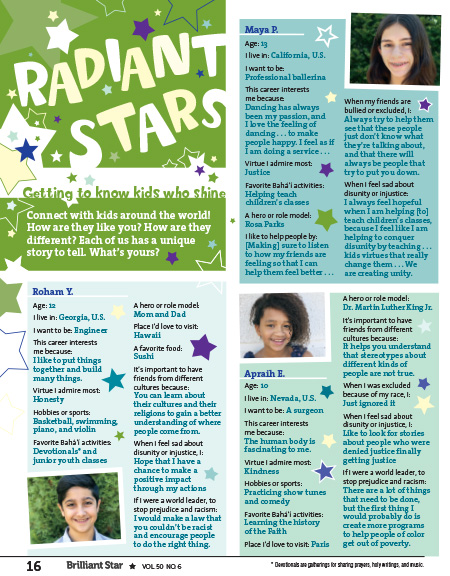
How are you similar to these kids from around the world? How are you different?
> PURPOSE
To facilitate a feeling of community among Brilliant Star’s readers (from around the U.S. and the world). In their responses to our reader surveys, kids who are the only Bahá’í in their school or one of just a few Bahá’ís in their area say that Radiant Stars reminds them that they’re not alone, and there are kids like them around the world.
Quote: “God has crowned you with honor and in your hearts has He set a radiant star; verily the light thereof shall brighten the whole world!” —‘Abdu’l-Bahá
> QUESTIONS FOR DISCUSSION
Pre-K/Kindergarten | Early Elementary
- What are some virtues you admire (such as kindness or patience)?
- What are your favorite things to do with your Bahá’í community or your faith group?
- Why is it important to have friends from different cultures, ethnicities, and backgrounds?
- When you feel sad about disunity or injustice in the world, what helps you stay positive and hopeful?
- If you could invent an ice cream flavor to celebrate diversity, what would you call it? What would it taste like?
Late Elementary | Junior Youth
- Why is it important to have friends from different cultures, ethnicities, and backgrounds?
- Have you, or a friend, ever been bullied or excluded because of your race, religion, ethnicity, or background? If so, how did you handle it?
- When you feel sad about disunity or injustice in the world, what helps you stay positive and hopeful?
- What’s something you’ve done with your family or friends to help build unity in your community?
- If you were a world leader, what’s the first thing you would do to help stop prejudice and racism?
- If you could invent an ice cream flavor to celebrate diversity, what would you call it? What would it taste like?
> ACTIVITIES TO ENHANCE LEARNING
Pre-K/Kindergarten
> Ask kids to draw a picture that shows their answer to a question from the Discussion Questions list.
> Read a book that highlights cultural diversity, such as Everybody Cooks Rice or Everybody Bakes Bread, by Norah Dooley. Invite students to talk about the different nationalities and cultures of the characters and what they all have in common.
> Watch the video and learn the song “Sweet Neighbors Come in All Colors”
https://www.youtube.com/watch?v=f1M_XaqJD8U
Early Elementary
> Ask kids to draw a picture that shows their answer to a question from the Discussion Questions list.
> Read a book that highlights cultural diversity, such as Everybody Cooks Rice or Everybody Bakes Bread, by Norah Dooley. Invite students to talk about the different nationalities and cultures of the characters and what they all have in common.
> Have kids take the “Building the Future” quiz and discuss their answers: https://brilliantstarmagazine.org/uploads/play/Luminous_Library_2011/Quiz_Building_the_Future_MJ11p5.pdf
Late Elementary | Junior Youth
> Divide the group into pairs and ask each person to interview their partner, asking them the discussion questions above and these standard Radiant Star questions:
Name:
Age:
I live in (state, country):
I want to be (future career):
This career interests me because:
The virtue I admire most in people:
Hobbies or sports:
Favorite Bahá’í activities:
Favorite animal or pet:
Places I’d love to visit:
I like to help people by:
A favorite book or song:
A favorite food:
A hero or role model:
After the interviews, ask each person to introduce their partner to the class and share some of their answers with the group.
> Invite each student to create a poster that illustrates their answers to the Radiant Star and Discussion Questions above. (If the school is virtual, the “poster” could be an 8 ½" x 11" piece of paper.) Depending on the materials available to students, the posters can include words, drawings, symbols, designs, photos, images cut from magazines, etc. When the posters are finished, ask each student to share their poster with the class and talk about some of the things they included. Then hang the posters in the classroom.
If any students would prefer not to make a poster, they could write a poem, song, or rap that includes some of their answers.
> Do this Nur’s Nook craft with the class:
Nur’s Nook: Create a String of Stars
https://brilliantstarmagazine.org/uploads/play/Luminous_Library_2016/Nur_Create_a_String_of_Stars_MJ16_p6.pdf
PAGE 19: WHAT DO YOU SAY?
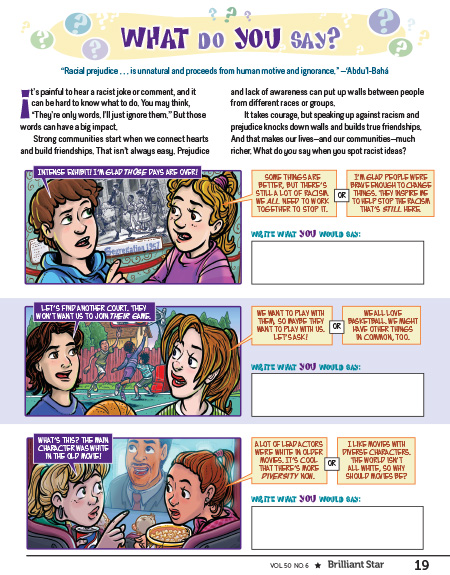
Practice speaking up against racism and prejudice.
> PURPOSE
The purpose of this activity is to help readers recognize prejudice in their daily lives, and to empower them to speak up against it. Three scenarios are presented in which a fictional kid reacts to a racist idea. Readers draft a response they might make in that situation.
Quote: “Racial prejudice . . . is unnatural and proceeds from human motive and ignorance.” —‘Abdu’l-Bahá
> QUESTIONS FOR DISCUSSION
Pre-K/Kindergarten | Early Elementary
- How do you feel when someone says something mean about someone else?
- What do you say to lift someone’s spirits?
- What can you do when a friend is hurt by unkind words?
Late Elementary | Junior Youth
- How do you feel when someone says something prejudiced?
- Why are the words we use so important?
- If speaking with prejudice is harmful, what power does speaking with love and kindness have?
> ACTIVITIES TO ENHANCE LEARNING
Pre-K/Kindergarten
> Give each student a sheet with the quote, “A kindly tongue is the lodestone of the hearts of men.” Ask them to use crayons, colored pencils, and markers to decorate the quote.
> Share a video of a plant experiment to explore the power of words.
https://www.youtube.com/watch?v=yihMw0e8pV4
Early Elementary
> Memorize the quote, “A kindly tongue is the lodestone of the hearts of men.” Then let kids play with magnets to explore what it means that their words can be a lodestone. How can words attract the hearts of others? How does prejudice stop that?
> Draw a picture of yourself speaking up against prejudice.
> Share a video of a plant experiment to explore the power of words.
https://www.youtube.com/watch?v=yihMw0e8pV4
Late Elementary
> Divide kids into pairs and invite them to act out the scenarios. One person reads the prejudiced comment and the other practices a reply. Then reverse the roles.
> Explore the uplifting power of speech. Look up phrases of greeting, expressions of joy, or words of love in languages around the world. Work together as a class to create a song, poster, or skit that includes each phrase.
Junior Youth
> Create a skit about the power of speech. Use the “What Do You Say?” scenarios as a starting point, and show the impact that words of love can have on a community.
> Help kids explore their own prejudices with a photo display. Give each student a piece of paper and pen to write their personal reflections. Show photos of diverse people and situations to the class, one at a time. Ask students to write down their first thoughts or assumptions about the people in the photos. Then, give the class time to quietly reflect on their assumptions and create a story for each photo, challenging their own prejudices.
PAGE 20: TALKING ABOUT ... THE REALITY OF RACISM
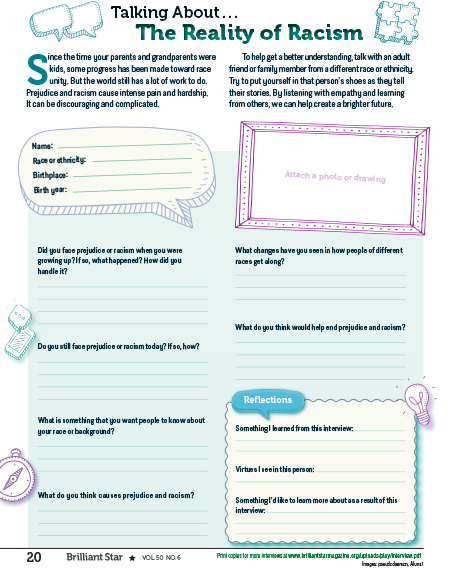
Interview an adult friend from another race or culture.
> PURPOSE
This page gives students an opportunity to listen to the experiences of others and try to imagine themselves in the same situations, to practice empathy. It may also offer a better understanding of the history of racism in the last few decades.
> QUESTIONS FOR DISCUSSION
Pre-K/Kindergarten | Early Elementary
- Interviewing someone might feel like a big deal, but it’s really just listening—especially if the person is someone you already know well, like an aunt, uncle, grandparent, or close family friend. Who are people you’d like to interview? Why do you want to hear their stories?
- What is prejudice?
- What is racism?
- Why are prejudice and racism bad?
Late Elementary | Junior Youth
- What is the difference between prejudice and racism?
- Do you think people growing up in all countries experience prejudice and racism?
- Do you think people growing up now experience prejudice?
- If you’ve experienced racism or prejudice, do you feel comfortable talking about it? If so, who do you feel you could talk to?
- If you think you might have a prejudice, who could you talk to about it?
> ACTIVITIES TO ENHANCE LEARNING
Pre-K/Kindergarten
> To give students practice with interviewing, ask them to pair up with someone they don’t know very well (if possible) and chat for a few minutes.
> Make a plan to do a first interview (if they’re pre-readers, they could just learn two questions to ask and draw a picture that expresses the answer.)
Early Elementary
> Put some simple questions on index cards, like Where do you live? What’s your favorite food? Do you have brothers and sisters? etc. To give students practice with interviewing, ask them to pair up and take turns picking cards and answering guestions. (Explain that answers will be shared with the class later.) Emphasize the listening part by asking kids to share the most memorable answer.
> Practice asking a person if you can interview them about their experiences with prejudice and racism over their lifetime. Practice what to say if they say no.
Late Elementary | Junior Youth
> To give students practice with interviewing, ask them to pair up and chat quietly for 10 minutes with someone in the class who they don’t know well (if possible). Ask each person to think of a negative or positive interaction between people of different skin colors that happened in their school, neighborhood, town, or anywhere in the U.S. One person shares their story while the other listens without commenting or asking questions. Then the listener asks questions about how speaker felt about the interaction and what the effects were. The speaker answers and the listener thanks the speaker. Then the people in each pair switch roles and repeat the process.
> Have the students answer the questions themselves first. Discuss what questions might be difficult and why. Discuss how to show respect to your interview subject.
> Ask students to develop a few more interview questions to add to the ones on this page.
> Challenge students to do research about events related to racial justice that happened in the U.S. over the last 100 years. Create a timeline together as a class.
> Make a list of older people you might be able to interview who grew up in the U.S. Figure out what decade they were your age. Try to match your people to the timeline and ask them about specific events.
Updated on 6.19.20