
Parents and Teachers
Teaching Tools & Ruhi Classes
Teachers’ Guides & Resources
Teachers’ Guide: “Hearts in Harmony,” Part 3

This guide is a tool to assist teachers of children’s classes and junior youth animators in using Brilliant Star’s race unity content in the classroom. While Brilliant Star is developed for kids aged 7-12, many younger and older kids enjoy learning from it. Activities can be adapted and expanded to engage groups ranging from ages 4-14. You’re invited to explore this guide and to share your own ideas in our Facebook group, Brilliant Star Idea Exchange.
These are the key themes in this issue; the discussion questions for each page can help to encourage dialogue:
-
Acknowledging the nobility of the soul and the commonalities among all members of the human family;
-
Understanding the meaning and impact of prejudice and racism, and using practical tools to overcome these negative forces;
-
The importance of putting prayer and study of holy writings into concrete action against prejudice and racism;
-
Building unity in our families, neighborhoods, and communities by getting out of our comfort zone and reaching out to others with kindness and friendship;
-
Emphasizing a sense of hope that creating a unified world is possible and inevitable;
-
Developing virtues of patience, perseverance, service, and initiative.
You can search, download, or print the full issue here.
We recommend Google Chrome for viewing and downloading PDFs.
For each page, you’ll find discussion questions and activities to enhance learning.
“Hearts in Harmony” Pages, Part 3
24 - Fun & Friendship from A to Z
26 - Shining Lamp: Robert Turner
27 - Riley’s Rainforest: Team Up with Diversity
29 - aMAZEing Adventure: Music of Unity
You Can Find Part 1 Here (pages 2-10)
You Can Find Part 2 Here (pages 11-20)
PAGE 21: MEDIA MADNESS

Complete tips for thinking critically about the media.
> PURPOSE
This page aims to help kids understand the presence and impacts of stereotypes in the media they consume. Through helpful tips, readers learn to identify stereotypes in movies, books, shows, and games, and are empowered to protect themselves from their effects.
Quote: “Freedom from racial prejudice . . . should be consistently demonstrated in every phase of their activity and life . . .” —Bahá’í Writings
> QUESTIONS FOR DISCUSSION
Pre-K/Kindergarten | Early Elementary
- Who are the main characters in your favorite books and shows? Do they look like you?
- Is there a place in the world you’d like to learn more about?
- Is there a book, movie, show, or game that helped you learn about someone different from you?
Late Elementary
- What are some stereotypes you’ve seen in books, shows, movies, and video games?
- Why is it important to read books and use other media with diverse characters?
- What makes stereotypes harmful?
- What can you do when you notice a stereotype in the media?
- Does the diversity in your community match what you watch and read?
Junior Youth
- Have you ever felt stereotyped?
- How do you feel when you see stereotypes in media?
- What do you do when confronted with a stereotype?
- What stereotypes have you noticed on the news, in ads, and in other media?
- What stories are missing from the media you consume?
> ACTIVITIES TO ENHANCE LEARNING
Pre-K/Kindergarten
> Draw a “Me Collage.” Give each student an empty outline of a human body, then invite them to draw pictures of the things they love – food, friends, family, activities, etc. Ask students to take turns sharing their collages, finding things kids have in common and what makes them unique.
> Watch the “Sweet Neighbors Come in All Colors” music video. Sing the song and dance together. Then draw “Sweet Neighbors” fruit characters to celebrate diversity.
https://www.youtube.com/watch?v=f1M_XaqJD8U
You can also print out “Sweet Neighbors” coloring pages here:
http://studio9inc.com/sweet-neighbors-coloring-pages
Early Elementary
> Divide into pairs. Each student traces their partner’s hand onto a blank sheet of paper. Then they write their partner’s name across the center of the paper hand, and a positive quality about them along each finger. Decorate the hands using crayons or colored pencils, then glue or tape them to a large sheet of paper to create a classroom mural.
> Create a “Me Collage.” Give each student an empty outline of a human body, old magazines, scissors, and glue. Invite them to draw or cut out pictures of the things they feel make up who they are – food, friends, family, activities, etc. Take turns sharing their collages, finding things kids have in common and what makes them unique.
Late Elementary
> Post a large world map at the front of the room. Ask each student to create a list all the places in the world they’re connected to. For example, where they currently live, where they were born, where their parents and grandparents were born, where their ancestors are from, where family currently lives, etc. Each student makes small rectangles of paper with their name on it and pins their name to each location they’re connected to on the map. Talk about the diversity and similarities of our connections that go deeper than skin color.
> Gather picture books or magazine for kids to explore. Working in pairs, ask kids to go through each book or magazine and identify which groups of people are represented and which ones are missing.
> Create a “Me Collage.” Give each student an empty outline of a human body, old magazines, scissors, and glue. Invite them to draw or cut out pictures of the things they feel make up who they are – food, friends, family, activities, etc. Then work together as a class to combine each individual collage into a class collage/mural.
Junior Youth
> Ad Study – Cut out age-appropriate ads from magazines. Divide into groups of two or three and give each group three or four ads to study. What stereotypes do they see? What unspoken messages are being conveyed to try to convince people to buy the products?
> Story Time – Together as a group, create a list of diverse characters. Describe them beyond what they look like. For example, what activities do they love to do with their family or alone? What is their favorite part of school? What is their least favorite school subject? Next, create a list of challenges or obstacles characters could face. Divide into pairs. Each pair chooses one character and one scenario to create a short story that avoids stereotypes and allows each character to be unique.
> Work together as a class to create a newspaper that’s free from harmful stereotypes. Write articles about what’s happening at the seasonal school you’re attending, interview diverse people, share photos of the different classes, etc.
PAGES 22-23: STARGAZER: VAN GILMER
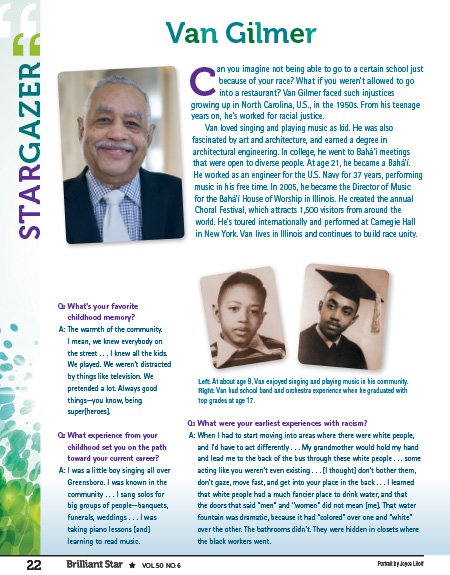
Get to know Van Gilmer, a musician and social justice advocate.
> PURPOSE
As the tagline (“Questions and Answers with an Inspirational Bahá’í”) suggests, Stargazer articles spotlight the life, work, and kid-friendly perspectives of adult Bahá’ís who kids can look to as a role model. Stargazers work in fields that are relevant to the theme of each issue. In this issue about “Hearts in Harmony,” choir director Van Gilmer describes his work using music as a tool to build community among people of different racial, ethnic, and religious backgrounds.
> QUESTIONS FOR DISCUSSION
Pre-K/Kindergarten | Early Elementary
- What is one thing you learned from this interview?
- Do you enjoy playing pretend, like Van did as a kid? What is your favorite thing to pretend to be or do?
- As a kid, Van sang at large public gatherings in his area. Do you like to sing, dance, or do plays for people? Talk about a time when you performed for a group of people.
- Is there a certain song or type of music that makes you feel close to God? Please tell us about it.
- Van said we need to create more opportunities for people of different races (especially black and white) to come together and get to know each other. What can you do (or what are you already doing) to get to know people of different races?
Late Elementary | Junior Youth
- What is one thing you learned from this interview?
- Which one of Van’s answers was most interesting to you? Why?
- Is there a certain song or type of music that makes you feel close to God? Please tell us about it.
- Imagine living during segregation—with separate water fountains, restrooms, and schools for people with different skin colors. How would you feel if you lived in that situation?
- Although segregation is no longer legal, African American people still face discrimination in education, jobs, housing, and other areas. Have you seen or experienced this?
- Van said we need to create more opportunities for people of different races (especially black and white) to come together and get to know each other. What can you do (or what are you already doing) to get to know people of different races? Share your ideas with the rest of the class, and then make a plan to create one new opportunity in your community.
> ACTIVITIES TO ENHANCE LEARNING
Pre-K/Kindergarten | Early Elementary
> Sing “We Have Come to Sing Praises” by Van Gilmer
https://www.youtube.com/watch?v=qX7KJhT2U28
> Talk about songs that lift your spirits, and why. Sing some of your favorites together. Examples of uplifting songs:
If You Want a Song (You Gotta Sing) – Okee Dokee Brothers
https://www.youtube.com/watch?v=0EOV0yWIKK0
Sesame Street: Will.i.am Sings "What I Am"
https://www.youtube.com/watch?v=cyVzjoj96vs&list=PLkDyfDyf23GaaEY49qYM74f8yBIN86t7E
Late Elementary | Junior Youth
> Encourage students to sing some of their favorite songs that relate to unity.
> Ask the class or groups of students to make a music video or create a dance to accompany their favorite unity song.
> Talk about songs that lift your spirits and why.
> Explore Brilliant Star’s Music Resources
https://brilliantstarmagazine.org/search/pdf/eyJyZXN1bHRfcGFnZSI6InNlYXJjaFwvcGRmIiwia2V5d29yZHMiOiJtdXNpYyJ9
PAGE 24: FUN & FRIENDSHIP FROM A TO Z

Unscramble words to discover conversation-starting questions.
> PURPOSE
This activity encourages students to reduce prejudice by making friends with someone from another race. It presents 26 questions that students can use to start an interesting conversation with someone new. Students unscramble one word in each question.
> QUESTIONS FOR DISCUSSION
Pre-K/Kindergarten | Early Elementary
- Do you ever have a hard time knowing what to say when you meet someone new? If so, what do you do about it?
- What are some ways to be fair and friendly in a conversation?
- What are some things you like to do with your friends?
- Are there kids you know that you could try to be better friends with? How would you do that?
Late Elementary | Junior Youth
- Do you ever have a hard time knowing what to say when you meet someone new? If so, how do you handle it?
- What makes a conversation interesting and meaningful to you?
- How do you feel when you’re having a meaningful conversation?
- How does it feel when you’re having a conversation about topics that aren’t meaningful, or when you hear gossip about other people?
- What are some ways that body language or nonverbal communication can send a message to others? What kind of body language makes a person seem friendly and approachable?
> ACTIVITIES TO ENHANCE LEARNING
Pre-K/Kindergarten
> Write letters A through Z on a poster or white board. Ask the class to share ideas about topics for conversation that begins with each letter. Then invite students to make up a question using one of the words and ask another student to answer it. Continue the activity, allowing enough time for each student to ask and answer a few questions.
> Play the telephone game. Have students sit in a row, and whisper a sentence to the first kid. Each kid whispers the sentence to the next person, so the sentence travels down the row. The sentence can only be whispered once, so everyone needs to listen carefully. The last person in the row says the sentence out loud. Is it the same or different than the sentence you started with?
It’s likely the sentence will get mixed up by the time it reaches the last person. Ask students if they think a story or rumor could get mixed up in the same way when it’s passed from one person to another.
Early Elementary | Late Elementary | Junior Youth
> After students have unscrambled the words in this activity, divide them into pairs. Give each pair a six-sided dice and a small object to use as a game token. Students put their token on the question that begins with the first letter of their first name. One student rolls the dice and moves their game token to the number of dialogue boxes shown on the dice (for example, if a student at “A” rolls a one, they would move their token to either B, J, or K). They read the question that they land on out loud and answer it.
Then the next student rolls the dice. Continue for 10-15 minutes or until both students have a chance to answer every question. Bring students back to together in a large group and ask them to share their thoughts about how they felt when playing the game. Did they learn anything new about their classmate?
> Ask each student to make up their own A to Z game with new questions for conversation. One word in each question should be scrambled. When everyone is ready, divide the student into pairs and ask them to swap activities and complete someone else’s. Then they take turns asking each other questions.
> Give each student an index card with one of the A to Z questions written on it. They write down their answer, adding details to make it personalized, and put their name next to it. Then collect the cards. Read each question and answer aloud and ask students to write the name of the person they think it came from. After you’ve read them all, read them again, and ask students to share the name of the person they guessed as the writer. The student who guesses the most writers correctly wins the game.
Note: This game can be played virtually by sending each other emails or text messages with the questions and answers.
PAGE 25: FLOCK OF FELLOWSHIP
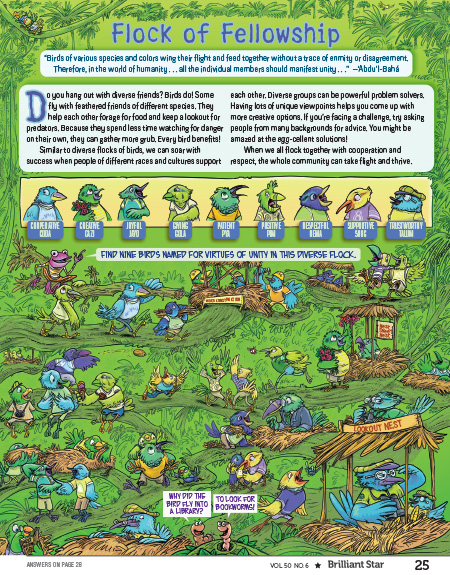
Find nine birds named for unifying virtues.
> PURPOSE
This piece teaches readers about the unity and teamwork that takes place in a mixed-species flock of birds. It’s also an animal find where they spot specific birds named for virtues of unity. Readers learn that diversity strengthens problem-solving, and are encouraged to support and seek advice from their own diverse communities.
Quote: “Birds of various species and colors wing their flight and feed together without a trace of enmity or disagreement. Therefore, in the world of humanity ... all the individual members should manifest unity ...” —‘Abdu’l-Bahá
> QUESTIONS FOR DISCUSSION
Pre-K/Kindergarten | Early Elementary
- Have you ever seen different types of birds flying together?
- Would you like it better if the world had one type of bird, or do you like having many types of birds? Why?
- Do you think birds fight about what color they are?
- What does teamwork mean?
- What does unity mean?
- What is a community?
- How do you like to help your friends?
- If you’re playing a game, how can you help everyone feel welcome to join?
Late Elementary | Junior Youth
- What is diversity?
- What are some other ways you’ve seen unity in diversity in nature?
- Do you live in a diverse community?
- Can you think of something cool you learned from someone of a different race, culture, religion, or background than you?
- Can you think of a time when you solved a problem with a diverse group?
- What are different ways we can help our community “flock together”?
> ACTIVITIES TO ENHANCE LEARNING
Pre-K/Kindergarten | Early Elementary
> Try a real-life virtue find. Write out each virtue that’s listed in “Flock of Friendship” on a piece of paper, with one virtue per paper. Then, hide the virtues and have the kids search for them. For each virtue they find, explain what that virtue means and give an example.
Optional: If you haven’t decorated the virtue papers, students can color and beautify them once they’re all found.
> Invite kids to draw their own birds and make them colorful and diverse.
> Make “nests” of your own with materials around your house or outside. The nests can be whatever size you choose. Once the kids have constructed their nests, you could name them after a virtue in “Flock of Friendship,” such as “Nest of Patience.”
> Make hard-boiled eggs, then paint them with virtues from this activity.
Late Elementary | Junior Youth
> Have students take the quiz: How Welcoming Are You?
https://brilliantstarmagazine.org/uploads/play/Luminous_Library_2017/Welcoming_Quiz_MA17_p6.pdf
> For an improvisational activity, have kids brainstorm a problem that their community or the world is facing. Then, have each kid choose a virtue from “Flock of Friendship” and act out a skit where they use their virtue to solve the problem.
> Build teamwork skills and strengthen bonds of friendship with these group games:
https://brilliantstarmagazine.org/uploads/play/Luminous_Library_2015/Games_for_Change_SOND15_JF16_p25.pdf
> Learn tips for solving problems as a team with this piece: “Zeke & Rhombus: Power Up with Diversity”
https://brilliantstarmagazine.org/uploads/play/Luminous_Library_2017/ND17p27_Zeke_Diversity_Tips.pdf
Answers: 1) team, 2) time, 3) brain, 4) Write, 5) words, 6) ideas, 7) location, 8) Keep, 9) welcomes
> Learn tips for community building with this piece: “Dance with Diversity”:
https://brilliantstarmagazine.org/uploads/play/Luminous_Library_2018/Dance_with_Diversity_V50_N2_RS.pdf
Answers: 1) fun, 2) passionate, 3) creative, 4) Practice, 5) patient, 6) Listen, 7) include, 8) positive, 9) Reflect, 10) thanks
> Have students craft a Family & Friends Tree as a way to show appreciation for their diverse communities:
https://brilliantstarmagazine.org/articles/nurs-nook-tree
PDF Version:
https://brilliantstarmagazine.org/uploads/play/Luminous_Library_2018/Nur_Friends_Family_Tree_V50_N2.pdf
PAGE 26: SHINING LAMP: ROBERT TURNER (1855-1909)
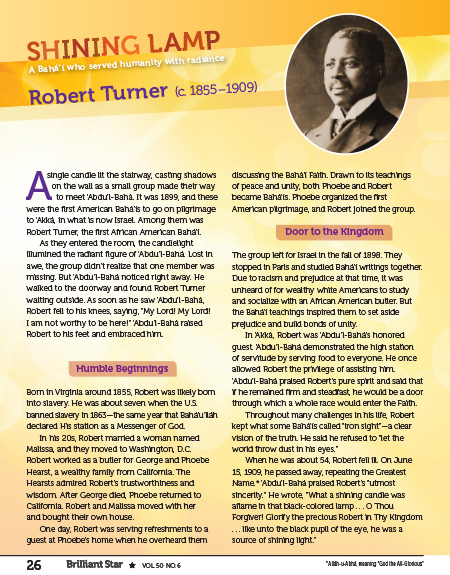
Meet the first African American Bahá’í.
> PURPOSE
This feature shares stories of inspirational Bahá’ís throughout the history of the Faith. As the first African American Bahá’í, Robert Turner opened the door for greater diversity in the American Bahá’í community. His presence on the first pilgrimage of Western believers challenged social norms and helped the small community grow.
> QUESTIONS FOR DISCUSSION
Pre-K/Kindergarten | Early Elementary
- How do you think you would feel if you got to meet ‘Abdu’l-Bahá?
- Robert Turner was the first African American Bahá’í. How do you think it feels to be the first person to do something new?
- Robert Turner was given the honor of serving with ‘Abdu’l-Bahá. If you could serve with ‘Abdu’l-Bahá, what would you like to do? How do you think you would feel?
Late Elementary
- What qualities did Robert Turner show in this story?
- What did Robert Turner mean when he said he wouldn’t let the world throw dust in his eyes?
- ‘Abdu’l-Bahá showed the pilgrims that service was noble and honorable. What impact do you think that had on Robert Turner, who worked as a butler?
Junior Youth
- What is “iron sight” and how can you develop it?
- What qualities does it take to be the first person in your family or community to do something new?
- What do you think it was like for Robert Turner to be the only African American in the first group of western pilgrims?
- ‘Abdu’l-Bahá showed the pilgrims that service was noble and honorable. What impact do you think that had on Robert Turner, who worked as a butler?
> ACTIVITIES TO ENHANCE LEARNING
Pre-K/Kindergarten
> Create a class mural. In the center of a large blank sheet of paper, write ‘Abdu’l-Bahá’s words about Robert Turner, “What a candle was aflame in that black-colored lamp . . .” Each student cuts a candle from colorful construction paper (it can be a simple rectangle) and glues it to the area around the quote. They can either draw a flame above their candlestick, or cut a flame from yellow construction paper to glue to their candles. Discuss ways we can be “aflame” with virtues like service, love, and friendship.
> Sit in a circle and light a single candle placed in the center of the circle. Or let each child hold a small battery-operated candle. Invite the class to say prayers for the spirit of Robert Turner and for friendship among people of all races.
Early Elementary
> Sit in a circle and light a single candle placed in the center of the circle. Or let each child hold a small battery-operated candle. Invite the class to say prayers for the spirit of Robert Turner and for friendship among people of all races.
> Draw a picture of a group of American Bahá’ís sailing to Israel for Bahá’í pilgrimage in 1912. Talk about the type of clothing they wore. For example, here is one image of Phoebe Hearst, Robert Turner's employer:https://en.wikipedia.org/wiki/Phoebe_Hearst#/media/File:Phoebe_Apperson_Hearst.jpg
Their ship may have looked something like this:
https://thomascsanger.com/wp-content/uploads/2016/11/mauretania.jpg
https://americanhistory.si.edu/onthewater/assets/graphic/full/6038.jpg
Late Elementary
> The first group of American Bahá’ís to go on pilgrimage traveled on a ship to Paris before making their way to Haifa, Israel. Write a story from the perspective of another passenger on that ship. What conversations can you imagine the Bahá’ís having with their fellow passengers? Their ship may have looked something like this:
https://thomascsanger.com/wp-content/uploads/2016/11/mauretania.jpg
https://americanhistory.si.edu/onthewater/assets/graphic/full/6038.jpg
> Prepare devotions for your seasonal school, dedicated to Robert Turner. You may want to choose prayers for the progress of his soul, prayers for humanity, and writings related to race unity. Before you begin the devotions, share the story of Robert Turner with the seasonal school participants.
Junior Youth
> The first group of American Bahá’ís to go on pilgrimage traveled on a ship to Paris before making their way to Haifa, Israel. Write a story from the perspective of another passenger on that ship. What conversations can you imagine the Bahá’ís having with their fellow passengers? Their ship may have looked something like this:
https://thomascsanger.com/wp-content/uploads/2016/11/mauretania.jpg
https://americanhistory.si.edu/onthewater/assets/graphic/full/6038.jpg
> Using a long sheet of banner paper, work together as a class to create a timeline of major events in the history of race relations in the United States and corresponding events in the history of the Bahá’í Faith. (If your class is large, you may want to split the students into groups and ask each group to create a timeline.) Ask students to decorate the timeline with images that relate to the events. (Remind students not to draw the Báb, Bahá’u’lláh, or ‘Abdu’l-Bahá, out of respect.) Possible resources:
https://www.racialequitytools.org/resourcefiles/racismimmigration-timeline.pdf
https://bahaipedia.org/Timeline
https://brilliantstarmagazine.org/articles/timeline
PAGE 27: RILEY’S RAINFOREST: TEAM UP WITH DIVERSITY
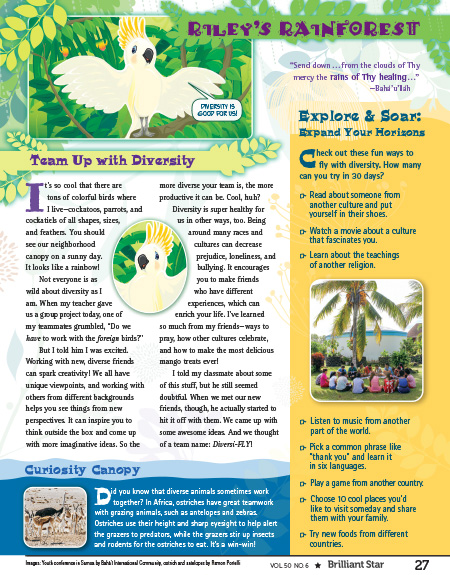
What are the benefits of unity in diversity?
> PURPOSE
This piece reveals the scientifically-proven benefits of working in diverse teams and being exposed to diversity in everyday life. Kids learn fun ways to experience and appreciate all the cultures that make our world vibrant and beautiful.
Quote: “Send down ... from the clouds of Thy mercy the rains of Thy healing ...” — Bahá’u’lláh
> QUESTIONS FOR DISCUSSION
Pre-K/Kindergarten | Early Elementary
- Do you know anyone who was born in another country? What have you learned about that country?
- What is a favorite food you love from another country?
- What are ways we can make everyone feel happy and welcome?
- Think of a garden. Is it prettier to have one type of flower, or many types of flowers?
Late Elementary | Junior Youth
- What is diversity?
- Why is learning about diversity important for building a unified community?
- What cultures make up your community?
- What are ways you like to appreciate diversity?
- What is racism?
- How does racism stop us from appreciating diversity?
- If you heard a racist joke or comment, what are some things you could do?
- How can we help everyone feel included in a group activity?
> ACTIVITIES TO ENHANCE LEARNING
Pre-K/Kindergarten | Early Elementary
> Discuss common terms for skin color (such as black and white) and how they don’t truly describe the actual shade of the person’s skin. Invite kids to think about their own skin color and create a name that describes it more accurately.
> Invite kids to draw a picture of their family, friends, faith group, or neighborhood using pencils, markers, or crayons with a wide range of options for skin tones.
> Play music from diverse cultures and have a dance party.
> Teach kids to say hello and goodbye in three languages. Possible resources:
https://bilingua.io/how-to-say-hello-in-100-languages
https://www.wikihow.com/Say-Goodbye-in-Several-Different-Languages
> Bring foods from three different countries and invite kids to try them, then guess where they’re popular. (Make sure to check with parents for dietary restrictions).
> Color “Our Global Family,” and ask kids what they enjoy about other cultures. Use crayons, markers, or colored pencils with a wide range of options for skin color.
https://brilliantstarmagazine.org/uploads/play/Luminous_Library_2013/JF13_Our_Global_Family.pdf
Late Elementary | Junior Youth
> Ask students to share three places around the world they would love to visit and why.
> Have students listen to recordings of people speaking in five different languages. Then replay the recordings and have them guess which language is being spoken.
> Play games from diverse cultures. Here are some options:
https://brilliantstarmagazine.org/uploads/play/Luminous_Library_2015/Let_the_Games_Begin_MJJA15.pdf
> Read a story based on a traditional folktale and learn some facts about the culture it comes from. Here are some options:
https://brilliantstarmagazine.org/articles/the-amazing-orchard
https://brilliantstarmagazine.org/articles/song-of-the-heart-adapted-from-a-yoruba-folktale
https://brilliantstarmagazine.org/articles/great-escapes
PAGE 29: AMAZING ADVENTURE: MUSIC OF UNITY

Navigate the musical maze at a jazz concert.
> PURPOSE
This page explains how jazz music is an example of unity in diversity. Just as different notes work together in a song, we can create beauty and peace in our communities when people of different races and backgrounds work together and form friendships. In a maze set at a jazz concert, readers follow blue music lines to reach a blended rainbow chord at the end.
Quote: “The diversity in the human family should be the cause of love and harmony, as it is in music where many different notes blend together in the making of a perfect chord.” —‘Abdu’l-Bahá
> QUESTIONS FOR DISCUSSION
Pre-K/Kindergarten | Early Elementary
- What kinds of music do you like to listen to or play?
- How would it sound if every member in a band played a different song?
- What happens when all the musicians listen to each other and work together?
- What does diversity mean?
- What are some ways that people are diverse?
- What does unity in diversity mean?
- What are some things we can do to make friends with all people?
Late Elementary | Junior Youth
- What kinds of music do you like to listen to or play?
- How would it sound if every member in a band played a different song?
- What happens when all the musicians listen to each other and work together?
- What does unity in diversity mean? Can you give some examples of ways that
- people show unity in diversity?
- How could you learn more about the diversity in your community?
- What are some things you can do to be a friend to all people?
> ACTIVITIES TO ENHANCE LEARNING
Pre-K/Kindergarten | Early Elementary
> Give each student a sheet of paper and crayons or colored pencils. Ask them to start drawing while you play jazz music (to tie into this maze) and to stop drawing when the music stops.
Leaving the paper and art supplies where they are, each student moves to the seat next to them. They draw on another student’s paper while you play music. Continue until each student has returned to their own paper, where they’ll see a drawing that reflects unity in diversity.
> Talk with students about body percussion (hand clapping, foot stomping, finger snapping, etc.). Ask each student to make up their own sound. Then invite everyone to continuously make their sound to create a group musical performance. The individual sounds will blend together to make something new.
> Choose some songs that convey different emotions, such as happiness, excitement, sadness, awe, etc. Ask students how they might dance if they felt happy, sad, etc. Announce the emotion conveyed before you play each song (or song portion), then ask students to dance in a way that expresses that emotion (for example, for a happy song, they might be energetic, and for a sad song they might move more slowly).
After you’ve played all the songs, bring the group together and talk about how all people have the same kinds of feelings at times, and that’s one way humanity is unified.
Late Elementary | Junior Youth
> Give each student a sheet of paper and colored pencils or markers. Ask them to start drawing while you play jazz music (to tie into this maze) and to stop drawing when the music stops.
Leaving the paper and art supplies where they are, each student moves to the seat next to them. They draw on another student’s paper while you play music. Continue until each student has returned to their own paper, where they’ll see a drawing that reflects unity in diversity.
> Ask students to draw their own mazes. One simple approach is to draw shapes (such as circles or squares) within shapes. Erase small parts of each shape to create gaps. Choose one path through the maze as the solution. Then draw lines to close off all other paths.
Decorate the maze with designs and images. Create a positive image at the end of the maze. Invite students to exchange mazes with another student (especially someone they don’t know well) and solve them. Then talk as a group about how students created their mazes and made their design choices.
For a basic example and step-by-step instructions, visit this website:
https://www.instructables.com/id/How-to-Draw-a-Maze/
> Ask students to work in groups to create their own dance that expresses unity in diversity. Assign a song to each group, or invite them to choose from a selection of songs. After the groups have had 15 minutes to work on their dance, bring the groups together and ask each one to perform for the class. Close the activity by inviting all of the groups to dance at the same time.
> Ask the students to create homemade harmonicas and/or ukuleles with these Nur’s Nook activities. Then invite everyone to play their instruments together in a group performance.
https://brilliantstarmagazine.org/articles/nurs-nook-songs-in-space
https://brilliantstarmagazine.org/uploads/play/Luminous_Library_2016/Nur_Ukulele_ND16.pdf
Updated on 6.18.20