
Stargazer: Ridvan Foxhall
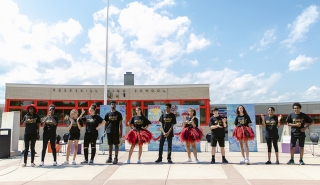

The arts are “therapeutic” and “an expression from the soul,” Ridvan Foxhall says.
Can you imagine flying across the world at age eight to live in another country—without your parents? That’s what Ridvan Foxhall did when she and her sisters went to New Era Bahá’í School in India. Their parents stayed in Nigeria to work. After high school, Ridvan moved to New York City to study fine arts and photography.
When Ridvan married her husband, Eric, and they had a son, she felt called to work with kids who have mental and behavioral differences. She earned a master’s degree in occupational therapy to help kids build social and emotional skills. Then she started a local chapter of the Children’s Theatre Company. It was such a hit that kids and parents asked her to expand it. So, in 2013, Ridvan founded New Era Creative Space, offering kids classes in arts, science, technology, and leadership, plus volunteer opportunities. Ridvan lives in New York with her family.
Q: What’s your favorite childhood memory?
My mother always threw us big birthday parties. And what was special about that is she baked our cakes. Nigeria is a very hot country ... You shouldn’t be baking big cakes in 90-degree weather, but my mother always made a big deal of my birthday.
Q: How did living in diverse cultures impact you?
I was living in a community [at school] where ... we had kids from literally all over the world, and when those kids become your family ... the oneness of humanity works ... [I had] a really strong sense of ... pride in my nobility ...

At age eight, Ridvan (second from left), her older sister, Eme (left), and her younger sister, Glory, left Nigeria to attend school in India.
Q: What was the most challenging experience for you as a kid?
I think [it] was leaving Nigeria. I was eight years old. The three of us—my sisters Eme and Glory and myself—we went to India, to the New Era Bahá’í School. That was really hard because ... I loved being with my parents, and that was a young age to be separated from them. Glory was six, I was eight, and Eme was 12. I think I overcame it because I had my sisters with me and we became a team ... I got to love the school, but I can’t say I did in the beginning. I was just like, why are we here—different country, different food, different language? As an adult, I appreciate it, but as a child ... I couldn't understand it.
Q: What is New Era Creative Space, and what inspired it?
I was inspired by Mehr Mansuri, [who founded] the Children’s Theatre Company (CTC) in New York City ... This concept of building character using theater really stuck with me ... With Mehr’s support, [I started] the Peekskill chapter of the [CTC] ... We [also] started a junior youth empowerment group ... We decided to go beyond theater and started New Era Creative Space ... I wanted to expand this concept of using the arts [in] empowerment groups ... using the Bahá’í JY model ...
Q: How do drama and other arts help our communities?
It’s kind of an expression from the soul—music, visual art, theater, spoken word ... The arts are therapeutic ... Bahá’u’lláh says something about music being a ladder to the soul. I feel that about all the arts. It gives [people] a voice ... an outlet.

Ridvan (second from right) gets support for New Era Creative Space from her husband, Eric (left), their daughter, Zia, and son, Jared.
Q: This issue of Brilliant Star is about joyful service. What can kids do every day to help their family, friends, or community?
With family, they can just support each other. I used to tell my kids that we are a community in this house. Everybody has a role to play, and if they can anticipate some of the needs of each other ... That's what service is ... you do it not because you’re asked but because something needs to be done and that can bring you joy ... I talk to the youth about ... what does kindness or truthfulness ... look like in the hallway of your school? ... We can be a part of the change ...
Q: What are some benefits and skills that kids gain by doing service?
Empathy is one of the benefits of service. Service makes you happy ... [It] seems like you’re doing something for someone else, but ... when I talk to the kids and we do [service], it brings them such joy and pride. So, service ultimately does more for you than it does for the person you’re serving. And ‘Abdu’l-Bahá says that ... if you’re feeling depressed or moody ... go serve someone else ...
Q: What’s something you’d like kids to know about ‘Abdu’l-Bahá?
You know that song, “Look at me, follow me, be as I am”?** The being part, ‘Abdu’l-Bahá lived [that], he served ... [He] met with dignitaries, but also helped clean people and take care of them and give them clothing. The humility of that ... I want people to remember that—the doing part. ‘Abdu’l-Bahá did. He walked service. I try to remember that, especially when I ... serve communities that are marginalized.
* See the 2021 performance of "Melanin Magic":
youtube.com/watch?v=_f8LIRB0XCs
** See youtube.com/watch?v=jyx-YILlUOM
Images: Melanin Magic photo by Rana Faure, portrait by Ocean Morisset
Discover553 Stargazer28 Stargazers94 African American36 Creativity296 Arts84 Theatre3 Drama15 Poetry19 Singing35 Leadership42 Service308 Empowerment6 Communities57