
Parents and Teachers
Teaching Tools & Ruhi Classes
Teachers’ Guides & Resources
Teachers’ Guide, “Hope for Our Future,” Part 2
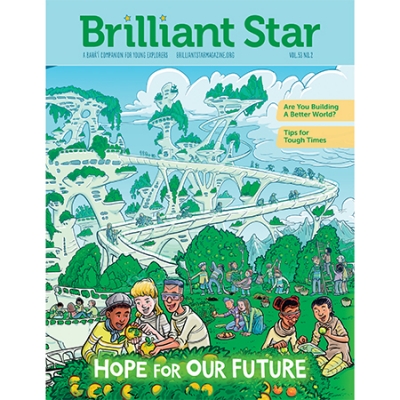
This guide is a tool to assist teachers of children’s classes and junior youth animators in using Brilliant Star’s “Hope for Our Future” issue in the classroom. While Brilliant Star is developed for kids aged 7-12, many younger and older kids enjoy learning from it. Activities can be adapted to engage ages 4-14. You’re invited to share your own ideas in our Facebook group, Brilliant Star Idea Exchange.
The Bahá’í Faith provides a unifying vision of society that meets humanity’s needs for oneness, equality, and justice. It asserts that the welfare of individuals is connected to the welfare of society. This issue provides tools to encourage kids in refining their characters, fortifying themselves against tests, and building unity in their families, schools, and communities.
Features and Topics include:
-
Inspiring story of Bahá’u’lláh’s vision for a world founded on peace and justice, with explanations of the Covenant and the Nine Year Plan;
-
Fun ideas for exploring nature with family and friends to build gratitude and wonder;
-
A hot-air balloon craft to encourage hope and joy;
-
Goal-setting chart to steer kids toward their dreams;
-
Tips for avoiding materialism and limiting screen time to focus on true happiness;
-
Story of Dr. Ugo Giachery and his work to help build the Shrine of the Báb and share the Faith with Malietoa Tanumafili II, the king of Western Samoa;
-
How to handle challenges with patience and courage;
-
Activity for writing and drawing about positive experiences with teamwork;
-
Quiz about how kids can take steps to build a brighter world;
-
Ideas from 10 kids around the world about creating a peaceful planet, fostering positivity, and having a hopeful outlook;
-
Building connections among diverse people and using consultation;
-
Relying on faith to help us weather storms and fortify our minds and spirits against tests;
-
Walking on a path of service throughout our lives.
We recommend Google Chrome for viewing and downloading PDFs.
You can search, download, or print the full issue here.
Hope for Our Future Pages, Part 2
13 - Quiz: Are You Building a Brighter World?
14-15 - Lightning and Luna, Episode #97: The Vault
You Can Find Part 1 Here (pages 1-10)
You Can Find Part 3 Here (pages 20-29)
AGE GROUPS:
Pre-K/Kindergarten (4-5)
Early Elementary (6-7)
Late Elementary (8-10)
Junior Youth (11-14)
PAGE 11: WE ARE ONE
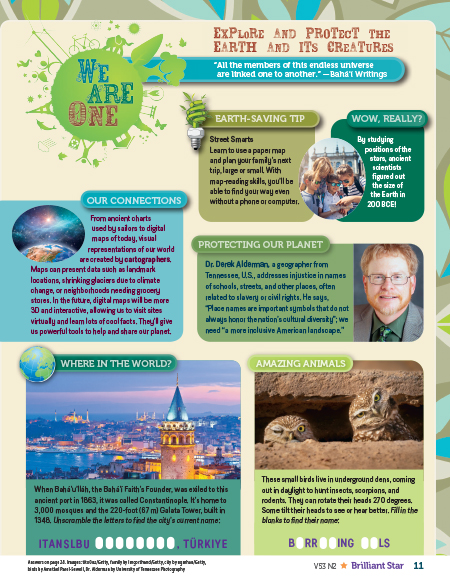
Explore and care for the planet!
> PURPOSE
The “We Are One” feature inspires us to explore and protect the Earth and its creatures by learning more about the environment and our connections with it and each other.
Quote: “All the members of this endless universe are linked one to another.”
—Bahá’í Writings
> QUESTIONS FOR DISCUSSION
Pre-K/Kindergarten (4-5) | Early Elementary (6-7)
- What is the name of the street you live on? (or your school or town) Do you know what it means?
- If you were naming a school or park, what would you call it? Why would you choose that name?
- Do you ever use maps? In what ways? (Examples: GPS, map of a theme park, hiking trail maps, etc.)
Late Elementary (8-10) | Junior Youth (11-14)
- What is the name of the street you live on? (Or your school or town) Do you know what the name means?
- Why are names of public places so important?
- If you were going to give a new name to your city or state, what would you choose, and why?
> ACTIVITIES TO ENHANCE LEARNING
Pre-K/Kindergarten (4-5) | Early Elementary (6-7)
> Map of Exiles
Read “Injustice in Constantinople” and share the map with the students.
https://brilliantstarmagazine.org/uploads/play/Luminous_Library_2017/Baha_Life_MA17_p4p5.pdf
> Map Exploration
Using a map or globe of the world, ask students to point to where they live and have visited. Help them find the places Bahá’u’lláh lived.
> Map Your Area
Have students make a map of the school area:
https://www.pbs.org/parents/crafts-and-experiments/lets-make-a-map
Make a 3D map of your area or a make-believe town:
https://brilliantstarmagazine.org/uploads/play/Luminous_Library_2018/The_Guardians_Creativity_V50_N2.pdf
Late Elementary (8-10) | Junior Youth (11-14)
> Map of Exiles
Have students take turns reading “Injustice in Constantinople.” Study the map.
https://brilliantstarmagazine.org/uploads/play/Luminous_Library_2017/Baha_Life_MA17_p4p5.pdf
> Map Puzzle
Have students complete the Ecoville map puzzle
https://brilliantstarmagazine.org/uploads/play/Luminous_Library_2010/Ecoville_Exploration_MA10_p22_RS.pdf
On poster board, invite them to make a new Ecoville-style map for their dream town.
> Passport for Travel
Have students plan their dream “Around the World” trip with 5 stops. Map out the route. They can fill out this passport for their trip:
https://brilliantstarmagazine.org/uploads/play/Vol52/V52N1p3_World_Citizen_opt.pdf
> Map of Goals
Maps can navigate more than just physical space. Use this map to sketch out future goals:
https://brilliantstarmagazine.org/uploads/play/Luminous_Library_2010/Mapping_Your_Future_ed.pdf
> Team Names
Look at a list of sports teams. Do any seem like they might be disrespectful to people? Which names are fun or inspiring for everyone?
Here’s one list: https://www.espn.com/womens-college-basketball/teams
> Make a topographic map
https://spaceplace.nasa.gov/topomap-clay/en/
> Owl’s nest egg cookies snack
*Check with parents or guardians for kids’ allergies or dietary restrictions
Put ¾ cup butterscotch chips and ½ cup creamy peanut butter in the microwave for 20 seconds, then stir. Repeat until melted. Pour over two cups crunchy chow mein noodles and mix well. Place spoonfuls of noodles on baking sheet lined with wax paper. Top with egg-shaped candies, then refrigerate until firm.
https://brilliantstarmagazine.org/uploads/play/Luminous_Library_TAB/MA19_Spring_RS.pdf
> Music
Places in the World – Red Grammer
https://youtu.be/H2XzOLKaSnE
Tour of the States - Music by Renald Francoeur, Drawing by Craighton Berman
https://youtu.be/_E2CNZIlVIg
PAGE 12: TRUE TREASURE
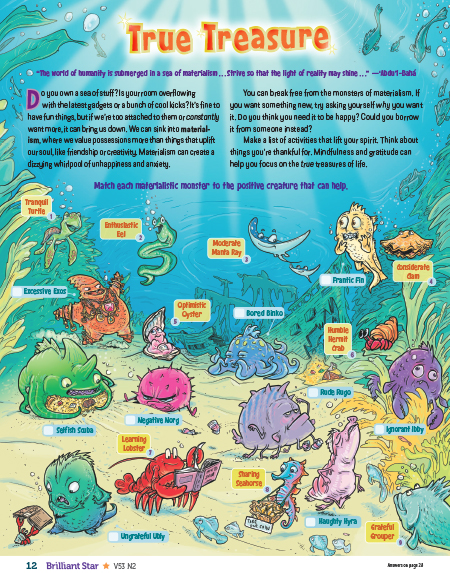
Explore virtues for avoiding materialism
> PURPOSE
This piece explores ways we can break free from the monsters of materialism and uplift our spirits. Readers match materialistic monsters with creatures named with virtues that can help them.
Quote: “The world of humanity is submerged in a sea of materialism... Strive so that the light of reality may shine.” —‘Abdu’l-Bahá
> QUESTIONS FOR DISCUSSION
Pre-K/Kindergarten (4-5) | Early Elementary (6-7)
- What is materialism?
- Do you think having tons of stuff you don’t need is a good thing?
- What does being generous mean?
- Can it make us happy to share our things with others?
Late Elementary (8-10) | Junior Youth (11-14)
- Why is having less stuff better for your health and happiness?
- Why do you think our society is so focused on material things?
- When do you know you have too much stuff?
- What are ways we can prevent ourselves from getting too attached to material things?
> ACTIVITIES TO ENHANCE LEARNING
Pre-K/Kindergarten (4-5) | Early Elementary (6-7)
> Handprint fish craft
Trace kids’ hands on colorful construction or cardstock paper. Cut out tracing. Create eyes and place them at the base of the cut-out palm, so the hands look fish-like.
Decorate hands with paper cutouts, markers, stickers, etc. Invite the kids to gift to someone they appreciate.
Link to craft:
https://frostingandglue.com/handprint-fish/
More ocean-themed crafts:
https://simplyfullofdelight.com/ocean-crafts-for-kids/
> Draw a Monster
Kids draw their own monster of materialism and a friendly creature that can help.
Late Elementary (8-10) | Junior Youth (11-14)
> What Are You Grateful For?
Have students write down 10 things they’re grateful for and why. What do those things contribute to their life?
> Mindful of Materialism
Read and discuss this article from Riley’s Rainforest to explore more ways of being mindful of materialism:
https://brilliantstarmagazine.org/articles/rileys-rainforest-what-money-cant-buy
PAGE 13: QUIZ: ARE YOU BUILDING A BRIGHTER WORLD?
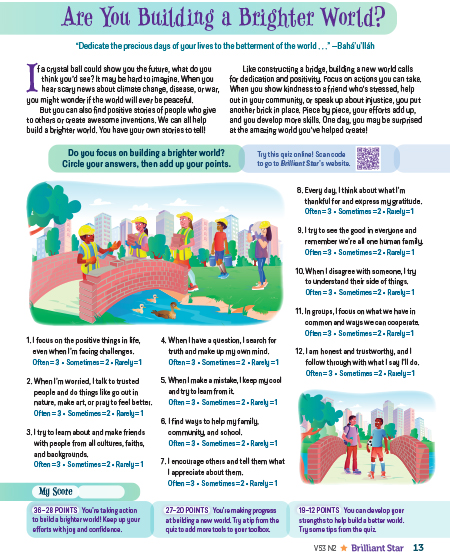
Take the quiz and find out!
> PURPOSE
We can all help build a better world when we approach life with dedication and positivity. WIth this quiz, kids rate themselves on their actions that help create a brighter world.
Quote: “Dedicate the precious days of your lives to the betterment of the world …”
—Bahá’u’lláh
> QUESTIONS FOR DISCUSSION
Pre-K/Kindergarten (4-5) | Early Elementary (6-7)
- What are some things you’re thankful for?
- What are some ways you can help people in your family? Your school? Your city?
- When you’re worried, what do you do to feel better?
- If you could magically see what the world will be like in twenty years (or when you’re grown up), what do you hope you’d see?
- What are some positive stories you’ve heard about people who are helping the world? (Examples: people in helping professions, scientists research cures for illness, humanitarian organizations, Bahá’í pioneers, etc.)
- What are some things you’d like to do someday to help other people?
Late Elementary (8-10) | Junior Youth (11-14)
- What are some things you’re thankful for?
- What are some specific ways you like to help people in your family? Your school? Your city?
- When you’re worried or stressed, what things help you cope and feel better?
- If you could magically see what the world will be like in twenty years, what do you hope you’d see?
- What are some positive stories you’ve heard about people or groups who are helping the world? (Examples: people in helping professions, scientists research cures for illness, humanitarian organizations, Bahá’í pioneers, etc.)
- What are some goals you have for helping others in the future?
> ACTIVITIES TO ENHANCE LEARNING
Pre-K/Kindergarten (4-5) | Early Elementary (6-7)
> Taking the Quiz
Take the quiz as a class by reading the introduction and quiz questions out loud. Have each student write down their answers on a sheet of paper. Then walk them through how to count up their scores. Or invite them to take the quiz online:
https://brilliantstarmagazine.org/articles/brighterworld
> Virtues in the Quiz
The following virtues are mentioned in the quiz or suggested by the actions described. Choose some to define and discuss with the class. What are some examples of these virtues in action? Good references include these:
https://www.virtuesproject.com/virtues-definitions-1
The Family Virtues Guide, by Linda Kavelin Popov, John Kavelin, and Dan Popov
The Virtues Project Educators Guide, by Linda Kavelin Popov
20 Teachable Virtues, by Barbara C. Unell and Jerry L. Wyckoff
Virtues indicated in the quiz:
Dedication - Introduction
Kindness - Introduction
Positivity – Introduction and Item 1
Trust – Item 2
Friendliness – Item 3
Appreciation for Diversity – Item 3
Independent Investigation of Truth – Item 4
Patience – Item 5
Helpfulness – Item 6
Encouragement – Item 7
Gratitude – Item 8
Unity – Item 9
Open-Mindedness – Item 10
Cooperation – Item 11
Honesty – Item 12
Trustworthiness – Item 12
> Bridge of Virtues
To tie into the bridge-building theme of the quiz, invite kids to build their own brick wall. You or your class can make your own bricks by wrapping boxes (such as shoe or tissue boxes) with used grocery bags. Kids can write the virtues from the quiz on the bricks and decorate them with images or designs that reflect that virtue. Designate a spot in your classroom for building a brick “wall” or miniature “bridge.” Discuss the quiz and the virtues in class, and ask each kid to add a brick as it’s mentioned.
> Team Building
Write a list of 10–20 things to make with LEGO bricks (such as a dog, car, tree, house, etc.). Form teams, and give each one an assortment of bricks. The game leader holds the list of words.
On “Go!” a player from each team gets a word from the leader. The player returns to the group and builds that item with the bricks. When a team member guesses the item, another player gets a new word from the leader. The winning team is the first one to have each person build an item that’s guessed correctly.
> Balloon Building
Split into two teams and give each team a bag of balloons and a roll of masking tape. They have four minutes to plan how to make the tallest tower they can, using only balloons and tape. After four minutes, say “Go!” and let teams build for 10 minutes. The tallest tower wins!
> Mystery Building
Divide the group into pairs and ask each pair to sit back-to-back. Each person in a pair is given the same LEGO blocks (identical shapes and colors). The first person builds a structure with their bricks. Then they describe to their partner how to build it. The second person has to listen carefully to follow the instructions. When they’re done, students compare their creations to see if they made an identical structure.
As a class, discuss what it was like to communicate and try to follow directions in this way. Was it easy or challenging? How can we apply these communication skills in other interactions?
> Virtues Skit
Choose an item or virtue from the quiz and work together as a class to create create a short skit that demonstrates that quality in action.
> Positive Banner
Roll out a large piece of banner paper and invite students to help create a banner that illustrates a brighter world. Before drawing starts, ask kids to share some of the things they’d like to include that will be part of a more positive world.
Late Elementary (8-10) | Junior Youth (11-14)
> Taking the Quiz
Take the quiz as a class by reading the introduction and quiz questions out loud. Have each student write down their answers on a sheet of paper. Then have each student count up their score. Or invite them to take the quiz online:
https://brilliantstarmagazine.org/articles/brighterworld
> Virtues in the Quiz
The following virtues are mentioned in the quiz or suggested by the actions described. Break students into groups and assign a virtue to each group. Invite them to create a short skit, song, or poster that illustrates that virtue and present it to the group.
Virtues indicated in the quiz:
Dedication - Introduction
Kindness - Introduction
Positivity – Introduction and Item 1
Trust – Item 2
Friendliness – Item 3
Appreciation for Diversity – Item 3
Independent Investigation of Truth – Item 4
Patience – Item 5
Helpfulness – Item 6
Encouragement – Item 7
Gratitude – Item 8
Unity – Item 9
Open-Mindedness – Item 10
Cooperation – Item 11
Honesty – Item 12
Trustworthiness – Item 12
> Team Building
Write a list of 10–20 things to make with LEGO bricks (such as a dog, car, tree, house, etc.). Form teams, and give each one an assortment of bricks. The game leader holds the list of words.
On “Go!” a player from each team gets a word from the leader. The player returns to the group and builds that item with the bricks. When a team member guesses the item, another player gets a new word from the leader. The winning team is the first one to have each person build an item that’s guessed correctly.
> Balloon Building
Split into two teams and give each team a bag of balloons and a roll of masking tape. They have four minutes to plan how to make the tallest tower they can, using only balloons and tape. After four minutes, say “Go!” and let teams build for 10 minutes. The tallest tower wins!
> Mystery Building
Divide the group into pairs and ask each pair to sit back-to-back. Each person in a pair is given the same LEGO blocks (identical shapes and colors). The first person builds a structure with their bricks. Then they describe to their partner how to build it. The second person has to listen carefully to follow the instructions. When they’re done, students compare their creations to see if they made an identical structure.
As a class, discuss what it was like to communicate and try to follow directions in this way. Was it easy or challenging? How can we apply these communication skills in other interactions?
> Truthfulness: The Foundation of All Virtues
Discuss with students this guidance from ‘Abdu’l-Bahá: “Truthfulness is the foundation of all human virtues. Without truthfulness progress and success, in all the worlds of God, are impossible for any soul.”
Talk about how truthfulness relates to other virtues. Then invite kids to complete this building-themed activity.
Firm Foundation
https://brilliantstarmagazine.org/uploads/play/Luminous_Library_2017/MJ17p13_Firm_Foundation_RS.pdf
> Nur’s Nook: Make a Fluttering Butterfly – Origami craft
Discuss with students ways we can develop virtues and transform our inner and outer lives. Invite them to make a fluttering butterfly craft to represent the goal of transformation.
https://brilliantstarmagazine.org/uploads/play/Luminous_Library_2016/Nur_Fluttering_Butterfly_SO16_p6.pdf
https://brilliantstarmagazine.org/articles/nurs-nook-make-a-fluttering-butterfly
PAGE 14: LIGHTNING & LUNA: EPISODE 97, ”THE VAULT“
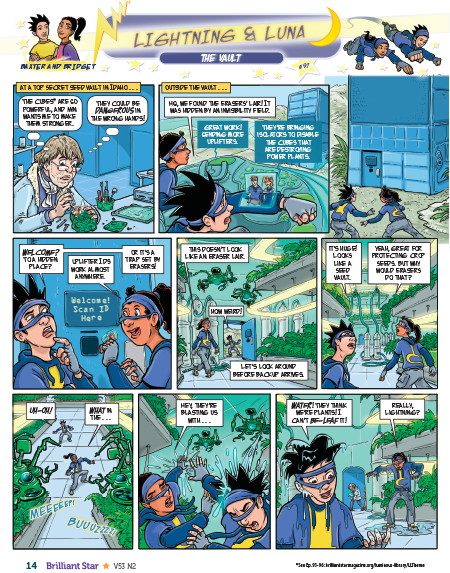
Have Lightning & Luna discovered a secret Erasers’ lair?
> PURPOSE
Brother and sister Lightning and Luna are part of a league of young superheroes called the Uplifters. They use their virtues and superpowers to save the world. When Lightning and Luna aren’t on a mission, they keep their superhero identities secret, cope with middle school, and have fun with friends.
> QUESTIONS FOR DISCUSSION
Pre-K/Kindergarten (4-5) | Early Elementary (6-7)
- Where do seeds come from?
- How does a small seed grow into a giant tree?
- What is a seed vault?
- Why does Bahá’u’lláh compare us to seeds? (see the prayer below)
Late Elementary (8-10) | Junior Youth (11-14)
- What is a seed vault?
- Why is it important to have a wide variety of seeds?
- Do you have a garden at home?
- Why do Bahá’u’lláh and ‘Abdu’l-Bahá compare us to seeds? (see the prayer and quote below)
> ACTIVITIES TO ENHANCE LEARNING
Pre-K/Kindergarten (4-5) | Early Elementary (6-7)
> Tiny Seed Prayer
I am, O my God, but a tiny seed which Thou hast sown in the soil of Thy love, and caused to spring forth by the hand of Thy bounty. This seed craveth, therefore, in its inmost being, for the waters of Thy mercy and the living fountain of Thy grace. Send down upon it, from the heaven of Thy loving-kindness, that which will enable it to flourish beneath Thy shadow and within the borders of Thy court. Thou art He Who watereth the hearts of all that have recognized Thee from Thy plenteous stream and the fountain of Thy living waters. Praised be God, the Lord of the worlds.—Bahá’u’lláh
(Prayers and Meditations, http://www.bahai.org/r/733962783)
> Read Lightning and Luna episodes #93-97
Explain the plot if necessary. Ask students what they think will happen next, and what they like about Lightning and Luna.
https://brilliantstarmagazine.org/luminous-library/LLTheme
> Read Li and the Emperor’s Seeds
Read and discuss the story with students. What virtues are shown in the story?
https://brilliantstarmagazine.org/uploads/play/pdf-play/Story_LiEmperorSeeds_SO07p4.pdf
> Seed Vault Facts
Introduce kids to the concept of the Global Seed Vault, which inspired this journey in Lightning & Luna.
Global Seed Vault Facts:
https://kids.kiddle.co/Svalbard_Global_Seed_Vault
Why do you think artists and writers include real-life global problems in their work (even in fantastical comics where people fly)?
What are some other problems that people could learn about from stories and art?
> Seed Matching Activity
Buy 4 kinds of bigger seeds, such as pumpkin, pea, pepper, sunflower, apple, etc. Have children color 4 envelopes with a picture of the seed and the plant/fruit. Print a slip of paper with planting instructions for each seed to put in the envelopes. Then give them a mixed up set of seeds to sort into the correct envelopes. Have them use tweezers if you want to make it more challenging.
> Snacks with Seeds
*Check with parents or guardians about allergies or dietary restrictions.
Get a wide variety of snackable foods with seeds. Have students identify the seeds. Talk about their diversity. Then eat the foods.
Examples: Sunflower seeds, pumpkin seeds, crunchy chickpeas, popcorn, oat snacks, apples, oranges, pears, bell peppers, edamame, pea pods, etc.
https://wholechildhomeschool.com/wp-content/uploads/2023/04/seeds-in-food-whsht-WCH-400x518.png
Late Elementary (8-10) | Junior Youth (11-14)
> Seed dissection
Dissect some seeds and talk about their amazing qualities. How are seeds like a human being? (Share the quote below from ‘Abdu’l-Bahá.)
https://www.littlegreenthumbs.org/wp-content/uploads/2020/05/Dissect-A-Seed.pdf
https://www.edibleschoolyardnyc.org/resources/seed-dissection/
“We must strive with energies of heart, soul and mind to develop and manifest the perfections and virtues latent within the realities of the phenomenal world, for the human reality may be compared to a seed. If we sow the seed, a mighty tree appears from it. The virtues of the seed are revealed in the tree; it puts forth branches, leaves, blossoms, and produces fruits. All these virtues were hidden and potential in the seed. Through the blessing and bounty of cultivation these virtues became apparent. Similarly, the merciful God, our Creator, has deposited within human realities certain latent and potential virtues. Through education and culture these virtues deposited by the loving God will become apparent in the human reality, even as the unfoldment of the tree from within the germinating seed.”—‘Abdu’l-Bahá
> Seed Vaults
Introduce students to the concept of the Global Seed Vault, which inspired this journey in Lightning & Luna.
Global Seed Vault Facts:
https://kids.kiddle.co/Svalbard_Global_Seed_Vault
Why do you think artists and writers include real-life global problems in their work (even in fantastical comics where people fly)?
What are some other problems we could bring to people’s attention with fantastical stories and art?
Seed Vault Videos:
Note: The videos include references to possible global disasters. The seed vault is sometimes called the “Doomsday” vault. Watch the video ahead of time to determine if it fits for your students.
Seed Vault Introduction (3 minutes)
https://www.youtube.com/watch?v=geJ5aiB2DyM
Global Seed Vault (7 minutes)
https://www.pbs.org/video/doomsday-vault-1680643128/
> Lightning & Luna Episodes #93-97
Have students read or act out the Lightning and Luna episodes #93-97.
What does hte name “Avarice” mean? Who are the bad guys here? What might happen next?
https://brilliantstarmagazine.org/luminous-library/LLTheme
PAGE 16: RADIANT STARS
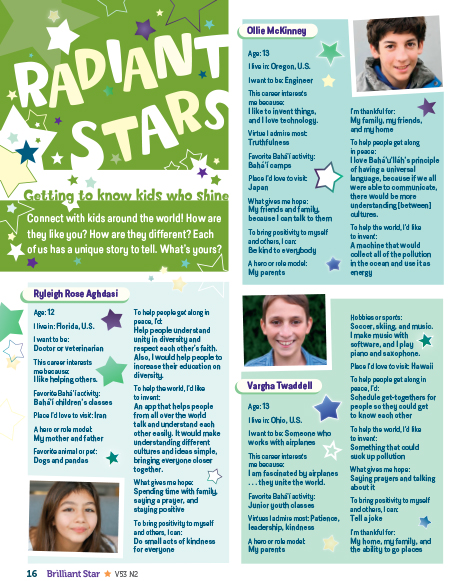
Meet kids from around the U.S. and the world!
> PURPOSE
The “Radiant Stars” feature is intended to facilitate a feeling of community among Brilliant Star’s readers. In their responses to our reader surveys, kids who are the only Bahá’í in their school or one of just a few Bahá’ís in their area say that “Radiant Stars” reminds them that they’re not alone, and there are kids like them around the world.
Quote: “God has crowned you with honor and in your hearts has He set a radiant star; verily the light thereof shall brighten the whole world!” — ‘Abdu’l-Bahá
> QUESTIONS FOR DISCUSSION
Pre-K/Kindergarten (4-5) | Early Elementary (6-7)
- What virtue do you admire most when you see it in other people? Why?
- If you could create a new invention to help the world, what would it be?
- What’s one thing you can do every day to help bring positivity to your life and to those around you?
- What are three blessings that you’re thankful for?
Late Elementary (8-10) | Junior Youth (11-14)
- What are your favorite activities to do with your faith group community?
- If you ruled the world, what would you do to help people of different faiths and cultures get along in peace?
- If you could create a new invention to help the world, what would it be?
- When you’re feeling worried about things going on in your life or in the world, what gives you hope?
- What’s one thing you can do every day to help bring positivity to your life and to those around you?
- What are three blessings that you’re thankful for?
> ACTIVITIES TO ENHANCE LEARNING
Pre-K/Kindergarten (4-5) | Early Elementary (6-7)
> Ask kids to draw a picture or write a poem that reflects their answer to a question from the Discussion Questions list.
> Choose one or more activities from this Brilliant Star Treasure Box page to do with the class: Loving Remembrance
https://brilliantstarmagazine.org/uploads/explore/Article_Images/NDJ_21_FINAL.pdf
Late Elementary (8-10) | Junior Youth (11-14)
> Divide the group into pairs and ask each person to interview their partner, asking them the discussion questions above and these standard Radiant Star questions:
Name:
Age:
I live in (state, country):
I want to be (future career):
This career interests me because:
The virtue I admire most in people:
Hobbies or sports:
Favorite Bahá’í activities:
Favorite animal or pet:
Places I’d love to visit:
I like to help people by:
A favorite book or song:
A favorite food:
A hero or role model:
After the interviews, ask each person to introduce their partner to the class and share some of their answers with the group.
> Choose one of the games on this “Brilliant Star Treasure Box” page to play with the class.
Get-to-Know-You Games https://brilliantstarmagazine.org/uploads/play/Luminous_Library_TAB/BstarTAB_JA_2017_Know_You.pdf
> Choose one or more activities from this “Brilliant Star Treasure Box” page to do with the class:
Loving Remembrance
https://brilliantstarmagazine.org/uploads/explore/Article_Images/NDJ_21_FINAL.pdf
PAGE 19: WINDS OF TESTS
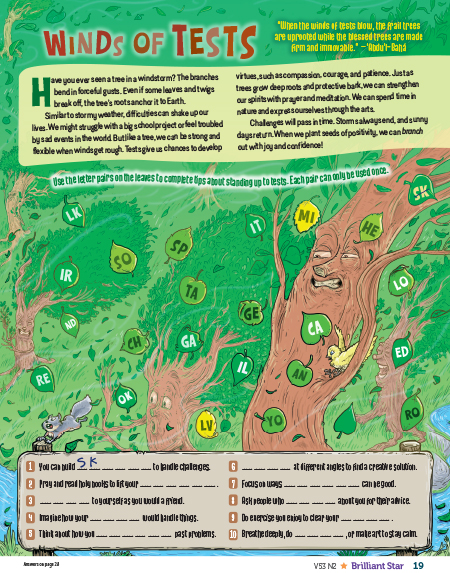
Tips for handling stormy tests
> PURPOSE
This page acknowledges that we all face various kinds of tests in our lives and provides tips for developing the strength and flexibility to face challenges like a tree in a windstorm—bending but not breaking.
Quote: “When the winds of tests blow, the frail trees are uprooted while the blessed trees are made firm and immovable.” —‘Abdu’l-Bahá
> QUESTIONS FOR DISCUSSION
Pre-K/Kindergarten (4-5) | Early Elementary (6-7)
- What’s a challenge you had recently, and how did you handle it?
- In this activity, there are 10 tips for handling tests or challenges. Which ones have you tried? Is there one that works best for you?
- Do you have ideas that aren’t mentioned here about how to solve problems?
- What are some virtues we can practice that can help us handle tests?
Late Elementary (8-10) | Junior Youth (11-14)
- What’s a tough challenge you faced recently, and how did you handle it?
- In this activity, there are 10 tips for handling tests or challenges. Which ones have you tried? Is there one that works best for you?
- Do you have ideas that aren’t mentioned here about how to solve problems?
- What are some virtues we can practice that can help us handle tests?
- Are there some challenges that you like to deal with on your own and others that you ask for help with? What’s an example of each type?
> ACTIVITIES TO ENHANCE LEARNING
Pre-K/Kindergarten (4-5) | Early Elementary (6-7)
> Challenge Games
Before playing one of the games below, tell kids that the purpose of the game is to help them learn about resilience. Explain what that is (i.e., the ability to recover from or adjust to challenges) and how it relates to coping with challenges.
Walk As One
Form teams of 4–6 people. Everyone on a team links arms. The outsides of their shoes must touch the shoes of the people on either side. The whole team moves from a starting line to a finish line without their feet losing contact (as if glued together). If anyone’s feet stop touching, the team goes back to start. The first team to reach the finish line wins.
Hula Happiness
Invite the group to stand in a circle. Place a hula hoop on one person’s arm, then ask everyone to join hands. Challenge people to move the hula hoop all the way around the circle without anyone releasing hands. It takes cooperation to maneuver the hoop over people’s heads and under their feet— and it leads to laughs!
https://brilliantstarmagazine.org/uploads/play/Luminous_Library_2015/Games_for_Change_SOND15_JF16_p25.pdf
> Ask kids to draw a picture of themselves as a superhero who’s overcoming a test. If they’re willing, ask a few to share their picture and discuss it with the whole group.
> Read a book or story about overcoming challenges and discuss the virtues involved. Examples:
The Only One, by C. Aaron Kreader
https://brilliantstarmagazine.org/articles/the-only-one
Picture Day, by Kimberly Moore
https://brilliantstarmagazine.org/articles/picture-day
A-maize-ing Escapade, by Donna Price
https://brilliantstarmagazine.org/uploads/play/Luminous_Library_2012/ND12_A-maize-ing_Escapade.pdf
Late Elementary (8-10) | Junior Youth (11-14)
> Invite students to play a game that involves dealing with a challenge. Discuss how it felt to work together during the game.
Walk As One
Form teams of 4–6 people. Everyone on a team links arms. The outsides of their shoes must touch the shoes of the people on either side. The whole team moves from a starting line to a finish line without their feet losing contact (as if glued together). If anyone’s feet stop touching, the team goes back to start. The first team to reach the finish line wins.
Hula Happiness
Invite the group to stand in a circle. Place a hula hoop on one person’s arm, then ask everyone to join hands. Challenge people to move the hula hoop all the way around the circle without anyone releasing hands. It takes cooperation to maneuver the hoop over people’s heads and under their feet— and it leads to laughs!
https://brilliantstarmagazine.org/uploads/play/Luminous_Library_2015/Games_for_Change_SOND15_JF16_p25.pdf
Juggle Jam
Everyone stands in a circle. One person tosses a soft ball across the circle to another player. That player tosses it back to the person next to the first one. Continue around the circle, calling out names if it helps. Practice the pattern a few times. Then add another ball and keep throwing in the same way. Add one or two more balls. You’ll look like an amazing juggling machine!
https://brilliantstarmagazine.org/uploads/play/Luminous_Library_TAB/BstarTAB_JA_2016_4_Haven.pdf
> Ask kids to draw a picture of themselves as a superhero who’s overcoming a test. If they’re willing, ask a few to share their picture and discuss it with the whole group.
> Have kids (individually or in small groups) write a poem, song, rap, or story about coping with a challenge and building a character strength in the process.
Updated on 4.17.24