
Parents and Teachers
Teaching Tools & Ruhi Classes
Teachers’ Guides & Resources
Teachers’ Guide, “Hope for Our Future,” Part 1
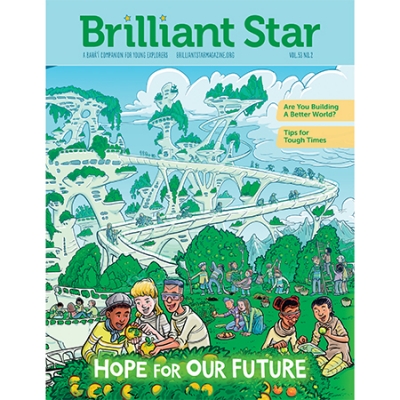
This guide is a tool to assist teachers of children’s classes and junior youth animators in using Brilliant Star’s “Hope for Our Future” issue in the classroom. While Brilliant Star is developed for kids aged 7-12, many younger and older kids enjoy learning from it. Activities can be adapted to engage ages 4-14. You’re invited to share your own ideas in our Facebook group, Brilliant Star Idea Exchange.
The Bahá’í Faith provides a unifying vision of society that meets humanity’s needs for oneness, equality, and justice. It asserts that the welfare of individuals is connected to the welfare of society. This issue provides tools to encourage kids in refining their characters, fortifying themselves against tests, and building unity in their families, schools, and communities.
Features and Topics include:
-
Inspiring story of Bahá’u’lláh’s vision for a world founded on peace and justice, with explanations of the Covenant and the Nine Year Plan;
-
Fun ideas for exploring nature with family and friends to build gratitude and wonder;
-
A hot-air balloon craft to encourage hope and joy;
-
Goal-setting chart to steer kids toward their dreams;
-
Tips for avoiding materialism and limiting screen time to focus on true happiness;
-
Story of Dr. Ugo Giachery and his work to help build the Shrine of the Báb and share the Faith with Malietoa Tanumafili II, the king of Western Samoa;
-
How to handle challenges with patience and courage;
-
Activity for writing and drawing about positive experiences with teamwork;
-
Quiz about how kids can take steps to build a brighter world;
-
Ideas from 10 kids around the world about creating a peaceful planet, fostering positivity, and having a hopeful outlook;
-
Building connections among diverse people and using consultation;
-
Relying on faith to help us weather storms and fortify our minds and spirits against tests;
-
Walking on a path of service throughout our lives.
We recommend Google Chrome for viewing and downloading PDFs.
You can search, download, or print the full issue here.
Hope for Our Future Pages, Part 1
4-5 - Bahá’u’lláh’s Life: Building a New World
6 - Maya’s Mysteries: Connect in Nature
8-9 - Nur’s Nook—Hopeful Horizons: Make a Hot-Air Balloon
You Can Find Part 2 Here (pages 11-19)
You Can Find Part 3 Here (pages 20-29)
AGE GROUPS:
Pre-K/Kindergarten (4-5)
Early Elementary (6-7)
Late Elementary (8-10)
Junior Youth (11-14)
PAGE 2: FLEXIBLE FELINES
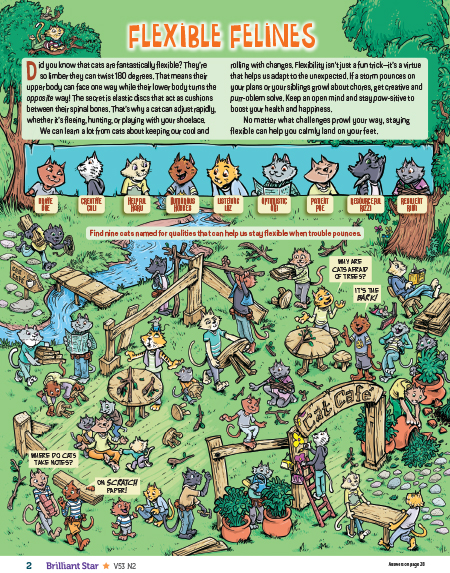
What can we learn from cats about flexibility?
> PURPOSE
This piece shares some cool facts about cat flexibility and compares it to the virtue of being flexible, even if things don’t go as planned. Readers find specific cats named for virtues that can help us stay flexible when trouble pounces.
> QUESTIONS FOR DISCUSSION
Pre-K/Kindergarten (4-5) | Early Elementary (6-7)
-
Do you know a cat, or own one? What are cats like?
-
What does flexibility mean for your body? What about for your mind?
-
Can you share a time when you did something super flexible?
-
How can we stay calm when something upsets us?
Late Elementary (8-10) | Junior Youth (11-14)
-
Can you share a time when you had to practice flexibility and patience?
-
What can help us stay flexible when something unexpected changes our plans?
-
Why might being flexible be important to our spiritual growth?
-
What are some other qualities that can help us “land on our feet” when we face challenges?
> ACTIVITIES TO ENHANCE LEARNING
Pre-K/Kindergarten (4-5) | Early Elementary (6-7)
> Have kids pretend to be cats and ask them to do fun things that require flexibility, like touch their toes, curl into a ball, stretch as tall as they can, etc.
> Ask kids draw their own flexible feline. Ask them how their cat would face an unexpected challenge, like being chased by a dog or getting caught in a rainstorm.
Late Elementary (8-10) | Junior Youth (11-14)
> Invite kids to complete this activity to learn more about staying flexible and positive:
A Happy Camper
https://brilliantstarmagazine.org/uploads/play/Luminous_Library_2018/v50n4p27_Happy_Camper_RS.pdf
> Ask kids to make up a story or skit about facing a challenge with flexibility. For fun, the story must somehow include a cat.
PAGE 3: STEER YOUR SHIP
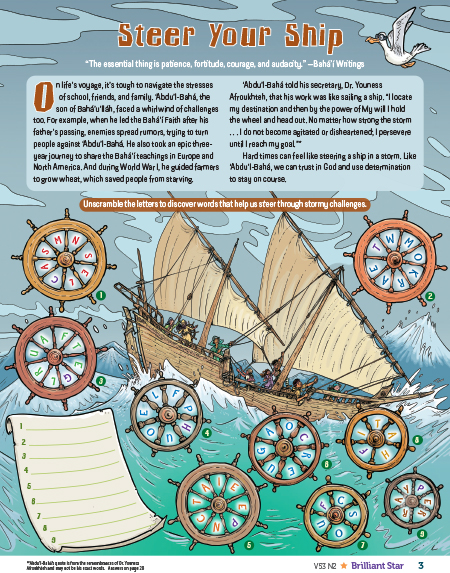
What helps you navigate through storms?
> PURPOSE
The purpose of this page is to introduce readers to ‘Abdu’l-Bahá’s inspiring vision about facing challenges as if you were steering a ship through a storm.
Here is the full quote:
‘Abdu’l-Bahá used the metaphor of a ship to describe his work as leader of the Faith from 1892-1921. Dr. Youness Afroukhteh, his secretary and interpreter, related how ‘Abdu’l-Bahá described his process: ‘I pull the sails of the ship firmly and fasten the ropes tight. I locate my destination and then by the power of my will I hold the wheel and head out. No matter how strong the storm, no matter how dangerous the threat to the safety of the ship, I do not change course. I do not become agitated or disheartened; I persevere until I reach my goal.”
https://bahai-library.com/afroukhteh_nine_years_akka&chapter=3
> QUESTIONS FOR DISCUSSION
Pre-K/Kindergarten (4-5) | Early Elementary (6-7)
- What does it mean to have a challenge?
- How is a challenge like a storm?
- What do you do to handle stormy weather?
- What is a challenge you’ve had recently and what did you do?
Late Elementary (8-10) | Junior Youth (11-14)
- How are challenges like storms?
- What do you do to handle stormy weather?
- What is a challenge you’ve had recently, and what did you do to cope?
- What are some things you can do when friends or family have challenges?
> ACTIVITIES TO ENHANCE LEARNING
Pre-K/Kindergarten (4-5) | Early Elementary (6-7)
> Read the introduction together. Discuss any words that are new to the students.
> Have students draw and color a simple ship’s wheel on a paper plate or piece of cardboard. Then have the students make a single-file line, putting their hands on the shoulders of the student in front of them. The student in front is the captain and has their ship’s wheel. Ask the captain to visualize where they want to go before starting. Then the captain moves forward, and all the other students stay with them. If the teacher demonstrates, they can make it fun by doing lots of loops or taking a twisting route to give the students the idea. Let each student have a turn as captain.
> Hide snacks in the classroom or outside. Give students visual treasure maps to find the snacks. You can make one map of the area in advance and copy it. Then mark different snack locations for each student.
> Simple Sailboat Snacks
*Check with parents or guardians for kids’ allergies or dietary restrictions.
Have students help construct simple sailboat snacks (below)
https://www.snackworks.com/recipes/easy-apple-sailboat-181787/
> A challenge that sailors had aboard a ship is having nothing to do. They played cards a lot. Playing cards is good for keeping your mind sharp, bonding with others, and providing harmless competition. Divide kids into pairs and invite them to play a card game, such as Go Fish.
https://www.playmonster.com/wp-content/uploads/2018/06/GoFishCard_Rules.pdf
Late Elementary (8-10) | Junior Youth (11-14)
> Make an Origami Friend-SHIP
https://brilliantstarmagazine.org/uploads/play/Luminous_Library_2014/Nur_FriendSHIP_SOND14p20p21.pdf
> Quiz: How Do You Captain Your Ship?
Write the quiz questions on cards and have the students take turns reading the questions. They can brainstorm ways to improve after each question, or at the end.
https://brilliantstarmagazine.org/uploads/play/Luminous_Library_2019/V51N2p2_Quiz.pdf
> A challenge that sailors had aboard ship was having nothing to do. They played cards a lot. Playing cards is good for keeping your mind sharp, bonding with others, and providing harmless competition. Sailors often played cribbage, but depending on the ages of the students, try Nertz, Speed, or another kid-friendly game.
https://www.wikihow.com/Play-Nertz
https://www.wikihow.com/Play-the-Card-Game-Speed
> Draw a ship’s steering wheel on a large poster. Make sure there are 8 spokes. Following the examples on the page, put the letters of the following words on sticky notes, mix them up, and stick them between the spokes. On another poster, write definitions of the words, with enough space between to stick the correctly spelled sticky notes. Taking turns or working together, have students unscramble the letters and stick them next to the correct definition. For older students, have them unscramble the letters, stick them on a blank poster, and decide on their own definitions.
Audacity—very bold and daring, fearless
Calmness—free from excitement or disturbance
Courage—strength of mind to carry on in spite of danger or difficulty
Firmness—fixed intention, determination
Faith—belief and trust in and loyalty to God, firm belief
Focus—concentrating on something
Grateful—practicing thankfulness for what you have
Patience—putting up with pains or hardships calmly or without complaint, calm self-control
Persist—to keep at something in spite of difficulties, persevere
Prayer—conversation with God
Teamwork—cooperating with others to get to an end goal, working respectfully and effectively with a group and doing your share
Vision—ability to think or plan ahead
> Music: Haul Away Joe (The Okee Dokee Brothers)
https://youtu.be/RDtRpqoAEC8
> Simple Sailboat Snacks
*Check with parents or guardians for kids’ allergies or dietary restrictions
https://www.snackworks.com/recipes/easy-apple-sailboat-181787/
PAGE 4 - BAHÁ’U’LLÁH’S LIFE: BUILDING A NEW WORLD
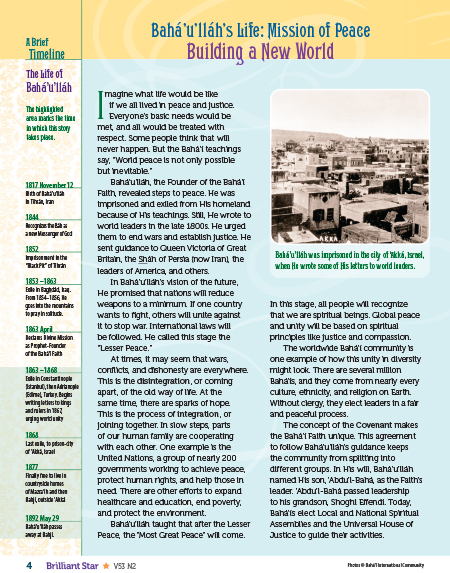
Explore a hopeful vision for the future of our planet.
> PURPOSE
This page introduces the concepts of the Lesser Peace and the Most Great Peace, which are stages in the Bahá’í vision of future world unity. The Covenant is also defined as an “agreement to follow Bahá’u’lláh’s guidance” that keeps the Faith from splitting into groups.
Quotes: “The purpose of religion as revealed from the heaven of God’s holy Will is to establish unity and concord amongst the peoples of the world …” —Bahá’u’lláh
“True peace and tranquility will only be realized when every soul will have become the well-wisher of all mankind.” —Bahá’u’lláh
> QUESTIONS FOR DISCUSSION
Pre-K/Kindergarten (4-5) | Early Elementary (6-7)
- What are some problems in the world today?
- What are some good things you see in the world? How do you feel when you think about them?
- What kinds of things would happen if everyone in the world was kind to each other?
- Do you ever tell other people about your faith or religion? If so, what do you say?
- What are some ways we can show our faith without words?
Late Elementary (8-10) | Junior Youth (11-14)
- What does “God’s holy Will” mean to you?
- What would unity among all people of the world look like?
- What are some examples you see in the world of problems or disintegration—coming apart of old ways of life?
- Do you ever tell other people about your faith or religion? If so, what do you say?
- What are some ways we can show our faith without words?
> ACTIVITIES TO ENHANCE LEARNING
Pre-K/Kindergarten (4-5) | Early Elementary (6-7)
> Well-Wishers of Humanity: Prayer Vocabulary
With your class, complete this activity about the quote that appears at the end of this story about Bahá’u’lláh. Then help kids memorize the quote or a portion of it. Invite them to draw pictures that illustrate the various phrases in the prayer, such as well-wishers of all humanity, assistants of every poor one, etc.
https://brilliantstarmagazine.org/uploads/play/Luminous_Library_2017/JA_17_Well-Wishers.pdf
> Quiz: Are You a World Citizen?
Ask students to complete the World Citizen quiz, either on paper or online, and add up their points. Discuss what it means to be a world citizen and how it relates to world peace. Invite kids to select a tip from the quiz to focus on over the next week.
https://brilliantstarmagazine.org/articles/quiz-are-you-a-world-citizen
> World Citizen Passport
Invite students to write, draw, and color their own world citizen passports.
https://brilliantstarmagazine.org/uploads/play/Vol52/V52N1p3_World_Citizen_opt.pdf
Late Elementary (8-10) | Junior Youth (11-14)
> Word Search Team Races
Split the class into groups of two or three and give each group a copy of the word search on page 5. Have kids cover the word search until the timer starts. Then set a timer for three minutes, and tell them to reveal their word searches. The team that finds the most words in three minutes wins!
> Well-Wishers of Humanity: Prayer Vocabulary
Ask students to complete this activity that highlights the prayer at the end of “Bahá’u’lláh’s Life.” Encourage them to get into pairs and help each other memorize the quote or a portion of it. Invite students to draw pictures that illustrate the various phrases in the prayer (such as well-wishers of all humanity, assistants of every poor one, etc.)
https://brilliantstarmagazine.org/uploads/play/Luminous_Library_2017/JA_17_Well-Wishers.pdf
> Quiz: Are You a World Citizen?
Ask students to complete the World Citizen quiz, either on paper or online, and add up their points. Discuss what it means to be a world citizen and how it relates to world peace. Invite kids to select a tip from the quiz to focus on over the next week.
https://brilliantstarmagazine.org/articles/quiz-are-you-a-world-citizen
> Bahá’í History: A Timeline
Review this timeline of Bahá’í history and point out the dates related to events mentioned in the story. These can include parts of the lives of ‘Abdu’l-Bahá and Shoghi Effendi, as well as the formation of the Universal House of Justice.
https://brilliantstarmagazine.org/articles/timeline
PAGE 6: MAYA’S MYSTERIES: CONNECT IN NATURE
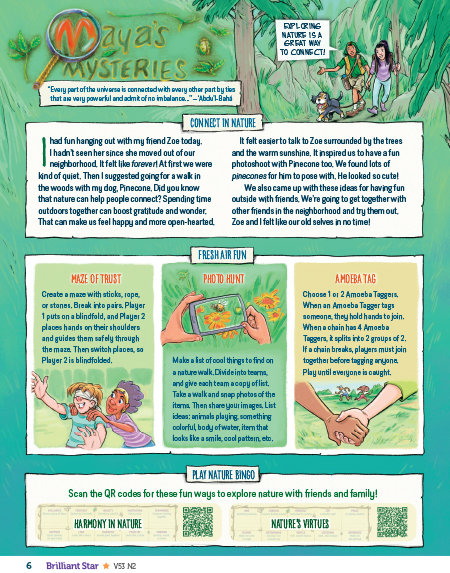
Spending time in nature together can help friendships bloom.
> PURPOSE
This piece explores how spending time in nature can help us connect with others. Kids play games to get fresh air with friends.
Quote: “Every part of the universe is connected with every other part by ties that are very powerful and admit of no imbalance...” —‘Abdu’l-Bahá
> QUESTIONS FOR DISCUSSION
Pre-K/Kindergarten (4-5) | Early Elementary (6-7)
-
What are your favorite things to do outside, alone or with friends or family?
-
How do you feel when you spend time outside?
-
What is the coolest outdoor activity you’ve done?
-
What are some things in nature that you think are really cool?
Late Elementary (8-10) | Junior Youth (11-14)
-
Have you ever had an experience where doing an outdoor activity with someone helped you feel closer to them?
-
How much time do you spend outside? Do you feel like it’s enough for your health and happiness?
-
Can you share a time when being in the great outdoors made you feel calm and at peace?
-
How do you think the world would be different if everyone prioritized enjoying the great outdoors?
> ACTIVITIES TO ENHANCE LEARNING
Pre-K/Kindergarten (4-5) | Early Elementary (6-7)
> Have kids collect a stick or rock from the ground, then decorate it with paint and/or string.
https://handsonaswegrow.com/kids-walking-sticks-summer-hikes/
> Ask kids to gather nature items from the ground (like pinecones, rocks, sticks, fallen leaves, etc.) and arrange them as funny faces.
https://makeandtakes.com/fall-activity-make-nature-faces
Late Elementary (8-10) | Junior Youth (11-14)
> Have kids do an outdoor photoshoot (like Maya!) of beautiful things they find in nature. If they wish to gather nature items to photograph, encourage them to use things that are already on the ground, or to simply pose with the item.
> Read this article to learn more about the benefits of being in nature (specifically through the Japanese practice of shinrin-yoku, which means “forest bathing”).
Riley’s Rainforest: Unwind in Nature
https://brilliantstarmagazine.org/articles/rileys-rainforest-unwind-in-nature
PAGE 7: WIND IN YOUR SAILS
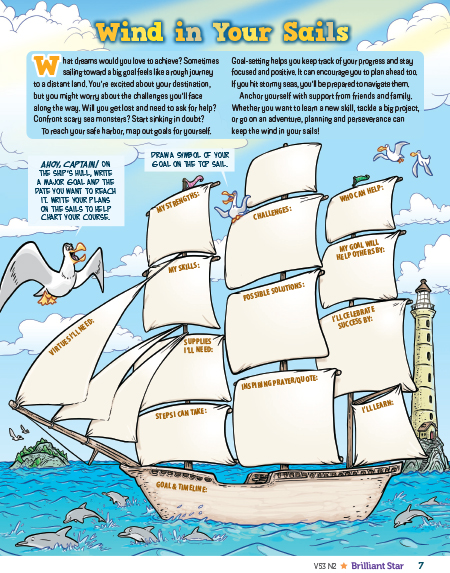
Set goals and identify key steps to chart your course for the future!
> PURPOSE
This ship-themed piece explores how goal setting can help us achieve our dreams and sail through challenges. Kids set a goal, then answer questions to help them attain it.
> QUESTIONS FOR DISCUSSION
Pre-K/Kindergarten (4-5) | Early Elementary (6-7)
-
What do you want to be when you grow up? What interests you about that career?
-
Is it good to ask for help when you need it?
-
Have you ever done something really hard before?
-
What helps you get through tough challenges?
Late Elementary (8-10) | Junior Youth (11-14)
-
Why did you choose your goal? Why is it important that you achieve it?
-
What is a big goal you’ve achieved in the past? What helped you accomplish it?
-
Why is it important to set goals?
-
What do you think are important things to keep in mind when setting goals for yourself?
> ACTIVITIES TO ENHANCE LEARNING
Pre-K/Kindergarten (4-5) | Early Elementary (6-7)
> Invite kids to draw a picture of what they want to be when they grow up. Ask them what skills they’ll need to learn in order to be successful in that career.
> Ask kids to pretend they are what they want to be when they grow up, like a firefighter, singer, scientist, etc. Ask them questions to help them get in character, like:
- What is your job?
- Why did you choose this job?
- What do you learn about?
- How do you help others?
Late Elementary (8-10) | Junior Youth (11-14)
> Ask students to close their eyes and imagine they’ve already accomplished their goal. What does it feel like? What challenges did they have to overcome? Who or what helped them? Have kids meditate on this for a few minutes, then share what they envisioned.
> Invite kids to take this quiz to learn more about perseverance. Explain how this quality is important when achieving goals and dreams.
Quiz: Power of Perseverance
https://brilliantstarmagazine.org/articles/quiz-perseverance
PAGES 8-9: NUR’S NOOK—HOPEFUL HORIZONS: MAKE A HOT-AIR BALLOON CRAFT
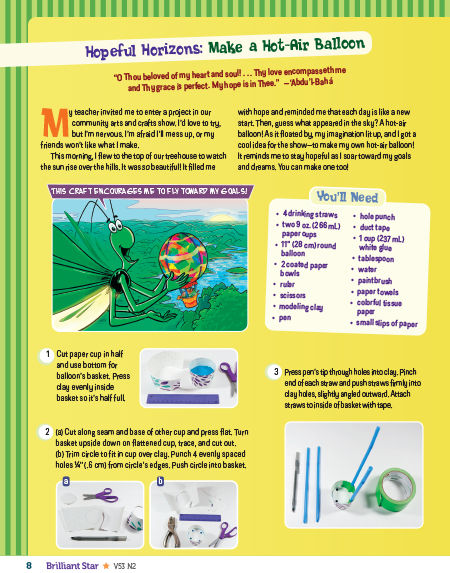
Create a cool hot-air balloon craft!
> PURPOSE
The purpose of this page is to make a hot-air balloon craft, which can remind us to stay hopeful while we work towards our goals and dreams.
> QUOTE
“O Thou beloved of my heart and soul! … Thy love encompasseth me and Thy grace is perfect. My hope is in Thee.”
—‘Abdu’l-Bahá
> QUESTIONS FOR DISCUSSION
Pre-K/Kindergarten (4-5) | Early Elementary (6-7)
- Why was Nur nervous about entering the arts and crafts show?
- Do you think you’d be nervous if you were in his place?
- What inspired Nur to enter the show?
- What kind of arts or crafts do you like to do?
- How do you get ideas about what you want to create?
- What are some hopes you have for the future?
Late Elementary (8-10) | Junior Youth (11-14)
- Have you ever entered an art show or another kind of show or competition? How did you feel about it?
- What gives you inspiration or hope about the future?
- What kind of arts or crafts do you like to do?
- How do you get ideas about what kinds of art projects you want to do?
- Have you ever had a ride on a hot-air balloon or airplane? What was it like?
- What helps you soar toward your goals?
> ACTIVITIES TO ENHANCE LEARNING
Pre-K/Kindergarten (4-5) | Early Elementary (6-7)
> Soaring with Art
Invite kids to draw and color this page to tie into the hot-air balloon craft. Post the finished pictures in the classroom.
https://brilliantstarmagazine.org/uploads/play/Luminous_Library_2017/ND17p12_Soaring_with_Art.pdf
> Make a hot-air balloon snack
*Check with parents or guardians about dietary restrictions or allergies.
You’ll need: apple, graham crackers, peanut butter (or frosting), pretzel sticks, mini marshmallows
What you do:
-
Cut your apple in half. Then slice each half into slices.
-
Break a graham cracker into two small squares for the basket. Spread peanut butter on one piece and put the squares together in a sandwich.
-
Stick ends of two pretzel sticks into peanut butter. Then place pretzels at top corners of cracker and bottom corners of apple slices.
-
Position the apple, graham cracker, and pretzels on a blue plate (for the sky). Add mini marshmallows for clouds. Enjoy!
https://i.pinimg.com/564x/b2/a6/1d/b2a61df77cf9b0554deeda1f15b25072.jpg
> Balloon & Spoon Race
Give each kid a blown-up balloon (or divide the group into teams and give a balloon to each team). Ask kids to balance their balloon on a large wooden spoon. Kids try to be the first person to make it to the finish line without dropping the balloon. If it drops or bursts, they need to return to start and try again. (For team play, take turns until everyone on a team makes it to the finish line without dropping it.)
> Simple Hot-Air Balloon Craft
If the Nur activity is too advanced for your students or you don’t have enough time to complete it, here’s an easier hot-air balloon craft that can be made with pre-cut construction paper shapes, string, and (optional) photo. You can discuss the concepts of hope and goals presented in Nur’s Nook. Invite kids to make the Nur craft at home with their families.
https://www.ourkidthings.com/oh-the-places-youll-go-hot-air-balloon-craft/
Late Elementary (8-10) | Junior Youth (11-14)
> Soaring with Art
Invite kids to draw and color this page to tie into the hot-air balloon craft. Ask students to share why they chose the designs and images on their balloons. Post the finished pictures in the classroom.
https://brilliantstarmagazine.org/uploads/play/Luminous_Library_2017/ND17p12_Soaring_with_Art.pdf
> Lift Up Your Team
Give each student a copy of this poster to color. Talk as a group about how they can do the various tasks in the list in your classroom, at school, or at home. Ask kids to color or highlight a task when they’ve had a chance to do it during your class or school session (Examples: laugh together, cheer for each other, try something new).
https://brilliantstarmagazine.org/uploads/play/Luminous_Library_2015/Lift_Your_Team_SOND15_JF16_p22.pdf
> Make a hot-air balloon snack
*Check with parents or guardians about dietary restrictions or allergies.
You’ll need: apple, graham crackers, peanut butter (or frosting), pretzel sticks, mini marshmallows
What you do: SEE ABOVEhttps://i.pinimg.com/564x/b2/a6/1d/b2a61df77cf9b0554deeda1f15b25072.jpg
> Celebrate! Activity
Read and discuss the introduction to this activity (which features another kind of balloon). Ask kids (as individuals or in pairs) to connect the word fragments to make nine words that help us celebrate and support friends and family. With the class, talk about the meaning of the words created and discuss how we can express those virtues on our own or with family and friends.
Answers: Creativity, encourage, enthusiasm, generous, gratitude, happiness, optimism, supportive, thoughtful
https://brilliantstarmagazine.org/uploads/play/Vol52/Celebrate_V52N4_Opt.pdf
PAGE 10: WAVES OF ONE SEA
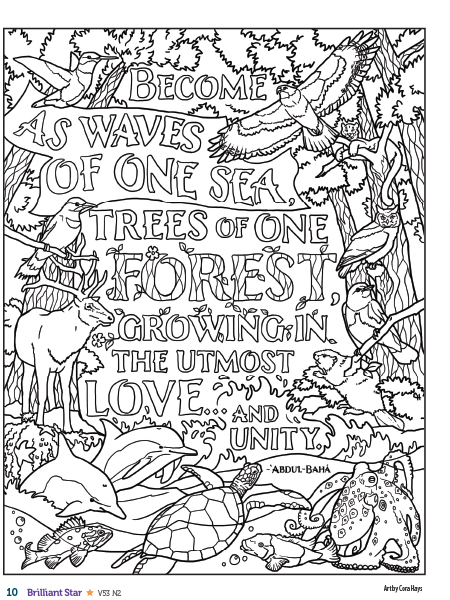
Invite kids to color and share this quote!
> PURPOSE
This page presents a quote from ‘Abdu’l-Bahá in white letters, surrounded by nature and wildlife for coloring. The art for this page was contributed by a Bahá’í in Minnesota named Cora Hays (https://kidsbookpainter.com/).
Quote: “Become as waves of one sea, trees of one forest, growing in the utmost love ... and unity.” —‘Abdu’l-Bahá
> QUESTIONS FOR DISCUSSION
Pre-K/Kindergarten (4-5) | Early Elementary (6-7)
- What does it mean to be like trees of one forest? How about waves of one sea?
- What are some things you can do to show love and unity to people?
- This page shows a nature scene with lots of animals. How do you feel when you’re outside in nature?
- What are some things you do to help take care of the Earth?
Late Elementary (8-10) | Junior Youth (11-14)
- What does this quote mean to you?
- What are some things you can do that might help you grow in “the utmost love and unity”?
- How do you feel when you’re in a nature setting like the one on this page? How can nature help us?
- What are some things you can do to take care of the Earth in your area?
- What are some other nature metaphors in the Bahá’í writings that express unity? (Examples: fruits of one tree, leaves of one branch, stars of one heaven, flowers of one garden)
> ACTIVITIES TO ENHANCE LEARNING
Pre-K/Kindergarten (4-5) | Early Elementary (6-7)
Invite students to split into groups and make up a song to go along with the quotation on this page. Students can bring their own musical instruments or create a harmonica or ukulele from Nur’s Nook.
Nur’s Nook: Harmonica Craft
https://brilliantstarmagazine.org/articles/nurs-nook-songs-in-space
Nur’s Nook: Ukulele Craft
https://brilliantstarmagazine.org/articles/nurs-nook-make-your-own-ukulele
> Learning from Animals
Ask students how many different animals they can find on the page. What do they know about these creatures? What qualities or behaviors do they have that reflect the theme of unity?
Post a fun fact about each creature and invite kids to guess which animal each fact describes. Examples:
- Beaver – Use teamwork to create lodges with underwater entrances.
- Birds (Great horned owl, Northern flicker, Red-tailed hawk, Redstart, Ruby-throated hummingbird)
– Birds (in general) evolved from dinosaurs.
– Great horned owls have three eyelids and fantastic hearing.
– A hummingbird is the only bird that can fly backwards.
- California two-spot octopus – Has three hearts and a big brain.
- Common dolphin – Communicate with a language of whistles and clicks.
- Cougar – Can jump upward 18 feet (5.5 m).
- Elk – Live in large herds led by a female.
- Fish (Rosy Rockfish, Sheephead) – Don’t have vocal cords but communicate with sounds, scents, motions, and electric pulses.
- Green sea turtle – Lay eggs and mostly eat sea grass and algae.
Late Elementary (8-10) | Junior Youth(11-14)
> Create a Unity Song - SEE ABOVE
> Context of the Quote
Split the class into groups and give each one a copy of the larger context of the quote. Ask them to read it and put it in their own words as a way to absorb the concepts it includes. Ask each group to create a skit, poster, or other art that illustrates the quote or part of it.
“As difference in degree of capacity exists among human souls, as difference in capability is found, therefore, individualities will differ one from another. But in reality this is a reason for unity and not for discord and enmity. If the flowers of a garden were all of one color, the effect would be monotonous to the eye; but if the colors are variegated, it is most pleasing and wonderful. The difference in adornment of color and capacity of reflection among the flowers gives the garden its beauty and charm. Therefore, although we are of different individualities, different in ideas and of various fragrances, let us strive like flowers of the same divine garden to live together in harmony. Even though each soul has its own individual perfume and color, all are reflecting the same light, all contributing fragrance to the same breeze which blows through the garden, all continuing to grow in complete harmony and accord. Become as waves of one sea, trees of one forest, growing in the utmost love, agreement and unity.” —‘Abdu’l-Bahá
Updated on 4.19.24