
Parents and Teachers
Teaching Tools & Ruhi Classes
Teachers’ Guides & Resources
Teachers’ Guide, “Thirst to Learn,” Part 1

This guide is a tool to assist teachers of children’s classes and junior youth animators in using Brilliant Star’s “Thirst to Learn” issue in the classroom. While Brilliant Star is developed for kids aged 7-12, many younger and older kids enjoy learning from it. Activities can be adapted and expanded to engage ages 4-14. You’re invited to explore this guide and to share your own ideas in our Facebook group, Brilliant Star Idea Exchange.
Key themes in this issue:
- Developing a deeper love of learning, exploring opportunities for engaging in crafts and professions, and seeing work performed in the spirit of service as worship
- Overcoming setbacks with patience, determination, and resilience
- Knowing yourself and building and exceeding your current skills while tapping into humanity’s “limitless capacity to transform”
- Avoiding distractions and participating in action, reflection, consultation and study to foster learning
- Achieving “dynamic coherence between the material and spiritual requirements of life”
- Engaging in acts of service with teamwork and compassion
You can search, download, or print the full issue here.
We recommend Google Chrome for viewing and downloading PDFs.
For each page, you’ll find discussion questions and activities to enhance learning.
“Thirst to Learn” Pages, Part 1
2 – My Inner Gems
3 – Squeeze Away Stress!
4–5 – Bahá’u’lláh’s Life: Journey to Constantinople
6 – What Do You Say?
7 – Puffling Patrol
8–9 - Nur’s Nook—Imagination Station 2: Make 9-Pointed Stars
10 – PAWS-itive Pets
You Can Find Part 2 Here (pages 11-21)
You Can Find Part 3 Here (pages 22-29)
Age Groups:
Pre-K/Kindergarten (4-5)
Early Elementary (6-7)
Late Elementary (8-10)
Junior Youth (11-14)
INTRODUCTION TO THEME
> Open the magazine and lay it flat on the table so students can see the full wrap-around cover art. Ask each student to name something from the cover art that catches their attention. Once everyone has commented, discuss how the illustration conveys the theme of the issue: developing life skills and goals with an attitude of learning. What questions do they have about the theme? What topics do they expect will be addressed? [Concept by Celia Taghdiri]
PAGE 2: MY INNER GEMS

Let your virtues shine!
> PURPOSE
This activity gives students an opportunity to reflect on their inner strengths, virtues, and goals to foster a deeper knowledge of their own spirits.
> QUOTE:
“Ye are My treasury, for in you I have treasured the pearls of My mysteries and the gems of My knowledge.” —Bahá’u’lláh
> QUESTIONS FOR DISCUSSION
Pre-Kindergarten | Early Elementary
- What is a gem or jewel?
- What makes a gem different from a regular rock?
- What are some of your inner gems or virtues?
- What are some things you can do to make your virtues shine and grow?
Late Elementary | Junior Youth/Youth
- What makes a gem different from a regular rock?
- What are some things you can do to help you discover your inner virtues?
- What are some things you can do to make your virtues shine and grow?
- What virtues do you admire most in other people?
> ACTIVITIES TO ENHANCE LEARNING
Pre-Kindergarten | Early Elementary
> Gem Craft
Invite students to draw and cut out gem shapes from construction paper (or cut them out ahead of time for younger students). Ask students to write the virtues they admire most on the gems (such as love, joy, friendliness, creativity, honesty). Then ask kids to decorate the gems with markers, stickers, glitter glue, beads, and other materials. Invite each student to show their gem to the class, talk about the virtue they chose, and then attach the gem to a poster for a collective display in the classroom.
> Virtues Guess
For each player, write a different virtue on a removable label. Without showing them the virtue, place a label on each person so they can’t see it, but others can. Mingle, look at other’s labels, and give friends clues about their virtue without naming it. When someone guesses their virtue correctly, they move the label to the front of their shirt and keep giving clues to others. Continue until everyone guesses their virtue.
Late Elementary | Junior Youth/Youth
> Virtue Gem Magnets
Gather small wooden circles (available from craft stores) and invite kids to paint them with acrylic paints. Ask students to write a virtue name on each one (such as love, friendship, or peace). Decorate them with stick-on gems. Secure a magnet to the back of each piece. Display them in the classroom on a metal board before sending them home with students.
https://www.thelifeofjenniferdawn.com/2015/02/easy-craft-for-kids-create-treasure.html
> Guess Who?
Provide students with slips of paper. The leader reads a question aloud, such as, “What made you smile this week?” (or use questions from the activity). Players write their answer and name, then turn them in. The leader reads each answer aloud. Everyone writes their guess for the person who wrote it. Then the leader reveals who wrote each one. Players get a point for each correct answer. The person with the most points chooses a question and moderates the next round.
PAGE 3: SQUEEZE AWAY STRESS!
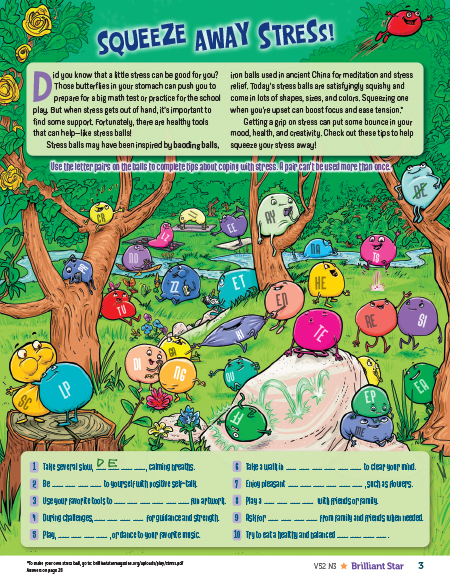
Relax and have a ball!
> PURPOSE
This piece explores ways to manage stress with tips and tools, like stress balls. Kids match letter pairs on personified stress balls to learn tips about coping with stress.
> QUESTIONS FOR DISCUSSION
Pre-Kindergarten | Early Elementary
- What does stress feel like?
- What are some times that you’ve felt stressed or worried?
- What are some activities you can do that make you feel better if you’re stressed or worried?
- What are ways you can help a friend or family member who’s stressed?
Late Elementary | Junior Youth/Youth
- Where does most of your stress come from?
- How do you like to cope with stress?
- Why is stress so common in our society?
- If you were less stressed, how would that impact your life?
> ACTIVITIES TO ENHANCE LEARNING
Pre-Kindergarten | Early Elementary
> Create your own stress balls by filling balloons with lentils or rice. Use a permanent marker to write the letter pairs as depicted on the personified stress balls, then invite kids to match them to discover the tips.
> Create stress balls with rice or lentil-filled balloons. Invite kids to squeeze the ball in different patterns. Have them squeeze it as hard as they can, or lightly squeeze it as many times as they can in one minute.
> Lead kids in a breathing exercise where they pretend to have a nice smelling flower in one hand and a slow burning candle in the other. They breathe in slowly through their nose as they smell the flower. They breathe out slowly through their mouth as they blow out the candle.
Late Elementary | Junior Youth/Youth
> Lead the kids through these stress ball exercises:
Place a stress ball in between your palms, keeping your forearm in a vertical position. Press and hold for 3-5 seconds, then relax. Repeat 10 times.
Hold a stress ball in your palm and squeeze it as hard as you can. Hold for 3-5 seconds, then relax. Repeat 10 times, rest for 1 minute, then repeat with the other hand.
Place a stress ball between the tip of one finger and the thumb. Press and hold for 3-5 seconds, then relax. Repeat 10 times with each finger, rest for 1 minute, then repeat with the other hand.
https://www.greencroft.org/Library/docLib/2020/04/5-Minute-Stress-Ball-Workout.pdf
PAGES 4-5: BAHÁ’U’LLÁH’S LIFE: JOURNEY TO CONSTANTINOPLE
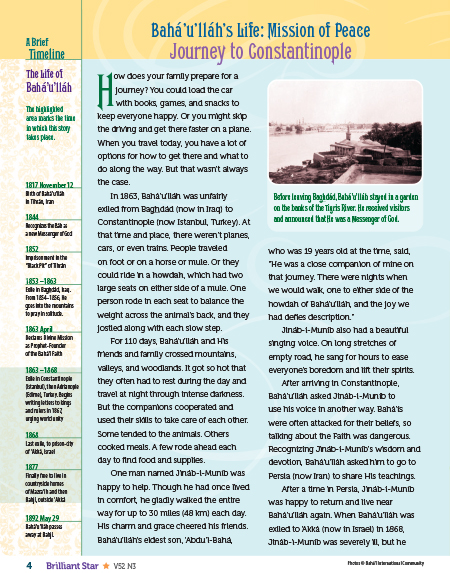
Bahá’u’lláh's followers served Him and each other on their journey.
> PURPOSE
This piece shares the story of Jináb-i-Muníb, who traveled with Bahá’u’lláh on His exile from Baghdád to Constantinople (now Istanbul). The story invites readers to explore themes of service, joy, and devotion.
> QUESTIONS FOR DISCUSSION
Pre-K/Kindergarten | Early Elementary
- What’s the farthest you’ve ever walked? (Compare to walking 110 days)
- How does your family travel? Where have you gone?
- When you’re traveling with others, how do you like to help?
- What song could you sing while traveling that would make your family happy?
Late Elementary | Junior Youth/Youth
- If we started walking today, when would we finish walking 110 days?
- If you were Jináb-i-Muníb, walking next to Bahá’u’lláh and across from ‘Abdu’l-Bahá, how would you feel?
- When you’re traveling with others, how do you like to help?
- What song could you sing while traveling that would make your family happy?
> ACTIVITIES TO ENHANCE LEARNING
Pre-K/Kindergarten | Early Elementary
> Take a Walk
Go outside and walk around as if you were going on a journey. Sing while you walk or play some walking music, for example:
Walking with Spring – Okee Dokee Brothers
https://www.youtube.com/watch?v=Cduti9g5-E4&ab_channel=OkeeDokeeBrothers
We Have Come to Sing Praises – Bahá’í Choir
https://www.youtube.com/watch?v=Ki7wCZhBi_Q&ab_channel=ShahramSabet
> Draw Your Service
Talk about what acts of service the students do at home or in their community. Ask if there’s a new act of service they would like to try. Have students draw a picture of themselves doing the new act of service.
Late Elementary | Junior Youth/Youth
> Imagine the Journey
Find Baghdád and Constantinople (now Istanbul) on a globe or map and look at the route. Imagine walking in the old days before there were paved roads, ferries, and hotels to stay in. The article mentions that some people tended to animals, others cooked meals and some road ahead to get supplies. What service would you like to offer?
> Service Prayer
Talk about what acts of service the students do at home or in their community. Ask if there’s a new act of service they would like to try. Share this service prayer:
https://brilliantstarmagazine.org/uploads/play/Luminous_Library_2014/Prayer_Happy_Serve_MA14p24.pdf
> Make a Poster
Make and decorate a poster with the quote: “Strive for the betterment of the lives of one another.”—Bahá’u’lláh
> Color a Poster
Read and color the “How to Lift Up Your Team” poster. Pick one idea to focus on that day.
https://brilliantstarmagazine.org/uploads/play/Luminous_Library_2015/Lift_Your_Team_SOND15_JF16_p22.pdf
> The Story of Jináb-i-Muníb
Share the longer version of the story of Jináb-i-Muníb:
https://bahaichronicles.org/jinab-i-munib-upon-him-be-the-glory-of-the-all-glorious/
> A Song About Jináb-i-Muníb by Grant Hindin Miller
From the album Songs for the Martyrs (2019)
https://www.youtube.com/watch?v=NCKHF93rsa4&ab_channel=GrantHindinMiller-Topic
PAGE 6: WHAT DO YOU SAY?
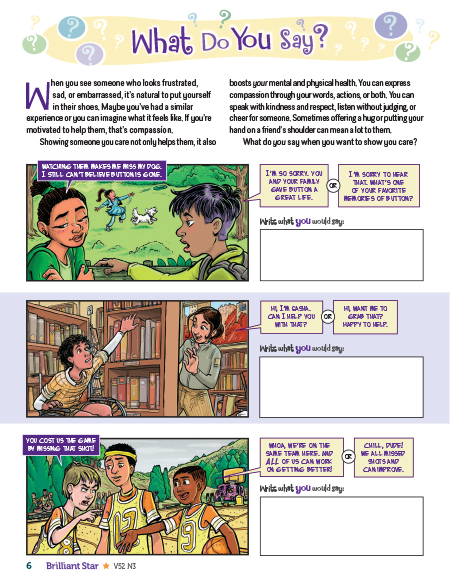
Practice responding with compassion.
> PURPOSE
This page introduces the term “compassion” to readers and invites them to consider how to respond in a caring way when they see someone who’s feeling down or needing assistance.
> QUESTIONS FOR DISCUSSION
Pre-K/Kindergarten | Early Elementary
- What does “compassion” mean?
- What are some ways you can show compassion to someone?
- How does it feel when you're sad or need help and someone is kind to you?
- Talk about a time when you showed kindness and compassion to someone who was sad. How did you feel?
- Are there ways to show you care without saying anything? What are some examples?
Late Elementary | Junior Youth/Youth
- What would you say if you were the person showing compassion in these situations?
- How does it feel when you're sad or need help and someone is kind to you? How does it feel later, when you look back on the experience?
- Talk about a time when a friend or family member was having a hard time and you showed them compassion. How did you feel, both in the moment and later?
- Can you show compassion to people you don’t know personally? How? (please give examples)
- What are some ways to show compassion without words?
> ACTIVITIES TO ENHANCE LEARNING
Pre-K/Kindergarten | Early Elementary
> Role-play any or all three of the scenarios on this page. Invite students to suggest other scenarios in which one person shows compassion to another and act those out.
> As a class, create a story about a character (which could be an animal, an imaginary creature, or a fictional character) who needs and receives compassion from someone else. Talk about how both characters feel and what happens afterward.
> Read the book We’re All Wonders (by R.J. Palacio) to the class and discuss it with the children. Why does the main character's (Auggie’s) mother call him a wonder? What does Auggie mean when he says “We’re all wonders”?
Check out the Educators’ Guide here:
https://assets.readbrightly.com/wp-content/uploads/2018/08/WereAllWonders_ClassKit_EduGd_WEB.pdf
> Choose a way for your class to show kindness to others at your school. (For example: Create art for them, serve them a snack, clean up from a meal, do a performance for them, etc.)
> Try this guided compassion meditation from Empower Tools with the kids. You can show the video or just play the audio and follow the prompts. https://youtu.be/oEplqZYUUvk
Late Elementary | Junior Youth/Youth
> Role-play any or all three of the scenarios on this page. Invite students to suggest other scenarios in which one person shows compassion to another and act those out.
> Ask each kid to write a story about a character (who could be based on a real person, a fictional character, an animal, or an imaginary creature) who needs and receives compassion. The story should describe both an initial scenario and how the characters feel or interact afterward.
> Rose, Thorn, Bud activity: Depending on class size and time constraints, give some or all of the kids a minute or two to share how they’re doing and what is happening in their lives. Ask them what the highlight of their day was (the Rose), what went wrong during their day (the Thorn), and what they are looking forward to (the Bud). This activity allows kids to connect with peers without the pressure of talking directly to someone they may not be totally familiar with. They can also practice compassion as they react and respond to any successes or struggles their peers are facing.
> Try this guided compassion meditation from Empower Tools with the kids. You can show the video or just play the audio and follow the prompts. https://youtu.be/oEplqZYUUvk
PAGE 7: PUFFLING PATROL

We can honor our spirits and avoid materialism.
> PURPOSE
This piece explores how materialism can be like a blinding light that draws us away from our spiritual path. An analogy is made to pufflings (baby puffins) in Iceland, who often mistake city lights for moonlight on their journey to catch fish for the first time in the ocean. Readers find 16 puzzled pufflings on the page.
> QUOTE:
“O Thou kind Lord! Sanctify my heart from all attachment, and gladden my soul with tidings of joy.” — ‘Abdu’l-Bahá
> QUESTIONS FOR DISCUSSION
Pre-Kindergarten | Early Elementary
- Have you ever seen a baby puffin in person? What was it like? (Or if no one has seen a puffling, what do you think it would be like?)
- What does it mean to get distracted?
- What helps you stay focused when you’re doing something important (such as reading, listening, or making something)?
- What are some people or things that help you feel happy?
Late Elementary | Junior Youth/Youth
- What does it mean to be distracted?
- What is materialism? What are some examples of material things that can distract our spirits?
- What are some examples of things that nourish our spirits?
- How does it feel when your spirit is being nourished?
- What is a goal you can work on to keep your spirit nurtured and avoid distraction? (Examples: Pray each day, practice mindfulness, take breaks throughout the day to breathe and reflect)
> ACTIVITIES TO ENHANCE LEARNING
Pre-Kindergarten | Early Elementary
> Draw Pufflings
Invite kids to draw puffins of their own.
https://artprojectsforkids.org/how-to-draw-a-puffin/
> Puffling Find
Cut out paper pufflings and hide them around the classroom for kids to find and return to a central “ocean” (such as a blue rug at the front of the classroom).
> Puffin Bird Craft
- Fold a paper plate in half to create and staple edges together.
- Attach an orange construction paper beak to the rounded edge of the plate.
- Use black paints or markers to decorate the puffin’s body. Attach googly eyes or draw the eyes.
- Add orange feet at the bottom of the body.
Craft examples:
Late Elementary | Junior Youth/Youth
> The Soul’s Journey
Invite students to learn more about their soul’s journey with this quiz:
https://brilliantstarmagazine.org/articles/quiz-your-souls-journey
> Draw a Puffin
Invite kids to draw puffins of their own and share them with the class.
https://artprojectsforkids.org/how-to-draw-a-puffin/
> Screen-Free Poster
Invite kids to create a poster of hands-on activities they can do at home that don’t involve screens, video games, TV, movies, or phones. Some of the activity ideas could be illustrated, or the poster could be decorated with colorful markers.
Ideas for screen-free activities:
https://www.mykidstime.com/things-to-do/101-fun-activities-for-kids-dont-involve-screen-time/
https://www.greenchildmagazine.com/screen-free-week-2014/
PAGES 8-9: NUR'S NOOK: IMAGINATION STATION 2: MAKE 9-POINTED STARS
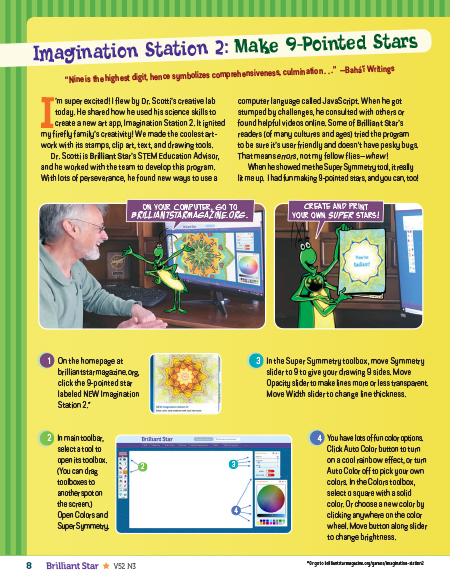
Imagination Station 2 helps kids express their creativity!
> PURPOSE
This page encourages readers’ creativity, perseverance, their interest in STEM/STEAMS, and introduces the Super Symmetry tool from Brilliant Star’s online art app, Imagination Station 2.
> QUOTE:
“Nine is the highest digit, hence symbolizes comprehensiveness, culmination ...” —Bahá’í Writings
> QUESTIONS FOR DISCUSSION
Pre-K/Kindergarten | Early Elementary
- What does it mean to be creative?
- What are some ways you like to be creative?
- If you get stuck doing a project or craft, how to you get unstuck?
- Why do you think 9-pointed stars are used as symbols of the Bahá’í Faith?
- Why does the number 9 stand for unity and completeness?
-
How does art get used together with science and math? (Examples: designing clothes we wear, building a house, making computer games, baking a cake, etc.)
Late Elementary | Junior Youth/Youth
- What does it mean to be creative?
- What are some ways you like to be creative?
- What do the letters in STEM or STEAMS stand for? (Science, Technology, Engineering, Arts, Mathematics, Spirituality)
- How are science and art similar? How are they different?
- What are some ways people combine science and art? (Examples: Drawing or designing a scientific invention, exploring the physical aspects of music or movement, such as making musical instruments or robots like animatronics, observing nature or science and creating art inspired by it, etc.)
> ACTIVITIES TO ENHANCE LEARNING
Pre-K/Kindergarten | Early Elementary
> Super Symmetry
If the students have access to computers or tablets, invite them to try the Super Symmetry tool. If students don’t have access, or if they’re too young, the teacher can use the tool to design and print out 9-pointed star for students to color.
> Make Paper 9-pointed Stars
Precut the different-colored triangles to help students make this craft:
https://alldonemonkey.com/2019/02/14/diversity-craft-for-kids-easy-nine-pointed-stars/
> Look for 9-Pointed Stars:
Share images of 9-pointed stars found in Bahá’í architecture:
Shrine of ‘Abdu’l-Bahá (under construction in Israel)
> Take a Quiz About Curiosity
Complete and discuss this “Are You Curious?” quiz together
https://brilliantstarmagazine.org/uploads/play/Luminous_Library_2012/JA12_Quiz_Are_You_Curious.pdf
Late Elementary | Junior Youth/Youth
> Super Symmetry
If computers or tablets are available, invite the students to use the Super Symmetry tool and other features of the Imagination Station 2 app.
> Make a Starry Mobile
Make this starry mobile to celebrate virtues and creativity:
https://brilliantstarmagazine.org/uploads/play/Luminous_Library_2011/MA11_Nur_Mystery_of_Me.pdf
> Look for 9-Pointed Stars:
Share images of 9-pointed stars found in Bahá’í architecture:
Shrine of ‘Abdu’l-Bahá (under construction in Israel)
> Practice Math Skills
Serve with STEM:
https://brilliantstarmagazine.org/uploads/play/Luminous_Library_2019/Serve_with_STEM_v51n4_RS.pdf
PAGE 10: PAWS-ITIVE PETS
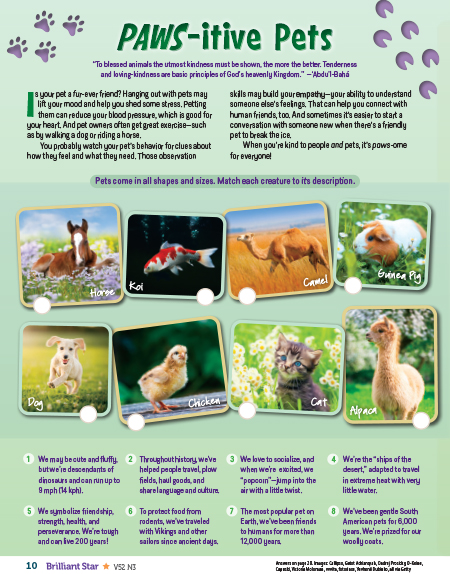
Pets are fun and fascinating!
> PURPOSE
Having pets can improve your health and build your empathy. Explore fun facts about pets around the world.
> QUOTE:
“To blessed animals the utmost kindness must be shown, the more the better. Tenderness and loving-kindness are basic principles of God’s heavenly Kingdom.” —‘Abdu’l-Bahá
> QUESTIONS FOR DISCUSSION
Pre-K/Kindergarten | Early Elementary
- Who in the class has a pet? What kind do you have?
- What are some things to remember when you play with pets?
- How do you know when an animal is hungry, tired, or scared?
- How do you know when a person is hungry, tired, or scared?
- If you were the pet, what kind of animal would you like to be?
- If you were the pet, how would you like to be treated?
Late Elementary | Junior Youth/Youth
- Who in the class has a pet? What kind do you have?
- What do you do to take care of your pet? What happens if you forget?
- How do you communicate with your pet?
- How do you know what your pet is feeling?
- How do you know what people are feeling?
- Do you invite friends to get to know your pet? What is that like?
> ACTIVITIES TO ENHANCE LEARNING
Pre-K/Kindergarten | Early Elementary
> Draw a Pet
Draw a pet and write the kindness quote on the page: “Be infinitely tender and loving to animals.”— ‘Abdu’l-Bahá
https://www.craftymorning.com/easy-drawings-for-kids/
> Practice Gentleness
Shoghi Effendi describes the Báb as a “gentle, the youthful and irresistible person” (God Passes By). Practice being gentle and careful by playing a game like pick-up sticks or Jenga. You can also play a “giant Jenga” game with foam blocks.
Or have a snowball relay race:
Create two teams, and give each team a cotton ball and a magazine. Mark a start and finish line. The first racer on each team fans cotton ball with magazine to blow it across the room (or table), then back to their team. The player hands magazine and “snowball” to the next person. The team who finishes first, wins.
https://brilliantstarmagazine.org/uploads/play/Luminous_Library_TAB/BstarTAB_JF_2017_FunFeb.pdf
> Life Skills: Review Pet Safety Rules
Discuss pet safety rules. Invite kids to create posters with tips and illustrations about safety around pets.
https://www.gooddoginabox.com/dog-safety-with-strange-dogs/
https://cthumane.org/pet-care-resources/dogs-children/
Late Elementary | Junior Youth/Youth
> Draw a Pet
Draw a pet and write the kindness to animals quote: “The beloved of God ... must they show forth the utmost loving-kindness to every living creature.” — ‘Abdu’l-Bahá
If computers or tablets are available, draw along with one of these videos:
How to Draw a Dog
https://brilliantstarmagazine.org/videos/how-to-draw-a-dog
How to Draw a Fish
https://brilliantstarmagazine.org/videos/how-to-draw-a-fish
> Practice Gentleness
Shoghi Effendi describes the Báb as a “gentle, the youthful and irresistible person” (God Passes By). Practice being gentle and careful by playing a game like pick-up sticks or Jenga. You can also play a “giant Jenga” game with foam blocks.
Or have a snowball relay race:
Create two teams, and give each team a cotton ball and a magazine. Mark a start and finish line. The first racer on each team fans cotton ball with magazine to blow it across the room (or table), then back to their team. The player hands magazine and “snowball” to the next person. The team who finishes first, wins.
https://brilliantstarmagazine.org/uploads/play/Luminous_Library_TAB/BstarTAB_JF_2017_FunFeb.pdf
> Domino Patterns
Another way to practice gentleness is to set up dominoes in a pattern. Talk about the patience and care required to create a domino structure. Examples:
https://frugalfun4boys.com/wp-content/uploads/2019/10/Domino-Collage-2-1536x1536.jpg
Updated on 5.26.23