
Space Ace: Q&A with NASA Astronaut Christina Koch
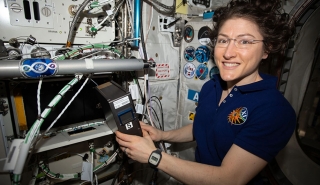
Christina Koch (pronounced “Cook”) became a NASA astronaut in 2013. She set a record for the longest single spaceflight by a woman, with a total of 328 days in space. She also participated in the first all-female spacewalk. She is assigned to the Artemis II mission to the Moon planned for 2025. Dr. Steve Scotti had so much fun learning about her and her career in this interview!
Q: What are the responsibilities as a Mission Specialist on the upcoming Artemis II mission, and what are you most excited about for that mission?
A: I think I’m just most excited that we’re doing this mission. It could be anyone flying on this mission. I think I would be just as excited. We are going back to the Moon [and] we are going to go back to stay. We’re going to learn everything that the Moon has to tell us about the universe we live in, our solar system, and essentially ourselves, and how we can explore even deeper. So it’s just such an exciting time.
I am what’s called a mission specialist on the mission ... They give different titles to the different roles of the astronauts. So we have a commander, a pilot, and two mission specialists. And the truth is, in the beginning of the mission, when we’re riding the rocket into space, those roles are pretty important.
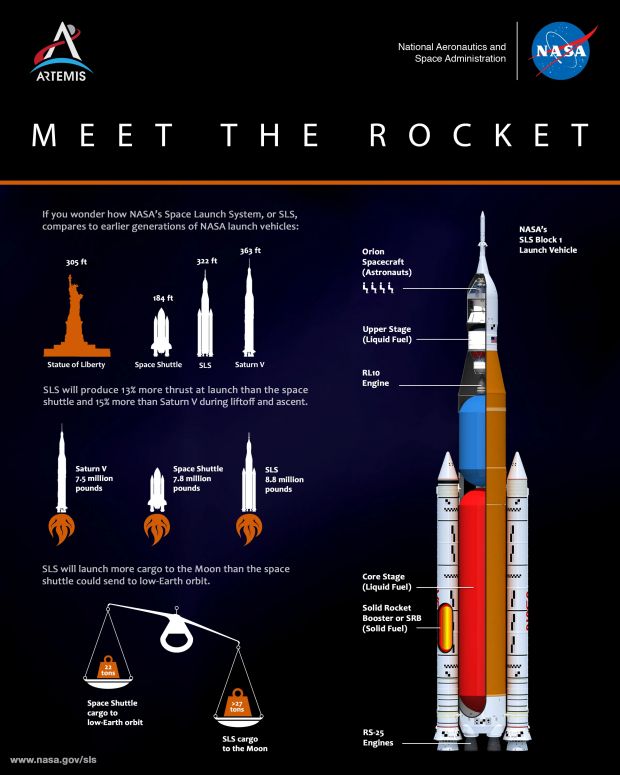
The Space Launch System for the Artemis mission is powerful and innovative.
The commander and pilot will sit in what we call the two front seats that are in front of the displays. So they’ll be seeing all the information coming from the spaceship, how it’s doing. They’ll be able to send some commands to make sure we fly there right, kind of like the pilot of an airplane. But after [that], when we’re just in the regular part of the mission, which is the majority of the time of this 10-day mission, we are going to actually completely even take apart the seats. We’re going to stash them away so that we have more space in the whole vehicle. And then everyone is kind of the same in some ways.
So mission specialist is basically just a title to mean that you are on this ride as an astronaut contributing in some special way. The commander and pilot are going to be focused more on those things like taking off and the rocket ride into orbit, as well as coming back from orbit and landing in the Pacific.
I would love to take on more of the things that will happen while we’re in orbit. Here’s one example. We are going to transform the inside of our spaceship to be a radiation shelter. That’s something that’s really important when we explore deep space. And that’s something that I could be the expert on and take on as my special project during the mission.
Another thing that I’m the sort of lead for is the hatch of the vehicle. And that’s because I happen to sit right next to the hatch. So I’m the person that’s going to be opening the hatch in any kind of emergency situation if we land. So we get to do all kinds of exciting things. How we divvy up those responsibilities is something that we’ll we talk about as a crew, but we definitely always help each other. And we want to make sure everybody has something that they get to focus on for the mission.
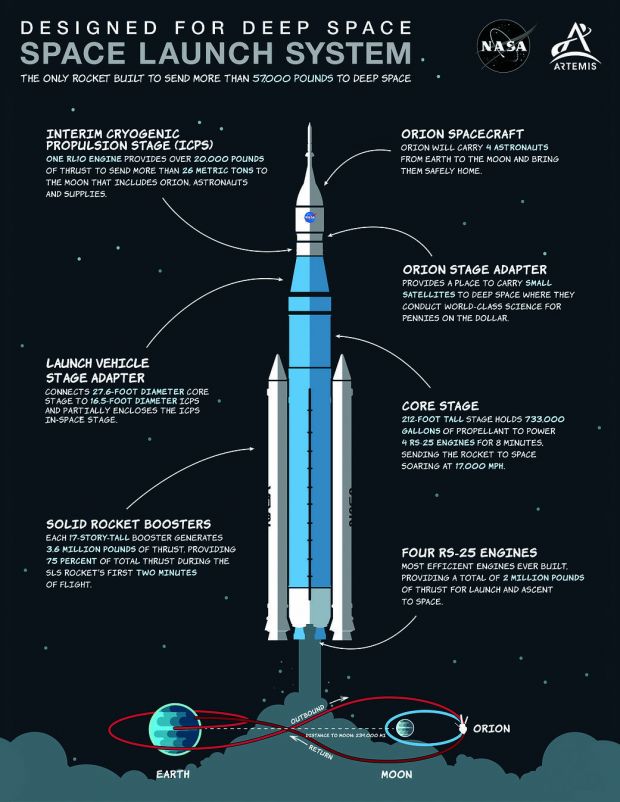
The Space Launch System Christina will ride on the Artemis II mission is designed for deep space.
Q: What inspired you to become an astronaut?
A: Well, it’s funny. I don’t really even remember a time when I didn’t want to be an astronaut. I’ve just wanted to do it my whole life. I think I was a little kid who wanted to be an astronaut, and I just never grew out of it. Looking back, something I realized about myself, though, is I loved things that made me feel small. I loved looking at the night sky. I love the ocean—I grew up in coastal North Carolina. And I just love contemplating the vastness of the universe and our place in it.
So I think that was my initial inspiration. And then a couple things along the way just continued to solidify this dream and to tell me that I was moving in the right direction. I found out that I loved and was good at math and science. I found out that I loved seeing all the things about space.
My family went to Kennedy Space Center when I was young, and I absolutely loved it. I brought home a bunch of posters and hung them up on my walls in my room.
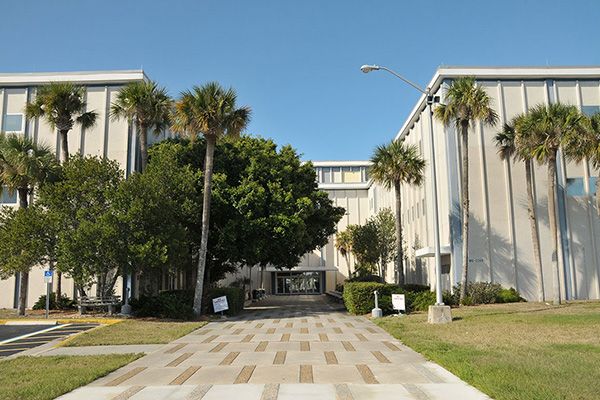
Kennedy Space Center Headquarters in Florida, U.S.
So it was just a small kind of nebulous dream that grew into something more and more tangible as the years went on. And eventually I found myself looking back at my career, and I thought, “Maybe I do have what it takes to contribute to this thing that I’ve loved my whole life,” and that’s when I decided to apply.
Q: What is the most difficult part of your training to be an astronaut? And what was the most fun?
A: Well, there are a lot of things that are challenging, and there are a lot of things that are fun, so it’s hard to pick just one. But I would say the most challenging part is putting it all together and having to switch between one thing and the next thing within such a short period of time. Because when we train to be astronauts, we don’t just learn one thing. We learn many, many things. And you might do several of them in the space of one day. And you have to kind of change your frame of mind between those different tasks.
So, for example, I might be flying in a supersonic jet in the morning and then have to go right after that to a Russian language class where I’m learning one of the hardest languages in the world. And then from there, go straight to driving the controls of the robotic arm in a simulator for the space station. So that was a big challenge for me. But there are so many things that were challenging for me. I definitely had to work very hard. I did not have a natural aptitude for a lot of the things that we had to learn ...
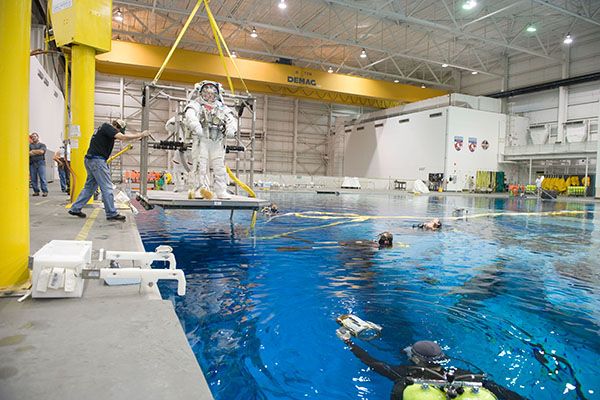
Astronauts Ron Garan and Mike Fossum training at the Johnson Space Center pool in Texas in 2010. Photo by Bill Stafford
It’s all so much fun. Maybe the most fun is doing our spacewalk training, because we train for spacewalks in a gigantic pool that has a mock-up of the International Space Station inside of it. It’s 40 feet deep. It’s so huge that to get in the pool you actually need scuba diving gear. And we get in it in a full space suit, and we practice full-length spacewalks, and that is just the coolest thing ever.
Even though it can feel very intimidating and very challenging, I would just tell myself in the morning, “Hey, I get to go to fake space today, so it’s going to be a really awesome day.”
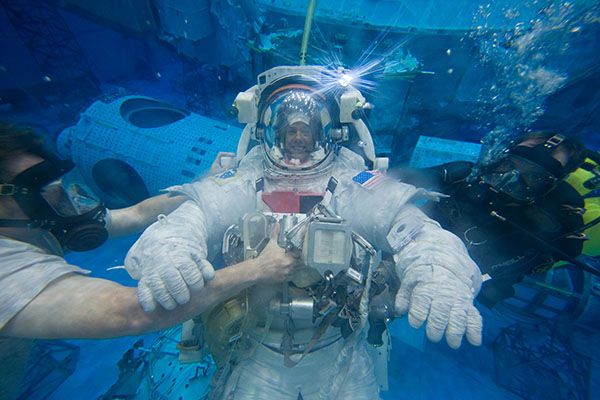
Astronauts Ron Garan and Mike Fossum training at the Johnson Space Center pool in 2010. Photo by Bill Stafford
Q: Most astronauts and space scientists are men. What challenges do you face in this field as a woman? And can you say how you overcame them?
A: I think there are a lot of challenges when you’re part of a group that’s not well represented around you when you’re going to your job every single day and you’re working through things. And, you know, in my case, you’re right. I was oftentimes the only female voice in many of the meetings that my team would have when we were doing engineering design in some of my jobs before I became an astronaut. I was working for NASA as an electrical engineer ...
I also think one of the biggest challenges is not really knowing what is difficult because you are part of an underrepresented group, or this is just difficult because it’s just difficult. You know, I worked really, really hard at everything I did, I studied, I put tons of hours in, I was extremely busy. I was always looking for the next challenge and willing to work hard to achieve those things.
But I think just having that extra circuit always running in your mind, wondering what about this is harder because I’m a woman? I’m trying to communicate in this field where people are not used to seeing someone like me. Where I don’t necessarily hang out with my colleagues as much. We don’t identify as much in, say, our off hours, or I don’t get that time together. There are so many different things. And I think, kind of like a computer circuit, when you’re thinking about something all the time, it can take away your processing of everything else. So that’s a challenge in and of itself. But overall, I came up with different things that worked for me personally to overcome some of those challenges ...
You hear people talk about giving yourself a pep talk, like, “All right, Christina, you’ve got this. You’re awesome. You’re really good at this.” For some reason, that never really helped me in achieving the challenging thing—like, for example, before doing one of those spacewalk trainings I was telling you about.
But I learned about this thing called stereotype threat, which means that people actually do worse when they think that they are being judged based on a stereotype. So I wouldn’t tell myself, “Christina, you are awesome.”
I would tell myself, “Christina, everyone up in that evaluation room that’s watching you and evaluating you, they think you’re awesome. Every time you make a mistake, they’re just going to be like, ‘Oh, she's got it. That was just a little thing. No big deal.’”
And that actually really helped me a lot. I would just tell myself over and over again, “They know I’m really, really good at this.” It didn’t matter that I didn’t actually believe that. But that was kind of something that helped me overcome some of those stereotypes that would creep in and have a negative effect on how I did.
Q: What do love about your job? (from Rose, age 10)
A: Oh my goodness. I love so many things about my job. I think one of the big ones is getting to interact with people like you, Rose—with students that are inspired by space. I get to share this awesome work that we’re doing. That is a really, really cool part of my job.
Another cool part of my job is getting to work with the team, and especially with a crew, a group of close-knit people that has a shared mission. And we’re all working really hard. We’re all supporting each other. That is a really incredible feeling that I’ve actually probably hadn’t experienced truly before this job, and it is absolutely awesome.
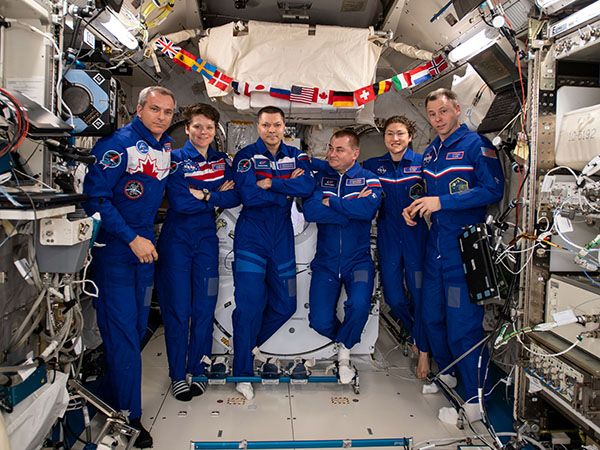
Crew members aboard the International Space Station in 2019 (left to right): David Saint-Jacques, Anne McClain, Oleg Kononenko, Alexey Ovchinin, Christina Koch, and Nick Hague.
Everything else, all those experiences, looking down on Earth, getting to do a spacewalk, getting to fly—those are absolutely wonderful. They’re thrilling in the moment. But the things that [are] meaningful that are my favorite part, those are the teamwork aspects of my job.
Q: What did you miss most from Earth when you were in space for a long time? (from Emma, age 14)
A: I missed my loved ones. I missed my family, my partner, my little dog. I didn’t really miss any things. I didn’t miss going to a coffee shop, getting fancy things. That stuff doesn’t really do it for me. But I definitely miss the people.
And I also love nature. It wasn’t until the end of my 11-month mission that I realized I was missing nature. I missed the feeling of wind on my face. I missed the smell of the beach, and things like that. Things that only Earth can offer, and that we all love about our shared planet.
Q: You and Jessica Meir did the first all-woman spacewalk back in 2019. You broke the record for the longest single spaceflight by a woman. And now you’ll be the first woman to orbit the moon. How does it feel to know you’re making history?
A: Well, I am just so happy that this history is being made. For me, I am most excited about the second woman to go to the moon. And I’m really excited about the next person that’s going to break the record that I have now. And I also know that I happened to be lucky enough in this case to be in the position to gain that record, but any of my amazing colleagues would have done exactly the same thing. I am just happy that we live in a world where we are striving towards the goal of everyone who has a dream has to work equally hard to achieve that dream. And that aspect of those historical moments are what are important to me.
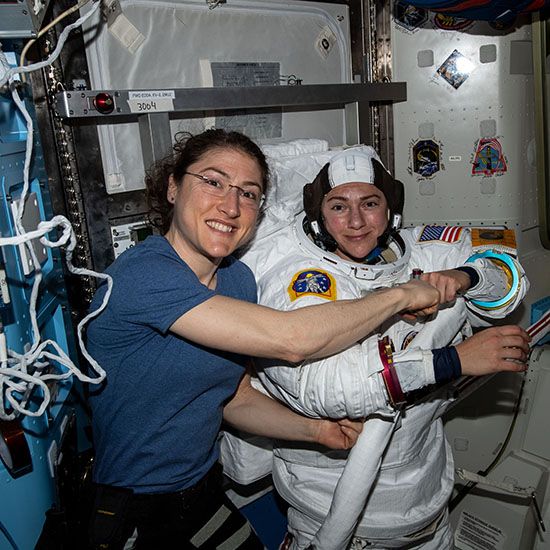
Christina and Jessica Meir prepare for their first spacewalk together in 2019.
I don’t like to necessarily focus on one person achieving one thing. I like to talk about the fact that what we really can celebrate in these historical moments is that we’re changing for the better. We’re changing into a world where we value contributions from anyone who has a dream and is willing to work hard to achieve that dream. That to me is the important and historical aspects to, to celebrate. And I’m just really fortunate and happy to be a member of the team that’s achieving those.
Q: If you could move to a planet with aliens in another galaxy, would you? Or would you stay on Earth? And why? (From Aava, age 13)
A: Well, I think I have to say, Aava, it would depend. It would depend on if I can take my loved ones with me. And we say this a lot. I’ve heard people onboard the space station say that we would stay forever if we could bring our family and friends. And I really feel that way. I would be very excited to go somewhere new, to see new things, but it would be tough to do it without my loved ones.
Q: How does your body feel in space? (From Sami, age 9)
A: It’s really wild how the human body adapts to space. I don’t know if you’ve ever done a headstand, but when you do, you kind of feel all the blood rushing up to your head. And that is how it felt for me when I first got to space. It felt like I was doing a headstand the entire time. And so I had to focus on my work through that feeling and try to ignore it, but it was tough. It felt that way for about a week straight.
But luckily, your body does adapt to microgravity. So after about a week, all those weird feelings kind of went away. And then it is just so much fun. It’s so much fun to float. You can jump up and be on the ceiling in two seconds. You can do flips. It’s really, really fun. And sleeping in space is really cool. It feels very peaceful. So there are a lot of really cool sensations.
Q: In your experience on long missions in close quarters, what helped people get along?
A: Wow. What a great question. A lot of the same things that help people get along on Earth. I think that finding common ground and communicating well and being very open with feedback and being open to receiving feedback is very important. You know, we have to feel free to be our authentic selves when we do these missions, because it’s a long time.
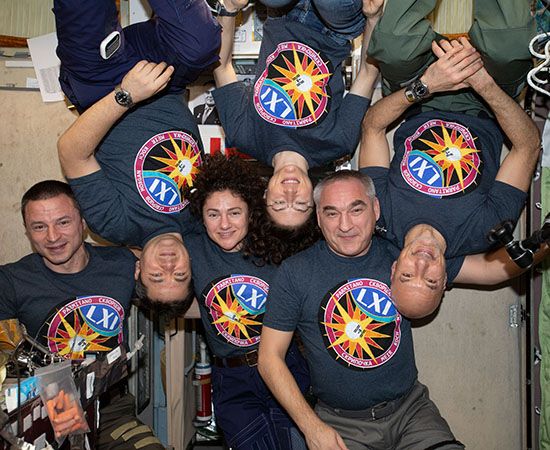
The crew of Expedition 61 aboard the International Space Station in 2019 (left to right): Andrew Morgan, Oleg Skripochka, Jessica Meir, Christina Koch, Alexander Skvortsov, and Luca Parmitano.
And that’s a really important aspect of being able to have a sustained presence onboard the space station. So that means that everyone’s different up there and you have to be okay with those differences. In fact, you have to embrace them. And finding that common ground means that even though there might be 99 ways that you’re different, there’s also some ways that you’re the same. And you can have conversations about shared loves in the world, and things that you see the same and things you see differently.
So that’s a big part of it. But I think a lot of it, we actually train these things on the ground. They are skills that we learn as astronauts: things like leadership, followership, communication, group living, self-care, team care. They are skills just as much as learning how to fix the space toilet.
And we make sure that we teach and practice those skills even on Earth. Because probably the most important thing that contributes to a mission’s success is how well you interact with your crew mates. And we take that very seriously. Kindness is probably the most important aspect.
Q: How did you feel when you first looked down at our planet in space?
A: I was so surprised. I knew it was going to be there. I knew we lived on Earth and I knew that it was a planet, but no kidding, we really do. And it was right there when I looked out my window from the Soyuz spacecraft for the first time. It was so bright. It was so beautiful. And it was against the backdrop of the universe. And seeing that all at once was such an overwhelming rush of emotions. I knew that I was in space. I knew that every single other person (almost) in the whole world was down there on the planet that I was above, and it was just absolutely overwhelming.
It gives you so much perspective for how much we have in common, all being from Earth. And how much we all rely on the same things to survive—the same things that are important to all of us.
Q: Did you have role models who were important to you? If so, who were they?
A: I had a lot of role models. I had role models in my family. My grandmother was a really important role model to me. She was extremely hardworking. She was a farmer, and she ran that whole farm.
She did everything from the payroll, to working in the fields, to making meals. And she did it all with a smile, without complaining, and with a sense of purpose and a sense of wanting to contribute. And in my family, that idea of working hard and contributing to something else was just held in such high regard.
And I would just think about how much she just wanted to be a part of something like that. So that’s a big role model.
In college, when I started to learn about the people of the civil rights movement— growing up in North Carolina, the people that fought for everyone to have equal rights and were so brave! They did things that I couldn’t imagine being brave enough to do. Those people really, really inspired me.
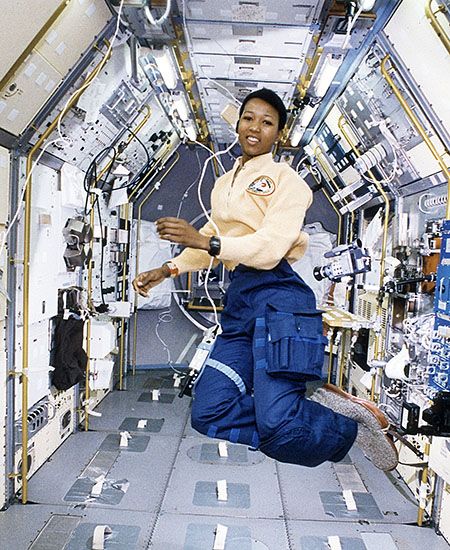
Astronaut Mae Jemison, the first woman of color to travel in space, aboard the Endeavour in 1992.
And people in the space industry: Sally Ride, Mae Jemison. People that probably endured so much hardship being the firsts and paving the way. Those people really inspired me because I would just think about how much fortitude they had to have in those roles and how much they had to work through being under the spotlight, but still focusing on doing their job and doing it well. That was really inspiring to me.
So I just owe a lot to the people that have inspired me through the years, and they’ve been from every corner you can imagine.
Q: What is your favorite space food? (from Anisa, age 9)
A: Ooh, well, I do love space mac and cheese, I will say, that is yummy … Can you believe we actually can eat full meals like Thai chicken? They’re all dehydrated, and all we have to do is add water. We eat very well up there.
Q: Do astronauts play sports in space? (From Olivia, age 10)
A: We love to play games. Now, sometimes certain sports are tough to play, because they do rely on gravity. We might not play a whole game of tennis or ping-pong or football, but we definitely can throw those things around. And let me tell you, you can throw really, really far in microgravity. It’s a lot easier. And it’s also very, very fun because it can go in almost any direction.
We also can play human games like human bowling, where your friend [is] like a cannonball, and you could just throw them across the module if you want, because no one weighs anything. So we have a lot of fun in space.
Q: What are the most important virtues or character strengths for an astronaut?
A: That’s a great question, because we talk about characteristics like adaptability and humility. But you know, putting it that way, I think integrity is something that I’ll talk about.
I think that someone who is true to thinking about the mission first and to bringing their best every day and to being honest and kind in everything that they do. That is very important.
Humility is important, being adaptable, being ready to take on anything and to adjust to a new situation. And relying on your team. Making sure that you’e not afraid to ask for help when you need it and offer help when someone else needs it.
So some of those things that make you a good friend are also things that make you a good astronaut.
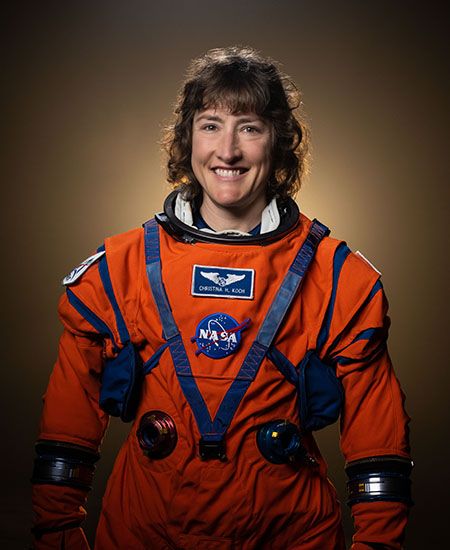
Q: What advice do you have for girls and boys who want to have careers in science or space?
A: So many things come to mind. One of them is to focus not just necessarily at participating in what you’re doing, but to be your absolute best in what you’re doing. If you’re doing something that no person has done before that that looks like you, it’s more important to just love and be passionate about what you’re doing, to find fulfillment in it, to give it your all, to work hard than it is to just be ’s something that I like to share. Focus on being your best at what’s meaningful to you. And that is what will allow you to go the farthest. That is what will bring you the most fulfillment.
Support the people around you. That is one of the most important things, because that usually means we’ll support each other.And when we do that, we raise everyone. We contribute the most that we can to the world around us.
And I think the last thing that I would say is don’t be afraid to do the things that scare you. Usually when something scares you, it’s because you’re interested in it. You’re intrigued by it, but you might think it’s just outside your reach. You might be afraid of failing if you go for it. But those are the exact things that you should go for. Those are the exact directions you should move in so that you can actually fulfill your potential and give back the most to the world. Contribute what you’re meant to contribute, what your gifts allow you to contribute.
Those are some of the pieces of advice I like to share. And you know, you mentioned inspiration. I have been inspired by people my whole life too: by Sally Ride, by Mae Jemison, by the leaders of the civil rights movement. Anyone who did things that they had to be brave in order to do. Anyone that pursued something that wasn’t necessarily conventional, but that they felt truly moved to do. Those people are the people that have inspired me. And I hope that in fulfilling my goals, I am making them proud in a way, and showing that the work that they did to open the path up for me was all worth it.
Images: NASA, NASA/MSFC, NASA/Bailey Collins
Space Ace54 Science206 DrScotti56 STEAMS77 Space70 Space Science42 Discover552