
Stargazer: Dr. Farzin Amzajerdian
Imagine leaving home as a teenager and moving across the world to a country where you don’t know anyone. That’s what Farzin Amzajerdian did when he left Iran for the U.S. at age 18.
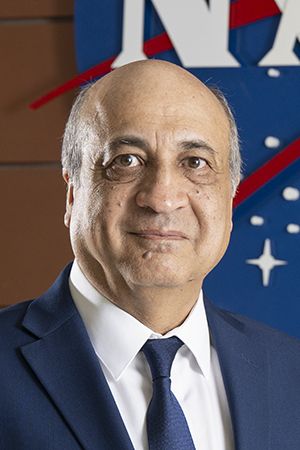
"I’m glad I ended up at NASA, because in high school, I must’ve seen every episode of Star Trek two or three times," Farzin says.
Born in Tihrán in 1957, Farzin was the youngest of four brothers. His dad passed away, and to make a living, his family turned the ground floor of their house into an appliance store. For a time, they all lived in two cramped rooms upstairs. After high school, Farzin went to college in Iran for a year.
He moved to the U.S. and earned a doctorate degree in electrical engineering from Oregon Graduate Institute. At age 44, Farzin started working for NASA. In 2022, he won NASA’s Invention of the Year award for his Navigation Doppler Lidar system, which accurately and quickly judges a spacecraft’s speed and distance to the surface to help it land safely. Farzin lives in Virginia with his wife, Jida.
Q: What’s one of your favorite childhood memories?
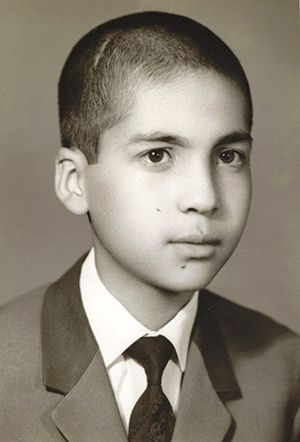
At age 11, Farzin lived in Tihrán with his mom and three older brothers. The first floor of their home was an appliance store.
A trip with my mother and [older] brother. We started in Tihrán and drove to three cities … Having my brother explain all the history was just magical … We went to Shíráz, to the House of the Báb.* I was maybe 10 years old. Just seeing my mom’s spirituality and the way she reacted as soon as we walked in—that was very special …
Q: What was the most challenging experience for you as a kid?
When I was six years old, my father passed away … I could feel the sadness, [and] we were poor … The way I handled it was not to ask for anything.
Q: Growing up, did you face prejudice because you were a Bahá’í?
In 7th and 8th grades, … I had teachers who bullied me, openly … They would give me bad grades also. That made me actually study these subjects better than anybody else, so I could get a passing grade.
Q: What experience from your youth set you on a path to your career?
I loved solving mathematical problems. When it came [time] to go to college, I heard that electrical engineering has a lot of math in it. [So] that’s [what] I wanted to do … I’m glad I ended up at NASA, because in high school, I must’ve seen every episode of Star Trek two or three times.
Q: What do you do at NASA?
I specialize in lasers for measuring and monitoring the atmosphere from orbit. For example, greenhouse gases … or wind velocity … So we can help with the weather forecast. The other area is to use lasers for going to the Moon, Mars, or other places in our solar system. These are especially needed to have a permanent presence on the Moon and Mars … Having something that … I came up with … going to the Moon is an excellent feeling …

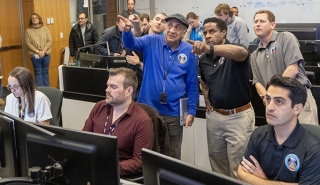
Farzin talks with visitors to NASA Langley Research Center in Virginia about the Navigation Doppler Lidar system he invented.
Q: What do you enjoy most about working for NASA?
The work we do … does help mankind. The goal is to help life here on Earth and to improve our understanding of the universe—where we come from and why we are here … Understanding is important, because it helps [with] how to live with each other here on Earth.
Q: What’s your advice for kids who want a career in engineering or science?
Develop interest in science and math … Once you get to middle school and high school, take as many advanced classes as you can in … science and math in particular. [Also], be curious about how things work around you. Especially with the Internet, you can actually explore, and that [can] be a fun activity.
Q: This issue of Brilliant Star is about the powers of the soul. What’s important for kids to understand about their soul?
When we say soul, it’s like that inner force that we have. The power of your soul can fuel passion … It is positive. Be passionate, because passion will bring excellence—in your conviction to your faith … the sport you play, and eventually, excellence in your profession and career.
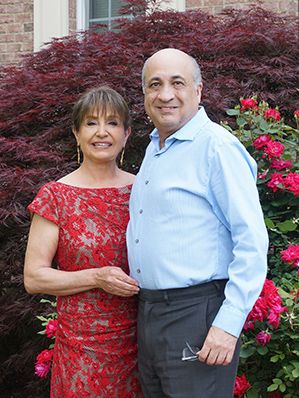
Farzin and his wife, Jida, met at the Los Angeles, California, Bahá’í Center in the 1980s.
Q: If you had one wish for Brilliant Star’s readers, what would it be?
To have the opportunity to help mankind. Kids can grow up and take different professions, and they’re all good, they’re all valuable … [and] contributing to society … There are challenges that we have in our world that can endanger mankind … To overcome these challenges, the solution can only be global …Human beings have to elevate their understanding of each other [and] the planet … The only solution can be spiritual—through the heart, through love of mankind.
*Due to religious persecution, the House of the Báb was destroyed in 1979.
Photos: Portrait by NASA Media Solutions, family photo by Farzin Amzajerdian, work photo by NASA Langley Research Center
Bahá’í Faith546 STEM269 Space Science42 Space70 NASA27 STEAM47 STEAMS78 Careers215 Science206 Spacecraft3 Discover553 Stargazers94 ScienceReligion24