
Shining Lamp: Mishkín-Qalam (1826–1912)
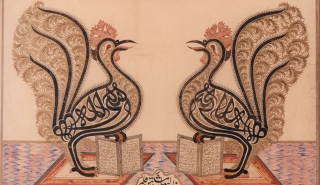

How do you express your love for God? Many people use arts, such as music or poetry. Mishkín-Qalam created calligraphy. Mishkín-Qalam was one of the most admired calligraphers in Iran. Born Mírzá Husayn-i-Isfahání in 1826, he was fascinated by painting and calligraphy from childhood. As an adult, he mastered every popular calligraphic style.
At age 25, he was invited to the court of the sháh, or king. The sháh was so impressed with his artistry that he gave him the title Mishkín-Qalam, which means “musk-scented pen,” and made him the private tutor of the royal family.
One day, Mishkín-Qalam met a man who told him about the Bahá’í Faith. He was so moved that he left his royal post and traveled to Adrianople (now Edirne, Turkey), where Bahá’u’lláh was living in exile. As soon as he met Him, Mishkín-Qalam became a devout Bahá’í.
He stayed in Adrianople and dedicated his talents to transforming Bahá’u’lláh’s words into art. He would write out the Greatest Name in Arabic—Yá Bahá’u’l-Abhá, which means “O Thou Glory of Glories”—in different styles and give them away.
Banished for His Faith
Mishkín-Qalam journeyed to Constantinople (now Istanbul). People flocked to see his beautiful calligraphy, and he began boldly teaching the Bahá’í Faith. Unfortunately, the Persian ambassador knew the authorities who had banished Bahá’u’lláh to try to stop His faith from spreading. The ambassador started rumors, telling officials that Bahá’u’lláh had sent Mishkín-Qalam to stir up trouble.
Though Mishkín-Qalam only tried to promote peace, people began to see him as a criminal. He was eventually jailed, exiled to the island of Cyprus, and held captive there from 1868–1878.
In 1886, Mishkín-Qalam moved to ’Akká, Israel, where Bahá’u’lláh had been sent. He rejoiced in Bahá’u’lláh’s presence, creating and sharing remarkable works of calligraphy. Others found comfort in his radiant spirit.
Spirit Personified
After Bahá’u’lláh passed away in 1892, Mishkín-Qalam lived in India for a time. Then he returned to Israel to be with ‘Abdu’l-Bahá, Bahá’u’lláh’s son and leader of the Bahá’í Faith.
Abdu’l-Bahá loved Mishkín-Qalam deeply, saying, “He was always smiling, effervescing; he was spirit personified, love embodied. For sincerity and loyalty he had no match, nor for patience and inner calm. He was selflessness itself, living on the breaths of the spirit.”
Mishkín-Qalam passed away in Haifa, Israel, in 1912. If you visit Haifa, you can see his original calligraphy at the Bahá’í World Center. Prints of his art appear in Bahá’í homes all over the world.
Photos © Bahá’í International Community
Shining Lamp55 Shining Lamps124 Bahá’í Faith546 Bahá’ís in History210 Calligraphy10 Arts84 Sacrifice10