
Stargazer: Roman Orona

At about age 8, Roman and his family lived in New Mexico, where they were the only Bahá’ís in their town.
“I’ve always been a performer, ever since I was a little kid,” says Roman Orona. Growing up in the only Bahá’í family in a small town in New Mexico, U.S., Roman sometimes felt like an outsider. But performing in his garage for the neighborhood helped him connect with others. He was 15 when his father gave him his Apache name: Ish Hish Itsaatsu, meaning “one who dances like or with eagles.”*
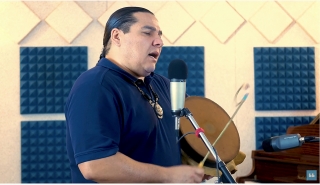
As he got older, Roman still loved performing, but he felt obliged to have a more conventional career. He earned a bachelor’s degree in civil engineering and biology, then worked in environmental engineering. Eventually, his desire to be a full-time artist and share his Indigenous culture and the Bahá’í teachings became irresistible. Roman began recording albums of traditional Apache music and Bahá’í writings set to Apache rhythms. In 2016, he won “Best Male Vocalist” at the Native American Music Awards. Later, he started iamHUMAN Media, a nonprofit company that produces videos, short films, a podcast, and arts classes. Roman now lives in Arizona with his family.
Q: What’s one of your favorite childhood memories?
We used to go a lot to Camp Mary White in New Mexico ... It was a Bahá’í campout and retreat, and I remember hanging out with all the other youth ... It was really, really fun, up in the mountains ... [to] really be kids—get out in the forest, climb trees, throw rocks in the lake.
Q: What was the most challenging experience for you as a kid?
I grew up in a small place ... and everybody there was ... Christian ... We were the only Bahá’ís. Those were hard times, but I think they were good times ... because it solidified a lot of who I am today.

When he was about 14, Roman earned a spot on the baseball team at his high school in Illinois.
Q: Please tell us about your Apache name.
Ish Hish Itsaatsu—one who dances like or with eagles.* It was given to me by my dad. To me, it means lofty one. It means one who pushes the bounds, one who tries to elevate himself and others. For Indigenous cultures ... the eagle was the bird that flew closest to the Creator ... [It’s] that spirit that my dad saw within me, to be able to take it high, or to go lofty ... I try on a daily basis, because those names are not to be taken lightly. It’s a name that was given because they’ve studied you, they’ve prayed ... I think [my dad] saved it until [I was] 15, because within the Baha’i Faith, [it’s] the age of maturity.
Q: What is iamHUMAN Media, and what topics do you address?
iamHUMAN Media is a national nonprofit working towards helping artists ... I’m trying to ... teach [kids] art ... because in school, they’re not getting to learn the guitar, the piano ... or taking pictures, or painting or voice lessons.
I started with 60-second videos. People would tell their story, [saying] ... “I am,” and [then] fill in who they were ... We filmed them from the feet ... to the head. We would zoom in to their eyes, and they would say their name and “I am human.” ... I try to make people ... recognize that humanity—we’re all related, simply by being human. Recognize gender equality [and] social justice ... I want to give a voice to my Indigenous brothers and sisters as well. Because ‘Abdu’l-Bahá [said] that the Indigenous peoples ... [when] we become educated, that we will in turn illumine the whole world.

Roman (third from left) celebrates Mother’s Day in 2020 with his wife, Shahrzad (second from left); their son, Tahj; and their daughter, Kaya.
Q: Your videos aim to bring people out of their comfort zone, to spur change. Why is it important for people to come out of their comfort zone?
As soon as we stop changing ... we stop growing, we stop learning ... I’d like to spur people to be a little bit uncomfortable ... then they can look within themselves and say, “Why does that make me uncomfortable? What do I need to change?” ... I tell my kids, when things get hard, be a blade of grass in the wind. Blades of grass don’t break; they flow, they bend, but they don’t break ... You’re getting blown hard one way, eventually with prayer and continuing to have perseverance, you’re going to rise up and stand nice and tall again. And you’ll be ready to take on the next winds. And those winds are those challenges in life, and we’ll always have those. I tell my kids, when those challenges come, the Creator, God, is telling you you’re ready to grow.
Q: This issue of Brilliant Star is about friendship. What can kids do to create friendships with people from diverse backgrounds?
The first thing is to smile and say hello ... It’s our responsibility to find those individuals that are sitting by themselves and not part of the group ... to introduce ourselves ... We have to show people what it is to be friends, what it is to show love, what it is to create unity. Especially when there are so many negative forces coming at you, be that shining light ... In Indigenous cultures, friendship equals family ... When we meet somebody new, we bring them immediately into our family.
*His name is pronounced “Ish-Hish-E-Shaht-Soo.”
Portrait by Robert Doyle/Canyon Records
Discover553 Friendship186 Native Americans16 Bahá’í Faith546 Creativity296 Service308 Race Unity224 Friends209 Careers215 Music177 Arts and Crafts223 Challenges257 Singing35 Acting10 Songs69 Stargazers94