
Shining Lamp: Ellsworth Blackwell (1902–1978)
One summer day in August 1937, about 400 people were expected to tour the Bahá’í House of Worship in Illinois, U.S. Ellsworth Blackwell and other volunteer guides were asked to come, and Ellsworth showed up.
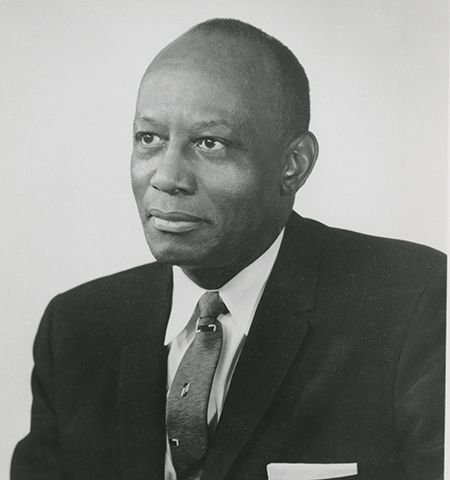
Ellsworth was devoted to building unity.
But when he arrived at the temple, he was stopped from guiding. Later, he was told that White guests might be offended by having Black guides. It must have been upsetting to be asked to help and then to be turned away.
Ellsworth was born in Mississippi in 1902. He studied at University of Iowa, then worked for a Chicago newspaper. After living in both the North and South, he knew that racial prejudice was a big problem in the U.S. One day, a coworker invited him to a Bahá’í meeting. Ellsworth wasn’t interested in religion, but the Bahá’í Faith seemed different. The Bahá’í teachings promise a world where everyone is respected and treated fairly. He hoped to bring this vision to life and became a Bahá’í in 1934.
Speaking Out for Justice
Ellsworth knew only allowing White guides at the temple was wrong. He wrote to Shoghi Effendi, who was the Faith’s leader at the time. Ellsworth asked if Bahá’í beliefs should change due to others’ prejudice. He wrote, “When are we to begin to live the Teachings of Bahá’u’lláh?”
Shoghi Effendi knew many White Bahá’ís didn’t yet understand race unity. He said this would change and that Black Bahá’ís should “arise and serve and teach, confident of the future ...”
Ellsworth also wrote to the Local Spiritual Assembly that led the Chicago Bahá’ís. There was no written rule against Black guides, they said. Soon after, Ellsworth was elected as the first Black member of the Assembly. He helped bring Black guides to the temple and later served on the National Spiritual Assembly for four years.
International Service
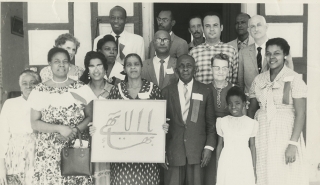
In 1940, Ellsworth made a bold decision. He left his job and moved to Haiti with his wife, Ruth, to teach the Faith. Ellsworth didn’t speak French, the local language, which made it hard to find work. So he loaded his car with charcoal (for cooking) and drove around selling it to earn a little money.
Haiti had no Bahá’ís when the Blackwells arrived. People soon flocked to Ellsworth. Ruth said they were “spellbound” when he spoke with help from a translator. After one meeting, about 100 people followed him out, asking to become Bahá’ís. They wanted to help build a better world, too. Shoghi Effendi called the Blackwells’ work “praiseworthy” and “unforgettable.” In 1974, Ellsworth reported that Haiti had 3,000 Bahá’ís!
The Blackwells moved to Africa in 1975. They went to Madagascar and then to what is now the Democratic Republic of the Congo (DRC). In 1978, Ellsworth fell ill and passed away. A shining monument marks his grave in the DRC.
“We’re going to build a world without war,” Ellsworth once said in a talk. Everywhere he and Ruth went, they helped to create that world. They knew it would take a lot of time and effort. But Ellsworth didn’t get discouraged. He was confident in the future. “No one can stop it,” he declared.