
Armed with Kindness
“If the heart is pure, white or black or any color makes no difference. God does not look at colors; He looks at the hearts.”
—‘Abdu’l-Bahá in Washington, D.C., April 1912
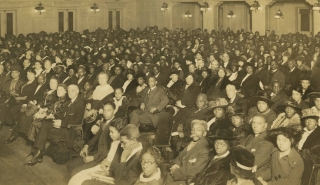
A crowd of 2,000 gathered in Washington, D.C., one evening in May 1921. They had come to learn about a controversial topic—eliminating racial prejudice. The audience at the First Congregational Church included Black and white people sitting side by side—and that alone was progress. In the same city just two years earlier, white mobs had attacked Black citizens in a four-day riot that killed 15 people. In fact, race-related riots took place in 25 cities around the country in 1919, leading to an estimated 250 deaths.
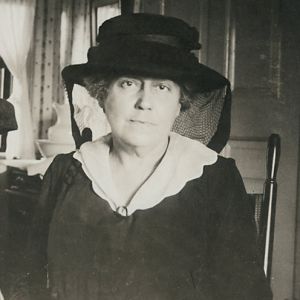
Agnes Parsons helped organize the first race amity convention.
Dramatic change was needed. ‘Abdu’l-Bahá, the leader of the Bahá’í Faith, helped set things in motion. He chose an unlikely collaborator—a wealthy white Bahá’í named Agnes Parsons. While she was visiting him in what is now Israel, ‘Abdu’l-Bahá shocked Agnes by asking her to arrange a convention for race amity. It would be the first of its kind in the U.S.—and probably the world.
She said, “I thought I would like to go through the floor... I did not think I could do it... Then a very extraordinary thing happened. I felt suddenly the power of his creative words. I was really getting the confidence that of course was necessary.”
When Agnes got home, she had no idea how to start. She turned to a prominent Black Bahá’í lawyer Louis Gregory. He said, “Nothing short of a change of hearts will do. Unless the speakers are able to make the power of love felt, the occasion will lose its chief value.”

Louis Gregory traveled widely to speak about race amity.
Agnes gathered a team, including Bahá’í journalist Martha Root, who handled publicity. About 19,000 programs were distributed to proclaim the convention’s goal of overcoming prejudice. They stated, “Correction of the present wrong requires no army, for the field of action is the hearts of our citizens. The instrument to be used is kindness, the ammunition—understanding.”

Martha Root used her skills as a journalist to promote Bahá’í events.
An impressive array of speakers participated over three days, including Bahá’í scholars, a former U.S. Senator, and two U.S. Representatives. Music uplifted the gatherings with traditional spirituals, performances by Howard University choral groups, and a violin solo by Joseph Douglass, grandson of a famous activist Frederick Douglass.
‘Abdu’l-Bahá sent an inspiring message: “Say to this convention that never since the beginning of time has one more important been held... It will become the cause of the enlightenment of America.”
The first race amity convention was a rousing success. Upon reading news of the event, U.S. President Warren Harding reportedly said, “Thank God for that convention!”
Later that year, on November 28, ‘Abdu’l-Bahá passed away. But the race amity work he began continued. Over the next two decades, race amity conferences across the country attracted well-known leaders and activists.
Today, Bahá’ís continue to promote racial harmony in many ways around the world. Still, much work remains to be done.
Photos courtesy National Baha'i Archives (No photos of the first race amity convention in Washington, D.C., are available.)
Discover553 Race Unity224 Bahá’ís in History210 ‘Abdu’l–Bahá139 Master57 Race Amity28 Elimination of Prejudice118 Oneness of Humanity107 North America41 Washington, D.C.7 Communities57 Kindness123 Openness39