
Bahá’u’lláh’s Life: His Ascension
“It is incumbent upon ... My Kindred to turn, one and all, their faces towards ... the Most Mighty Branch [‘Abdu’l-Bahá].”
—Bahá’u’lláh
One autumn evening in 1879, two hours after sunset, Bahá’u’lláh mounted his white donkey, Barq (Lightning), and moved to His final home—the Mansion of Bahjí.
For about 26 years, Bahá’u’lláh had been imprisoned, exiled, and persecuted for sharing His peaceful teachings. His eldest son, ‘Abdu’l-Bahá, served alongside Him at every step. During their imprisonment in ‘Akká, Israel, ‘Abdu’l-Bahá helped care for the Bahá’í community, met with government officials, and assisted the poor and sick.
One day Bahá’u’lláh said, “I have not gazed on verdure for nine years. The country is the world of the soul, the city is the world of bodies.” In response, ‘Abdu’l-Bahá rented a garden and home for Him outside the city. Though technically still a prisoner, ‘Abdu’l-Bahá was so respected that no one stopped him from leaving ‘Akká. Sometimes officials even joined him.
But when all the arrangements were ready, Bahá’u’lláh refused to leave the city! He was a prisoner and wouldn’t disobey His sentence. An important Muslim leader admired Him so much, he begged Bahá’u’lláh to move to the country. Bahá’u’lláh finally agreed. He lived in a house called the Mansion of Mazra’ih for about two years before moving to the Mansion of Bahjí. There, He spent the last years of His life revealing holy writings, welcoming visitors, and caring for the Bahá’ís. Meanwhile, ‘Abdu’l-Bahá continued his important service in ‘Akká. It brought great joy to Bahá’u’lláh when ‘Abdu’l-Bahá visited Him at Bahjí.
After nearly 13 years, Bahá’u’lláh became sick with a fever. It went away, but came back a few weeks later. He gathered family and friends at His bedside for one last time and said, “I am well pleased with you all ... May God assist you to remain united.”
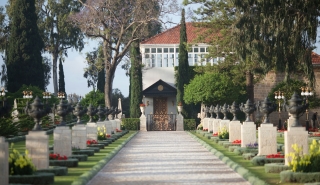
On May 29, 1892, Bahá’u’lláh passed away. ‘Abdu’l-Bahá announced the event to the Sultán of Turkey with the words, “the Sun of Bahá has set.” Bahá’u’lláh was laid to rest shortly after sunset that day, in a house near the Mansion of Bahjí that later became His shrine. For an entire week, mourners of many faiths and backgrounds came to grieve with the family and offer tributes to Him.
Nine days after His passing, nine witnesses gathered to read Bahá’u’lláh’s will. It was the first time in known history that a Messenger of God had left written instructions about the leadership of His Faith. Bahá’u’lláh appointed ‘Abdu’l-Bahá as the head of the Bahá’í Faith and told His followers to turn to him for guidance.
In His will, Bahá’u’lláh wrote, “The religion of God is for love and unity; make it not the cause of enmity or dissension.” His will allowed the Bahá’í Faith to stay unified after His passing. ‘Abdu’l-Bahá spent the rest of his life guiding the growing Bahá’í community as a loving champion of justice. He wrote that “no greater manifestation of love and kindness can be conceived in the world” than to visit the Shrine of Bahá’u’lláh and pray for a loved one.
For a printable version, download a PDF with a word search puzzle.
Photos © Bahá’í International Community
Bahá’í Faith546 Bahá’ís in History210 BahaLife32 Bahá’u’lláh163 ‘Abdu’l–Bahá139 Holy Family28 Bahji8 Holy Writings39 Sacred Places4