
Can Bees Help Us See the Good in Others?
Every object in the world, from a basketball to a skateboard, has outward physical qualities, such as size, shape, and color. But some qualities aren’t so easy to know about. We need to investigate them in a different way.
It’s the same when we try to discuss the different qualities or strengths of people. Each of us has physical qualities that are easy to identify, such as our height or hair color. But our spiritual qualities, such as kindness, patience, or truthfulness, can’t always be easily spotted from a brief look. Those qualities need to be investigated in different ways, and maybe with a lot more effort.
How can we see spiritual qualities in all the people around us, and not just our friends or people we think are kind?
Seeing the good in others takes practice and effort. ‘Abdu’l-Bahá, who led the Bahá’í Faith from 1892–1921, advised, “One must see in every human being only that which is worthy of praise. When this is done, one can be a friend to the whole human race.”
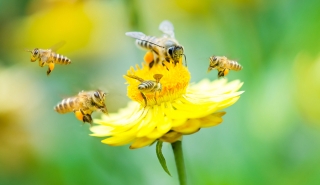
If we take a clue from bees, seeing others’ virtues may be easier than we think. When we look at flowers in a beautiful garden, we see all the amazing colors of each flower. But these colors aren’t exactly what attracts the bees.
Bees see the world very differently than we do. They don’t see red, at the end of what we call the visible spectrum (the colors in a rainbow: red, orange, yellow, green, blue, indigo, and violet). Bees see into the ultraviolet spectrum as well. The ultraviolet (UV) spectrum is just beyond the visible spectrum on the violet end. If you’ve ever been in a dark room where certain colors glow brightly, you’ve seen special lights called blacklights that put out ultraviolet light. If you view certain flowers under ultraviolet light, what you see could be very different from what you’re used to. In many cases, additional patterns will appear.
You may wonder, Why would a flower need to display different patterns in ultraviolet light? What purpose could it serve?
If you look at enough flowers in this way, you’ll see that the flowers seem to be guiding the bees to certain places on the flower. In some cases, the ultraviolet colors actually form a bullseye pattern.
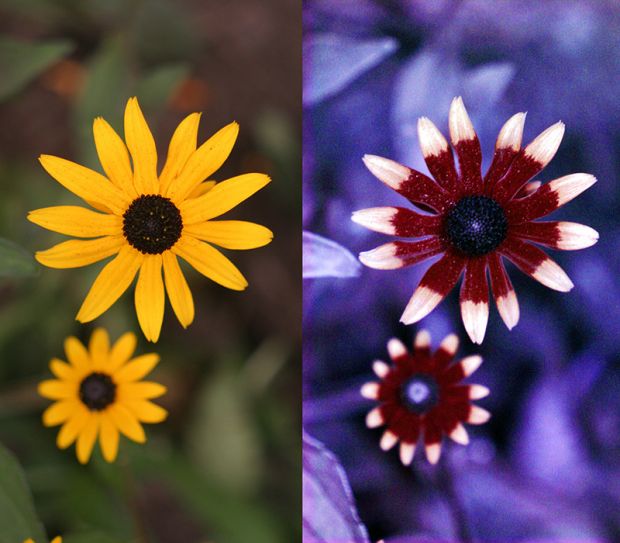
Though we can't see ultraviolet light, this photo taken with a UV filter gives us an idea of how a bee may see the flower. Photo by Andrew Davidhazy
The flowers have adapted over time to attract bees to the perfect spot for their own pollination. These spots contain a sweet liquid called nectar, which bees use to make honey, as well as a powdery substance called pollen, which is used by the flowers to make seeds. When bees land on a flower to get the nectar, the pollen gets stuck to their legs. Then the pollen is spread around when the bees fly to other flowers to get more nectar. This process helps both the flowers and the bees.
Just like the flowers, a person’s spiritual qualities may not always be visible on the surface. They may only be seen or understood if we use other methods to find them. Similar to the way the eyes of bees can filter light so they see patterns in the ultraviolet spectrum, we may need a “mental filter” to find the spiritual qualities of others.
For example, maybe you think you have a great idea to build a robot for your science project. But the partner you’re working with keeps pointing out things that could go wrong or the reasons your idea won’t work. Instead of getting upset with them for being negative, you could focus on the positive. Your partner is thinking carefully and helping you both do a great project. Then you can discuss your views calmly.
This can work another way, too. When we develop spiritual qualities like honesty and helpfulness in ourselves, those qualities can attract new friends—just like the flowers attract the bees.
If we look past a person’s weaknesses, and instead look for their spiritual qualities and strengths, we can see their true value. They may do the same for us, too.
So the next time you see a bee buzzing around a flower, try to notice exactly where the bee spends most of its time. Then once the bee is gone, look closely at what makes that part of the flower special. And the next time a friend forgets to meet you on time, instead of just feeling mad, try noticing the other ways they’re kind or helpful.
We’d love to learn about your experiences with science and the questions that you’re curious about. Email us at brilliant@usbnc.org. Enjoy exploring Earth’s wonders!

David Hooper is a computer science professional in the software industry. He loves physics, math, and the general sciences, and he tutors students in these subjects. He also volunteers as an assistant teacher for Bahá’í children’s classes and loves helping kids and youth understand how science and spirituality can work in harmony.
Top image: szefei
Science206 Bees15 Flowers14 Positive Attitude66 DrScotti63 STEM269 Vision7 Virtues140 Discover553 Science and Religion23 STEM Station32 STEAM47 STEAMS78