
Parents and Teachers
Teaching Tools & Ruhi Classes
Teachers’ Guides & Resources
Teachers’ Guide, “Soaring with Unity,” Part 1

This guide is a tool to assist teachers of children’s classes and junior youth animators in using Brilliant Star’s “Soaring with Unity” issue in the classroom. While Brilliant Star is developed for kids aged 7-12, many younger and older kids enjoy learning from it. Activities can be adapted and expanded to engage ages 4-14. You’re invited to explore this guide and to share your own ideas in our Facebook group, Brilliant Star Idea Exchange.
Key themes in this issue:
- Creating a warm community atmosphere as one spiritual family
- Building unity in the family and community through shared meals, games, play, and laughter
- Fostering meaningful conversations, spiritual strength, prayer, service, and unity in diversity among families and community groups
- Practicing loving consultation, expressing feelings, and resolving conflicts in the family and community
- Encouraging and cheering for family and friends in good times and bringing them hope and love in challenging times
- Talking with your family and other families about gender equality and race unity and demonstrating freedom from racial prejudice, in any of its forms
- Being aware of forces of materialism that widen the extremes of wealth and poverty”
- Using the arts as a “means of generating joy, strengthening bonds of unity, disseminating knowledge, consolidating understanding,” and sharing Bahá’í principles
- Virtues of love, trustworthiness, cooperation, justice, forbearance, unity, joy, prayerfulness, and resilience
You can search, download, or print the full issue here.
We recommend Google Chrome for viewing and downloading PDFs.
For each page, you’ll find discussion questions and activities to enhance learning.
“Soaring with Unity” Pages, Part 1
2 – Celebrate!
3 – Pack for a Peaceful Journey
4-5 – Bahá’u’lláh’s Life: A True Brother
6 – Dive Deeper
7 – Growing Nobility
8-9 – Nur’s Nook—Connect with Your Community: Create a Welcoming Door
10 – Stuart and Gabriella: Critter Communities
You Can Find Part 2 Here (pages 11-20)
You Can Find Part 3 Here (pages 20-29)
Age Groups:
Pre-K/Kindergarten (4-5)
Early Elementary (6-7)
Late Elementary (8-10)
Junior Youth (11-14)
PAGE 2: CELEBRATE

Lift people up with loving support
> PURPOSE
This piece illustrates how celebrating the achievements, unique qualities, and virtues of those around us is an important part of creating a happy and thriving community. Readers match pairs of balloons to find nine words that help us celebrate and support our friends and family.
> QUESTIONS FOR DISCUSSION
Pre-K/Kindergarten | Early Elementary
- How do you feel when you’re at a party with family or friends?
- How can we show kindness to our friends?
- How do you like to show your family you love them?
- What’s something you love about one of your friends?
- What virtues do you see in your friends and family? (Examples: kindness, love, patience, sharing)
Late Elementary | Junior Youth/Youth
- What are ways we can celebrate and appreciate our friends and family?
- How do you feel when someone tells you they appreciate you?
- What effect could expressing appreciation have on your family? Your community?
- How do you like to show your love and appreciation for friends and family?
- What virtues do you see in your friends and family?
> ACTIVITIES TO ENHANCE LEARNING
Pre-K/Kindergarten | Early Elementary
> Invite kids to draw a picture of someone they love. Have them share three things they love about them.
> Invite students to create a homemade thank-you card for a friend, family member, or teacher. Paint a bright mix of watercolors on watercolor paper. When dry, cut the paper into heart shapes and glue them to a blank card. Inside, students can include a Bahá’í quote, such as “Concentrate all the thoughts of your heart on love and unity.” Or they can write their own message or draw a picture.
> Uplift the World
Everyone sits scattered around a play area. An inflatable beach ball represents the world. Toss the ball in the air, and players bat it back up as straight as possible. Keep the world uplifted for as long as you can—it takes cooperation from everyone! Count out loud with each hit and see how high you can go.
https://brilliantstarmagazine.org/uploads/play/Treasure_Box_MJ15_Celebrate_Unity.pdf
> Balloon Bop
Choose a Bahá’í quote to memorize together. Give each person a paper plate to decorate, then tape a jumbo craft stick to the back of each plate. Blow up a balloon. Using decorated plates as paddles, pass balloon to each other. When someone hits a balloon, they say the next word of the quote (with help from group if needed). Start over every time the group forgets a word or a player misses balloon. Play until you can easily recite the quote.
https://brilliantstarmagazine.org/uploads/about/TAB_JA_22_FINAL.pdf
Late Elementary | Junior Youth/Youth
> Blow up real balloons and write or tape a word fragment from this page on each one. Give a balloon to each person, and ask them to find the student with the other portion of their word. When they connect, partners compose a sentence about supporting family or friends using their word. Go around the room and ask each pair to share their sentence aloud.
> Gratitude Letter
Invite students to write letters of gratitude for someone they appreciate and admire. It might be a family member, neighbor, teacher, or other community helper. Ask them to include specific examples of how that person’s actions impact their lives. They can point out the virtues they see in that person as well. If students wish to, they can plan to visit the person and read the letter aloud to them. Some ideas:
https://ggia.berkeley.edu/practice/gratitude_letter
> Invite students to create a homemade thank-you card for a friend, family member, or teacher. Paint a bright mix of watercolors on watercolor paper. When dry, cut the paper into heart shapes and glue them to a blank card. Inside, students can include a Bahá’í quote, such as “Concentrate all the thoughts of your heart on love and unity.” Or they can write their own message or draw a picture.
> Balloon Bop
Choose a Bahá’í quote to memorize together. Give each person a paper plate to decorate, then tape a jumbo craft stick to the back of each plate. Blow up a balloon. Using decorated plates as paddles, pass balloon to each other. When someone hits the balloon, they say the next word of the quote (with help from the group if needed). Start over every time the group forgets a word or a player misses a balloon. Play until you can easily recite the quote.
https://brilliantstarmagazine.org/uploads/about/TAB_JA_22_FINAL.pdf
> Treasure Chest Gift
Help students create a treasure chest gift for a friend or family member using cardboard and craft sticks:
https://brilliantstarmagazine.org/articles/nurs-nookgems-of-friendship-create-a-treasure-chest-gift
PAGE 3: PACK FOR A PEACEFUL JOURNEY
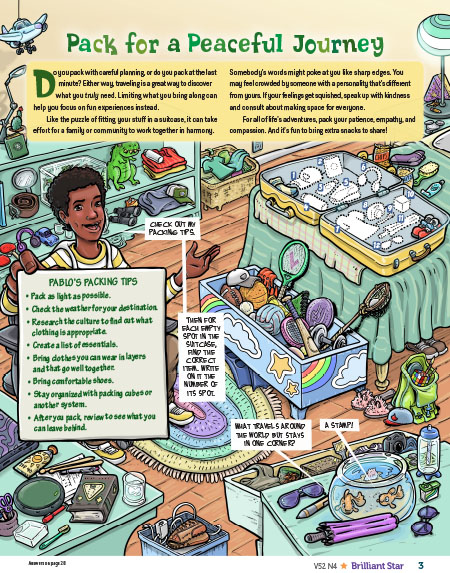
What do you need for an awesome adventure?
> PURPOSE
This page compares fitting in with your community to packing a suitcase. It encourages readers to use their virtues to get along and gives practical packing tips.
> QUESTIONS FOR DISCUSSION
Pre-K/Kindergarten | Early Elementary
- Do you pack your backpack for school? If so, how do you arrange things in it?
- If you were packing for a big trip, what’s the first thing you would pack?
- If you were packing a suitcase for a trip, where would you want to go?
- When you’re on a trip with your family, what are some things you can do to help it be a peaceful and happy time?
Late Elementary | Junior Youth/Youth
- Have you ever packed a suitcase for a big trip? Where to?
- What are the most important things to pack in your suitcase?
- What are the most important virtues to bring on a trip?
- When you’re working with others, what can you do to help get along with everyone?
> ACTIVITIES TO ENHANCE LEARNING
Pre-K/Kindergarten | Early Elementary
> Obstacle Course Relay Race
Create an obstacle course, but ask students to navigate it with a rolling suitcase or backpack, as if they’re traveling.
> Obstacle Course Team Challenge
Put an open suitcase at the end of the obstacle course. Set packing items along the course for kids to pick up. A team of 4-5 kids navigates the course together. They pick up the items as they go. They’ll have to cooperate to finish the course while carrying more and more items. At the end, they pack the suitcase and then, together, so they can help each other, they go back through the obstacle course, with the suitcase, to the starting line.
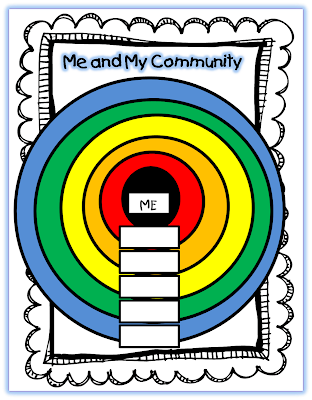
Create a community poster
> Me and My Community
Create a chart like the one at right and make a copy for each student. Ask them to fill in their name, school, city, state, country, and planet as they move outward. Have students compare their work to see what circles they have in common. Ask them to write in the names of friends and family in the appropriate circles.
More community activities:
http://firstgradewow.blogspot.com/2012/07/me-and-my-community.html
Late Elementary | Junior Youth/Youth
> Obstacle Course Relay Race
Create an obstacle course, but ask students to navigate it with rolling suitcases, as if they’re traveling. Between each racer, students need to unpack and repack the suitcase.
> Play an extreme packing memory game
Have students sit in a circle. The first student says, "I'm going on a trip and I’m taking an alligator (or anything that starts with “A”). The second student says, “I’m going on a trip and I’m taking an alligator and a banana (or anything that starts with “B”). Continue through the alphabet in order. Kids will probably have to help each other to get to Z. Then they can all say where they would go on their trip.
> Make Postcards
Have students make their own postcards (4" x 6" is the standard U.S. size). If a printer is available, they could take photos and paste or print them on cardstock. Otherwise, they can draw, use travel stickers and stamps. Who would they like to mail their postcard to? (As of July 9, 2023, US postcard rates will be 51 cents. International rates from the US will be $1.50.)
https://postalmuseum.si.edu/make-your-own-postcard
> Backpack of Virtues
Have students draw their community backpack—their virtual bag of virtues that they bring with them wherever they go. They can draw all the items in it and what they might be used for. For example, they can have a Can of Courtesy, a Loving Light, and a Patient Pencil that they use to get along with others.
Ideas for virtues to include:
https://www.virtuesproject.com/virtues-definitions-1
PAGES 4-5: BAHÁ’U’LLÁH’S LIFE: A TRUE BROTHER
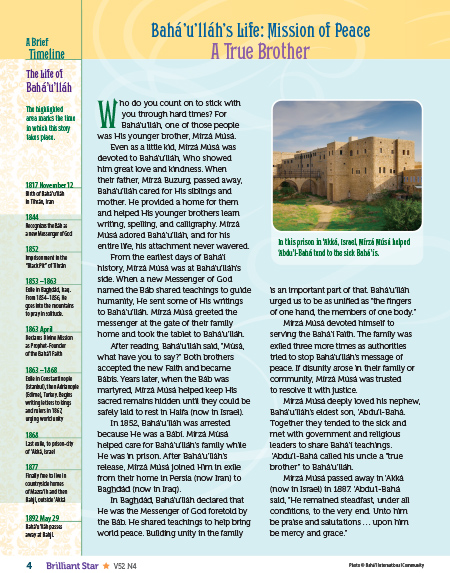
Mírzá Músá was His devoted brother and helper
> PURPOSE
In general, this feature brings readers closer to understanding the Person and Station of Bahá’u’lláh. This page explores the virtue of loyalty by sharing the story of Mírzá Músá, Bahá’u’lláh’s loyal brother. It introduces four games that strengthen bonds of unity with family and friends.
> QUOTE:
“One should wish for one’s brother that which one wisheth for oneself.”
—Bahá’u’lláh
> QUESTIONS FOR DISCUSSION
Pre-K/Kindergarten | Early Elementary
- Who was Mírzá Músá?
- What does it mean to be loyal?
- What kind of people do you want to be loyal to?
- If your sibling had an important role, how do you think you would feel?
- When you have important things to do, what can your sibling do to support you?
Late Elementary | Junior Youth/Youth
- Who was Mírzá Músá?
- What does it mean to be loyal?
- What do you think it would be like to be the younger brother or sister of Bahá’u’lláh?
- If your sibling had an important role, how do you think you would feel?
- When you have important things to do, what can your sibling do to support you?
> ACTIVITIES TO ENHANCE LEARNING
Pre-K/Kindergarten | Early Elementary
> Play the Ping-Pong Party game from the page. Modify the game by having the teacher write the questions. Some ideas:
https://brilliantstarmagazine.org/uploads/play/Luminous_Library_2015/Cool_Conversations_JFMA15.pdf
https://brilliantstarmagazine.org/uploads/play/Luminous_Library_2019/Fun_Friendship_v50n6.pdf
> Play the Top Two game from the page. Modify the game by having the students draw a simple picture of something they want the class to know about them.
> Play the Interconnections game from the page. The teacher can provide simple prompts. Ideas:
- Wearing the same color
- Have the same kind of pet
- Same favorite color
- Same birthday month
- First name starts with the same letter
> Take the Team Player quiz as a class and consult about ways to be a team player in your family or classroom.
https://brilliantstarmagazine.org/uploads/play/Luminous_Library_2013/Quiz_Team_Player_edited_SO13p9.pdf
Late Elementary | Junior Youth/Youth
> Play the four games on the page. For the Interconnections game, here are some ideas for prompts:
- Wearing the same color
- Have the same kind of pet
- Same favorite color
- Same birthday month
- First name starts with the same letter
Make kites and go outside and fly them together.
https://brilliantstarmagazine.org/uploads/play/Luminous_Library_2018/v50n4p8_Nur_Kite_RS.pdf
https://brilliantstarmagazine.org/articles/nurs-nook-uplift-with-craftsmake-and-fly-cool-kites
PAGE 6: DIVE DEEPER
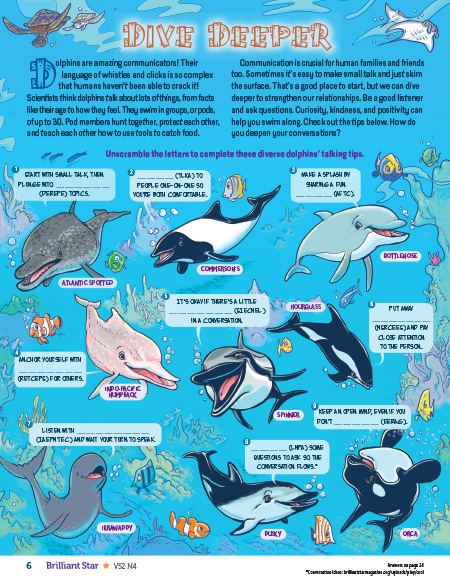
What can dolphins teach us about dialogue?
> PURPOSE
This piece explores how we should be more like dolphins—great communicators! Readers learn more about the amazing communication skills of dolphins and unscramble tips to have deep, meaningful conversations with friends and family.
> RELATED QUOTE:
“Every word is endowed with a spirit, therefore the speaker or expounder should carefully deliver his words at the appropriate time and place ...”
—Bahá’u’lláh
> QUESTIONS FOR DISCUSSION
Pre-K/Kindergarten | Early Elementary
- What do you talk to your friends about?
- How can you be a good listener?
- What are some ways you can be kind when talking with friends?
- Do you like talking or listening more? Why?
Late Elementary | Junior Youth/Youth
- What is “small talk?”
- What are deep conversations?
- What ways do you like to have deeper conversations?
- Do you think you can have a deep, meaningful conversation with anyone?
- Do you ever ask your friends about their opinions or beliefs?
- How would you show respect to someone if you disagreed about something important?
> ACTIVITIES TO ENHANCE LEARNING
Pre-K/Kindergarten | Early Elementary
> Each kid communicates their favorite color to the class, but instead of saying what their favorite color is, they list common objects that are that color. For example, if their favorite color is blue, they could say, “My favorite color is like the sky.” or “My favorite color is like a berry.” They shouldn’t point to the thing in the environment. The others listen and guess what the color is.
> Cut a hole in a closed cardboard box and place an object inside. Without peeking, kids reach in and feel the object, then take turns guessing what it is.
> Have a show and tell. Each student chooses an object that’s important to them to present to their classmates. Encourage classmates to ask questions.
Late Elementary | Junior Youth/Youth
> Put students in pairs and have them pretend they’re meeting each other for the first time (or maybe they are meeting each other for the first time)! They can have made-up names and be a fictional character if they wish. After a minute or so, switch partners until everyone has met each other. Afterward, ask them to reflect on the experience. How did they feel at the beginning of the interaction? Did they discover anything they had in common? Did they feel differently at the end of the interaction?
> Students write down three things about themselves that they think few people know. Then they put their paper in a bowl. Each student draws a paper from the bowl and tries to guess who wrote it. When they guess correctly, they also ask a question or share a positive comment about one of the facts listed on their paper.
PAGE 7: GROWING NOBILITY
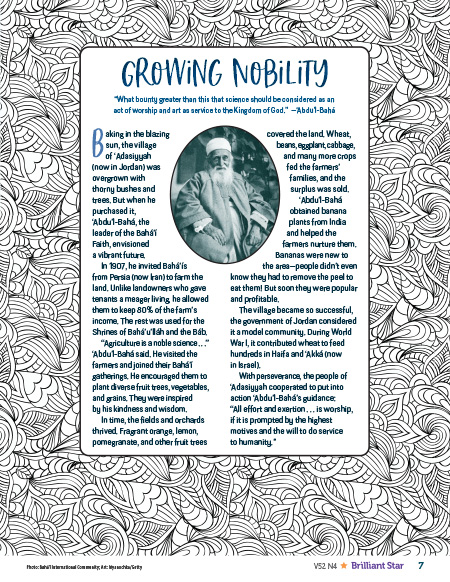
‘Abdu’l-Bahá helped farmers flourish
> PURPOSE
This page shares the story of how ‘Abdu’l-Bahá purchased a village in the ‘Akká area, then encouraged and supported farmers there. He set up a fair system to pay the farmers and helped them grow diverse crops. The page also features a decorative border for coloring.
> QUOTE:
“What bounty greater than this that science should be considered as an act of worship and art as service to the Kingdom of God.”
—‘Abdu’l-Bahá
> QUESTIONS FOR DISCUSSION
Pre-K/Kindergarten | Early Elementary
- Do you like to try new foods? What’s a new food you tried and found out you liked it?
- Have you ever worked in a garden? What kinds of things did you do?
- ‘Abdu’l-Bahá said that studying science is like worship. What are some things you’ve learned about science?
- ‘Abdu’l-Bahá said that art is service to God. What kinds of art do you like to do?
- The farmers of ‘Abdu’l-Bahá’s village cooperated to grow crops. What’s a time you cooperated with someone? How did it feel?
Late Elementary | Junior Youth/Youth
- ‘Abdu’l-Bahá said, “Agriculture is a noble science.” In what ways do you think it’s noble?
- Why do you think ‘Abdu’l-Bahá encouraged the farmers to plant a variety of different crops?
- Imagine an important and beloved guest is coming to visit your home. What would you do to prepare for the visit?
- What are some ways that studying science and creating art are like worshiping or serving God?
- Are there some kinds of art and science that are more of a service than others? What are some examples?
> ACTIVITIES TO ENHANCE LEARNING
Pre-K/Kindergarten | Early Elementary
> Healthy Apple Donuts
*Check with parents or guardians about dietary restrictions or allergies.
Core an apple, then cut it into even slices. Spread on a layer of yogurt or peanut butter like “frosting.” Add diced fruit or berries and chunks of granola on top of the frosting.
https://www.foodnetwork.com/recipes/apple-donuts-3838711
> Mindful Eating
*Check with parents or guardians about dietary restrictions or allergies.
Discuss mindful eating: the practice of eating slowly, making healthier choices, savoring food, and stopping when your body signals it’s had enough. Invite kids to choose a small piece of food, like a cracker or grape, and use their five senses to savor it.
- See: What do you notice? What color is it? What shape is it?
- Feel: Is it soft or hard? Squishy or rough?
- Hear: Does it make any sounds if you squeeze it?
- Smell. How would you describe the smell?
- Invite children to close their eyes as they explore taste.
- Taste: Put the food in your mouth. Before you chew, what is the first thing you taste? Is it sweet or salty? Sour or savory? As you start to chew, chew slowly and before you swallow, think about the change in flavor, texture and sounds. Does it change the longer you chew?
https://www.actionforhealthykids.org/activity/mindful-eating/
> Music: Garden of Thy Heart
Late Elementary | Junior Youth/Youth
> Community Life
Divide students into small groups (if the class is large). Ask them to write a story or skit about what life in the “model community” of ‘Adasiyyah might have been like. How would people handle challenges like disagreements or bad weather? How would they celebrate when things went well? Invite them to share their work with the larger group.
> Mindful Eating
*Check with parents or guardians about dietary restrictions or allergies.
Discuss mindful eating: the practice of eating slowly, making healthier choices, savoring food, and stopping when your body signals it’s had enough. Invite kids to choose a small piece of food, like a cracker or grape, and use their five senses to savor it.
- See: What do you notice? What color is it? What shape is it?
- Feel: Is it soft or hard? Squishy or rough?
- Hear: Does it make any sounds if you squeeze it?
- Smell. How would you describe the smell?
- Invite children to close their eyes as they explore taste.
- Taste: Put the food in your mouth. Before you chew, what is the first thing you taste? Is it sweet or salty? Sour or savory? As you start to chew, chew slowly and before you swallow, think about the change in flavor, texture and sounds. Does it change the longer you chew?
https://www.actionforhealthykids.org/activity/mindful-eating/
> Fruit Salsa
*Check with parents or guardians about dietary restrictions or allergies.
Dice one pint of strawberries, two peeled kiwis, and one apple. Mix together in a bowl with ¼ cup of sugar, 8 oz. of raspberries, and 1–2 tablespoons of lemon juice. Refrigerate for about 30 minutes. Serve with cinnamon pita chips
> Mindful Eating Placemat
Give each child a sheet of sturdy paper about 10 inches high and 14 inches wide. With markers, colored pencils, and/or magazine cut-outs, invite them to decorate it and write tips about mindful eating. To make the placemat more durable, it can be laminated with clear contact paper, or a clear plastic tablecloth can be used at meals. Sample tips:
- Slow down
- Take small bites
- Chew more slowly
- Savor your food
- Sit at a table
- Take a breath between bites
- Put away distractions
- Eat on a plate
- Think about where the food came from
- Say a prayer of thanks
https://cdn.agclassroom.org/media/uploads/LP818/Mindful_Eating_Placemat_17x11.pdf
> Garden Goodness: Fill in the letters to find gardening virtues and tips
https://brilliantstarmagazine.org/uploads/play/Luminous_Library_2014/Garden_Goodness_MA14p17.pdf
PAGES 8-9 NUR’S NOOK—CONNECT WITH YOUR COMMUNITY: CREATE A WELCOMING DOOR
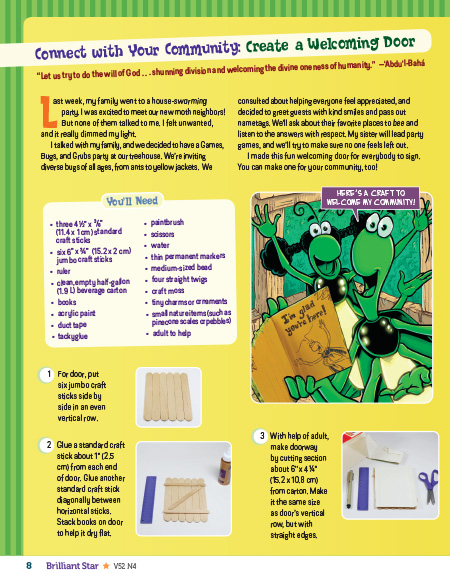
Create a welcoming door to your home and heart
> PURPOSE
This craft activity encourages readers to think about inclusiveness and how to welcome everyone in the community.
> QUOTE:
“Let us try to do the will of God … shunning division and welcoming the divine oneness of humanity.”
—‘Abdu’l-Bahá
> QUESTIONS FOR DISCUSSION
Pre-K/Kindergarten | Early Elementary
- Have you ever been left out? How did that feel?
- What are some ways that you try to include other kids in your games or activities?
- What is a fun game to play with others?
- What is a fun way to learn other kids’ names?
Late Elementary | Junior Youth/Youth
- How does it feel to be left out?
- What can you do to help others feel included and welcomed?
- What do you like to say when you meet someone new?
- What are some things you might talk about when you want to be friends with someone?
> ACTIVITIES TO ENHANCE LEARNING
Pre-K/Kindergarten | Early Elementary
> Help students unscramble the words to these conversation starters. Then pair up and practice using the questions to spark a conversation.
https://brilliantstarmagazine.org/uploads/play/Luminous_Library_2019/Fun_Friendship_v50n6.pdf
> High-Five Game
Instruct the kids that they are having a high-five contest. They will have a set amount of time (5-10 minutes) to go around to their peers, ask their names, and exchange a high five (not too hard). Optionally, create an upbeat atmosphere with a timer and music that gets kids excited to high-five as many new friends as possible. When the timer goes off, gather everyone together and say, “raise your hand if you high-fived 10 people… 20 people…” etc. Talk about how kids felt sharing a high five.
https://www.scienceofpeople.com/icebreakers-for-kids/
> Circle Up Game
You Need: Colored chalk or tape and a group of 10+ children
Set-Up: Mark off five circles on the ground that are large enough for 5-8 kids to stand inside of. Make sure each circle is a different color.
How to Play: Gather the kids around the circles and announce the game’s rules. You will call out a color (based on which circle they should run to) and a topic. On the count of three, the kids will run to group up in each circle based on shared interests. For example, you can say, “Circle up in the green if your favorite animal is a dog.” The kids who love dogs will run to the green circle and wait. Next, you can say, “Circle up in blue if you like chocolate ice cream,” and so on. Continue for up to 20 minutes to allow kids to see what their peers are interested in.
https://www.scienceofpeople.com/icebreakers-for-kids/
Late Elementary | Junior Youth/Youth
> Make a bullseye game to play with friends
https://brilliantstarmagazine.org/uploads/play/Luminous_Library_2015/Nur_Bullseye_SOND15_JF16_p20.pdf
> Play these four cooperative games
What are some virtues that are helpful when you’re playing cooperatively?
https://brilliantstarmagazine.org/uploads/play/Luminous_Library_2015/Games_for_Change_SOND15_JF16_p25.pdf
> Unscramble the words to these conversation starters. Then pair up and practice using the questions to spark a conversation.
https://brilliantstarmagazine.org/uploads/play/Luminous_Library_2015/Cool_Conversations_JFMA15.pdf
> Circle Up Game
You Will Need: Colored chalk or tape and a group of 10+ children
Set-Up: Mark off five circles on the ground that are large enough for 5-8 kids to stand inside of. Make sure each circle is a different color.
How to Play: Gather the kids around the circles and announce the game’s rules. You will call out a color (based on which circle they should run to) and a topic. On the count of three, the kids will run to group up in each circle based on shared interests. For example, you can say, “Circle up in the green if your favorite animal is a dog.” The kids who love dogs will run to the green circle and wait. Next, you can say, “Circle up blue if you like chocolate ice cream,” and so on. Continue for up to 20 minutes to allow kids to see what their peers are interested in.
To add an extra level of challenge, you can include fun ways to reach the circles, such as, “Circle up and hop on one foot to purple if you play a musical instrument.”
https://www.scienceofpeople.com/icebreakers-for-kids/
PAGE 10: STUART AND GABRIELLA: CRITTER COMMUNITIES
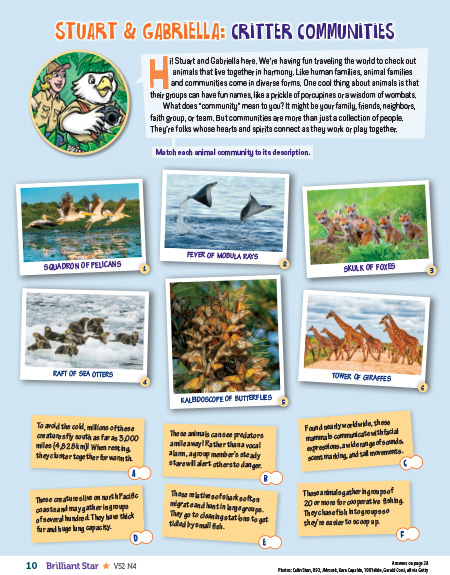
Discover how animals get along in groups
> PURPOSE
This page celebrates a variety of animal families and communities and explains that some animal groups have cool or amusing names. Six photos of animal groups are presented, as well as six facts about the animals. Kids match each photo to the corresponding fact.
> QUESTIONS FOR DISCUSSION
Pre-K/Kindergarten | Early Elementary
- If you could magically change into one of these creatures, which one would you choose? Why?
- What virtue(s) are the animals in each group showing by how they act together?
- What does “community” mean to you? What are the different communities you belong to? [Teachers can make a list of all the kids’ answers on a chalkboard fir reflection and discussion about commonalities.]
- Depending on class size, ask a few or several kids this question: Focus on one of the types of communities you mentioned. What is something that you and others in that community do together to communicate, have fun, to help each other?
Late Elementary | Junior Youth/Youth
- If you could magically change into one of these creatures, which one would you choose? Why?
- What virtue(s) are the animals in each group showing by how they act together?
- What does “community” mean to you? What are the different communities you belong to? [Teachers can make a list of all the kids’ answers on a chalkboard fir reflection and discussion about commonalities.]
- Depending on class size, ask a few or several kids this question: Focus on one of the types of communities you mentioned. What is something that you and others in that community do together to communicate, have fun, or help one another?
> ACTIVITIES TO ENHANCE LEARNING
Pre-K/Kindergarten | Early Elementary
> Invite kids (as a whole class or in groups of 4-6 kids) to pretend that they are members of one of the animal groups on this Brilliant Star page. Have them act out the behavior described in the fact for that group. Continue for the other five groups.
> Ask kids to draw a picture of either their favorite animal group from this page or themselves doing some activity with others in their own [human] community.
> Read a storybook about collective animal names, such as A Troop of Kangaroos, by Lisa Mundorff or A Business of Ferrets, by Lauren Beckwith. Or review a list of collective names and share the most appealing once with students. Talk about the different meanings for the group names and the images they bring to mind.
List of collective animal names:
https://www.treehugger.com/strange-collective-animal-names-4868835
Late Elementary | Junior Youth/Youth
> Invite kids (as a whole class or in groups of 4-6 kids) to pretend that they are members of one of the animal groups on this Brilliant Star page. Have them act out the behavior described in the fact for that group. Continue for the other five groups.
> Ask kids to draw a picture of either their favorite animal group from this page or a group of another favorite animal. If they gave the group a new collective name, what would they choose?
> Have kids (individually or in small groups) write a poem, song, rap, or story about a community—of humans or animals—that works together for the benefit of all.
Updated on 7.28.23